

Posting, boosting, and endlessly scrolling through analytics-yet the needle on your revenue dashboard barely moves. You see competitors turning engagement into customers, but your own efforts feel like shouting into a digital void, struggling to justify the time and resources invested. If you're overwhelmed by the chaos of platforms and unsure how to generate tangible results, you are not alone. This is a strategic challenge, not a creative one.
The solution lies in shifting your perspective. Effective Social Media Marketing is not about chasing likes or viral moments. It is a calculated business discipline built on data, precision, and a relentless focus on measurable outcomes. The era of random posting is over; success in 2026 and beyond will be defined by performance, transparency, and strategies that directly contribute to the bottom line.
This guide cuts through the noise. Forget vanity metrics. We will provide a clear, data-driven framework to select the right platforms, create content that converts, and measure the true return on your investment (ROI). It's time to stop guessing and start building a social media presence that functions as a predictable, scalable engine for real business growth.
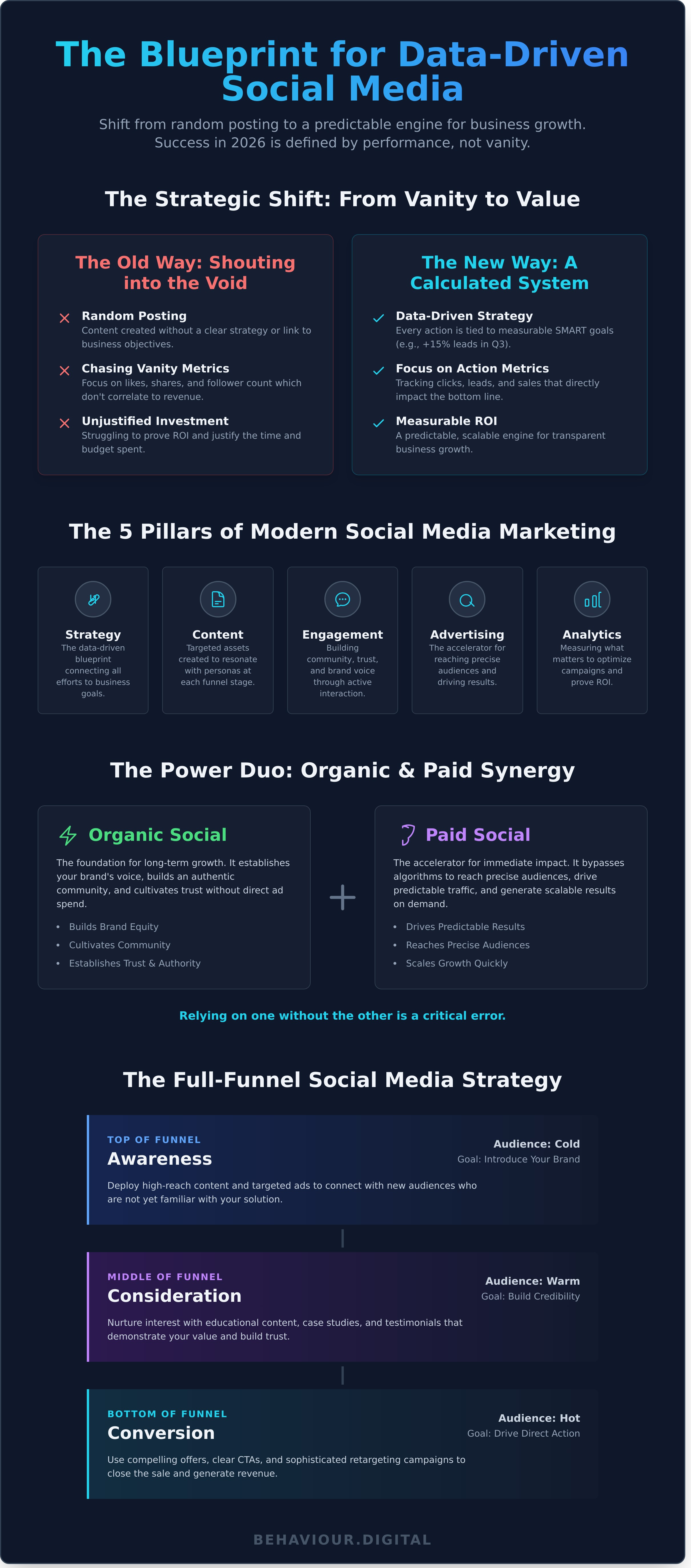
Effective social media marketing is not a content distribution channel. It is a calculated system designed to achieve measurable business objectives. Many businesses mistake activity for progress, focusing on posting schedules and vanity metrics. This approach fails because it lacks strategic intent. The fundamental difference between personal social media use and professional marketing is purpose. One is a casual conversation; the other is a planned presentation engineered to drive a specific outcome.
At its core, social media marketing is the process of leveraging social platforms to connect with your audience, build your brand, increase sales, and drive website traffic. This is not a single activity but an integrated system built on five core pillars: Strategy, Content, Engagement, Advertising, and Analytics. Each pillar is a critical component of a data-driven machine built for growth. Without a coherent strategy connecting them, your efforts will remain fragmented and ineffective.
A modern strategy requires a sophisticated blend of organic and paid efforts. Organic social media is your foundation-it builds brand voice, cultivates community, and establishes trust over time without direct ad spend. Paid social media is the accelerator. It uses targeted advertising to reach precise audience segments, bypass algorithmic limitations, and drive immediate, predictable results. Relying on one without the other is a critical error; organic builds the brand equity that paid campaigns capitalize on for scalable growth.
Social media is a full-funnel tool, capable of guiding customers from initial awareness to final conversion. Its role changes at each stage, requiring a dynamic content and advertising strategy to be effective. A well-executed plan addresses the entire customer journey
Effective paid social media marketing is not about creating accounts and posting content. That is a tactic, not a strategy. True performance begins with a data-driven blueprint that directly serves your business objectives. Without this foundation, you are simply spending money, not investing it. A successful strategy requires a methodical approach, and as outlined in authoritative resources like Forbes' The Ultimate Guide to Social Media Marketing, it starts with absolute clarity on your goals.
Vague objectives like "get more followers" are vanity metrics that do not drive growth. Instead, we build campaigns around SMART goals: Specific, Measurable, Achievable, Relevant, and Time-bound. This transforms an abstract wish into a concrete target. For example, a weak goal is "increase brand awareness." A SMART goal is: "Increase qualified website leads generated from LinkedIn campaigns by 15% in Q3." This is a tangible business outcome we can measure, optimize, and report on.
Your investment is wasted if it doesn't reach the right people. Go beyond basic demographics like age and location. We need to understand the psychographics: their pain points, professional goals, and motivations. Which social platforms do they genuinely use for research and decision-making? What content formats do they trust? Answering these questions allows us to target with precision, ensuring your message resonates and drives action.
The social media landscape is crowded. To stand out, you must understand it. Identify 2-3 of your key competitors and analyze their social media presence. What platforms are they on? What content performs well for them, and where are the obvious gaps or weaknesses in their strategy? This analysis is not about imitation; it is about identifying opportunities to establish your unique voice and value proposition in the market.
KPIs are the metrics that prove your strategy is working. They are the direct link between your daily activities and your overarching SMART goals. If your goal is to increase leads, your KPIs are not likes or shares; they are link clicks, landing page conversion rates, and cost per lead. By defining these from the outset, you create a framework for accountability and set the stage for demonstrating a clear return on investment (ROI).
Your objective dictates your platform choice. This is non-negotiable. For high-value B2B lead generation, LinkedIn’s professional targeting is unparalleled. E-commerce and visually driven brands, such as the children's equipment supplier SoftplayToys4kids, must prioritise product discovery and inspiration on Instagram and Pinterest. For local service businesses, Facebook's hyperlocal targeting and community features remain the most effective tool for driving appointments and inquiries.
Once your channels are selected, consistency is key. Define 3-5 core content pillars-the foundational topics your brand owns. This framework ensures your messaging is coherent and builds authority in your niche. As any credible social media for business guide will confirm, a strategic content mix is vital. Leverage a blend of formats, including short-form video, data-rich carousels, and authentic user-generated content, to drive engagement and deliver business value.
A strategy without data is just a guess. The most common objection to investing in paid social is the question: "How do I know if this is actually working?" The answer lies in moving beyond vanity metrics and focusing on what generates tangible business value.
Likes and follower counts feel good, but they don't pay the bills. We focus on action metrics: clicks that lead to your website, leads captured through a form, and direct sales. To track these, you need a precise toolkit. Native platform analytics (like Meta Ads Manager) provide in-campaign data, while Google Analytics 4 (GA4) shows you what users do once they reach your site. The critical link between them? UTM parameters. These simple tags added to your URLs are non-negotiable for attributing every click, lead, and sale back to the specific social media campaign that generated it
A robust paid social media strategy is not a part-time task. It demands a significant investment in time, specialized skills, and technology. As you look to scale, you face a critical decision: build an internal team or partner with a specialist agency? This is not a question of cost; it is a strategic choice about how you invest in scalable growth.
Both paths have distinct advantages and challenges. The right decision depends entirely on your company’s resources, goals, and timeline for achieving measurable results.
As we've explored, the landscape of 2026 demands a fundamental shift in perspective. Success is not measured in likes or follows, but in tangible business outcomes. It requires a foundation built on data, a clear strategy for measuring ROI, and a deliberate plan for scaling your efforts. Effective Social Media Marketing has evolved from a simple communication tool into a sophisticated performance channel that drives predictable growth.
At Behaviour Digital, this is our entire focus. From our base in Glasgow, we build data-driven strategies for businesses across the UK, designed for one purpose: delivering measurable ROI. We integrate our expertise across Social, PPC, and CRO to ensure every action creates real business impact. We don’t chase vanity metrics; we build partnerships for growth.
Ready to see what a performance-focused strategy could look like for your business? Request a free, no-obligation social media strategy review. The potential for scalable growth is significant. Let's unlock it together.
There is no universal figure. A data-driven approach starts with your business objectives, not a magic number. As a baseline, many businesses allocate 5-15% of their total marketing budget. However, the optimal investment depends on your Customer Acquisition Cost (CAC) and revenue goals. We recommend starting with a defined test budget for 3-6 months, measuring ROI rigorously, and then scaling the campaigns that deliver measurable business results. This ensures your budget is a performance-driven investment.
The most critical error is operating without clear business objectives, focusing on vanity metrics like likes instead of leads and revenue. Another common mistake is failing to tailor content to each platform’s unique audience and format. Finally, many businesses neglect ongoing analysis and optimization. Launching a campaign and failing to iterate based on performance data is a direct path to wasted ad spend. Success requires a continuous cycle of testing, learning, and refining your strategy.
Initial performance indicators like impressions and clicks are visible within 24-48 hours of launching a paid campaign. However, meaningful business results-such as a positive return on investment (ROI) or a consistent lead flow-typically require 90 days. This period is crucial for gathering sufficient data, testing different audiences and creatives, and optimizing campaigns for profitability. True success is not instantaneous; it is engineered through methodical, data-driven adjustments over time.
LinkedIn is the definitive platform for B2B marketing due to its unparalleled professional targeting capabilities. It allows you to target users by job title, company size, industry, and seniority, reaching decision-makers directly. While LinkedIn is the primary channel, a comprehensive B2B strategy may also leverage X (formerly Twitter) for industry dialogue or Meta platforms for sophisticated retargeting campaigns based on website visitor data. The optimal mix is always determined by where your specific audience is most active.
Absolutely, provided the strategy is precise and data-driven. A smaller budget demands ruthless efficiency. Success hinges on concentrating your resources on a single, high-impact platform where your target audience is most engaged. Hyper-specific targeting, compelling ad creative, and continuous optimization are non-negotiable. With a smaller budget, the goal of your social media marketing is not widespread brand awareness but generating a profitable return from every dollar spent.
A content calendar is a strategic blueprint for your social media activity, not just a schedule. It ensures your content is consistently aligned with your overarching marketing campaigns, product launches, and business goals. It systematizes your workflow, prevents reactive, off-brand posting, and guarantees that every piece of content serves a specific, predetermined purpose. A calendar transforms your social media from a daily task into a predictable asset that supports sustained business growth.
.png)
.png)
We help clients all over the globe grow their digital advertising campaigns. Ready to see what we can do for you? Get started with your free growth plan.
GET STARTED