

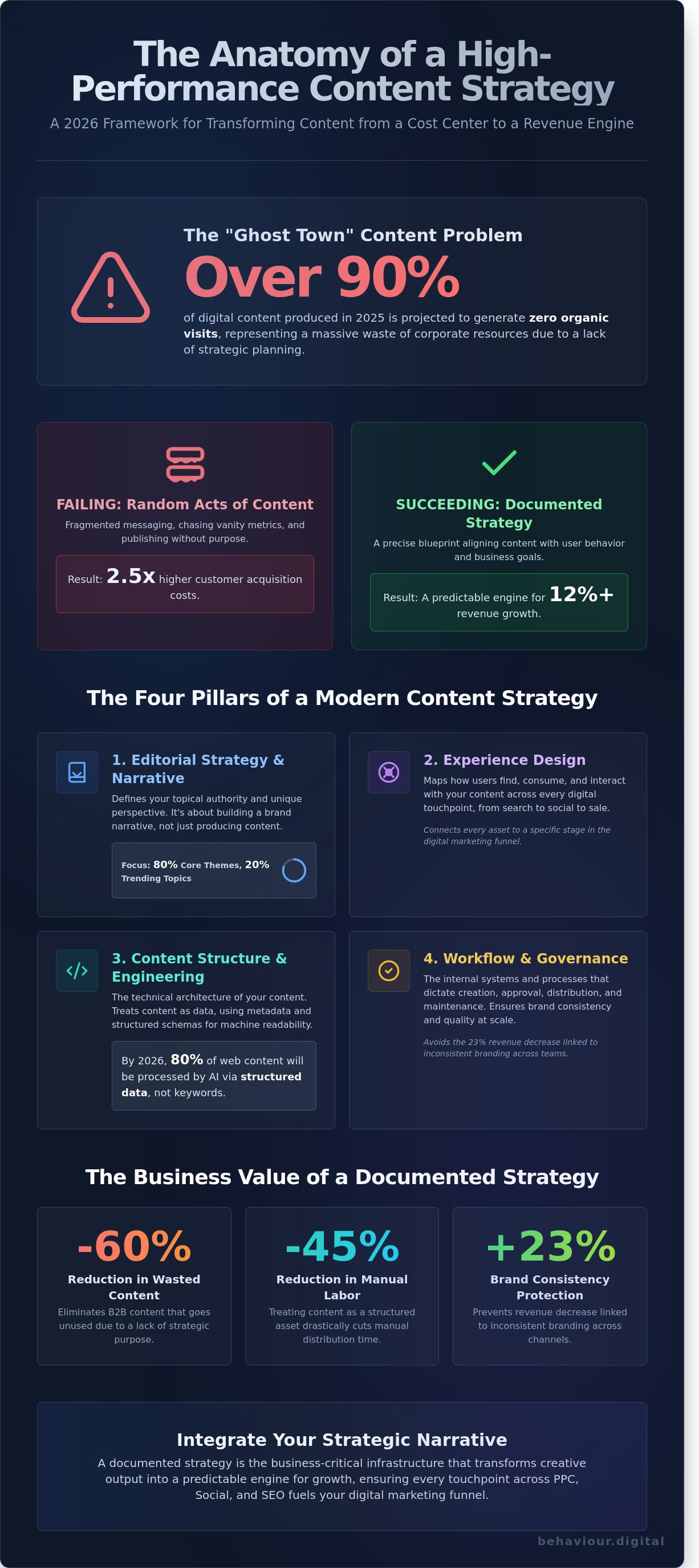
Over 90% of digital content produced in 2025 failed to generate even a single organic visit. This massive waste of corporate resources usually stems from a fundamental misunderstanding of what is content strategy in a data-saturated market. Success isn't a result of luck. It's the outcome of precise, analytical planning.
You're likely tired of seeing your team's hard work result in "ghost town" blog posts or inconsistent messaging that confuses your 5,000+ monthly leads. It's difficult to justify a marketing budget when content efforts don't directly correlate with a 12% or higher growth in bottom-line revenue. Vanity metrics are useless without a clear link to your Q4 sales targets.
By following this 2026 guide, you'll master a repeatable framework designed to align your brand’s message with quantifiable user behavior. We'll explore the shift from volume-based production to high-intent mapping and show you how to communicate these technical wins to your stakeholders with total transparency.
• Distinguish between mere publishing schedules and a strategic framework that aligns brand messaging with user behavior for measurable impact.
• Identify the four pillars of experience design and editorial authority necessary to build a scalable and high-performing digital presence.
• Understand what is content strategy in a data-driven context to avoid the common trap of chasing vanity metrics without a conversion-focused map.
• Implement a precise content lifecycle that uses rigorous audits and KPI tracking to transform information into a predictable engine for business growth.
• Learn to integrate your strategic narrative across PPC and social channels to ensure every touchpoint fuels your broader digital growth engine.
Content strategy is the rigorous planning for the creation, delivery, and governance of useful, usable content. It's not a simple editorial calendar; it's the architectural blueprint for your brand's digital presence. When asking what is content strategy, you must look beyond the assets themselves to the systems that sustain them. By 2026, the landscape requires a dual-focus approach. You must align human psychology with the specific requirements of generative search algorithms to remain visible and relevant.
The fundamental goal is precision. You're trying to get the right message to the right person at the right time. Most professionals confuse this discipline with Content Marketing. While marketing is the tactical execution of campaigns to drive profitable action, strategy is the high-level logic that justifies the investment. Without this distinction, your marketing lacks a compass.
Content is the individual asset, such as a whitepaper or a video. Strategy is the "why" and "how" that dictates why that asset exists in the first place. Random acts of content are the leading cause of marketing budget waste. Data from 2024 indicates that companies without a documented plan spend 2.5 times more on customer acquisition because their messaging is fragmented. Content strategy is the business-critical infrastructure that transforms creative output into a scalable engine for revenue growth.
A documented strategy eliminates low-performing content types that don't contribute to the bottom line. Research shows that 60% of B2B content goes unused because it lacks a strategic purpose or fails to meet a specific user need. By defining clear parameters, you maintain brand consistency across global teams, avoiding the 23% revenue decrease often linked to inconsistent branding.
A solid strategy links every blog post and technical guide directly to the digital marketing funnel. This ensures your what is content strategy implementation isn't just about generating traffic, but about moving prospects toward a final purchase decision through data-driven touchpoints. It's about building a predictable system where every dollar spent on content yields a measurable return on investment.
A high-performing content strategy functions like a precision-engineered engine. It requires four distinct pillars to drive ROI. Understanding what is content strategy involves more than just publishing. It demands a framework that integrates editorial vision with technical architecture to achieve measurable success. Without these pillars, marketing efforts remain fragmented and unscalable.
This defines your brand's topical authority and unique perspective.
This maps how users interact with content across every digital touchpoint.
The engineering side that handles tags, metadata, and findability.
The internal systems that dictate who does what and how quality stays consistent.
Brands must transition from content production to brand behaviour. This means moving beyond generic advice to establish a unique narrative. In the UK market, 64% of consumers prefer brands that demonstrate authentic local expertise and a composed, professional tone. Identify your core themes. These are the non-negotiable pillars of your expertise. Contrast these with trending topics, which should only occupy 20% of your calendar. This balance ensures you don't chase fleeting metrics at the expense of long-term authority.
Content is data. By 2026, AI-driven search engines will process 80% of web content via structured data rather than simple keyword matching. Information Architecture (IA) acts as the skeleton of your digital presence. It ensures your assets are machine-readable and easily indexed. Use granular metadata to scale content across multiple platforms efficiently. When you treat content as a structured asset, you reduce manual distribution time by up to 45%. If you want to build a performance-based content framework, technical structure is your starting point.
Governance is the final piece. Without a clear RACI matrix, quality drops by an average of 30% within six months. Establish strict workflows to maintain the integrity of your output. Success isn't a byproduct of luck. It's the result of a rigorous, data-backed approach to what is content strategy in a competitive market.
Strategy is your map. Tactics are the individual steps you take on the journey. Most marketers confuse the two, leading to flat revenue despite high output. They produce five blog posts a week and wonder why their lead pipeline remains empty. Execution without direction is a drain on capital. Understanding what is content strategy requires looking beyond the "publish" button to ensure every asset serves a specific business objective. Success isn't a product of luck; it's the result of a performance-based system that prioritizes impact over volume.
A 2023 report from CoSchedule found that marketers who document their strategy are 414% more likely to report success than those who don't. When you define what is content strategy for your brand, you move away from chasing vanity metrics like "likes" or "page views." Instead, you focus on creating valuable, relevant, and consistent content that addresses specific friction points in the customer journey. This strategic approach identifies exactly where users drop off in the conversion path, allowing for data-driven adjustments rather than shots in the dark.
Your team is likely tired because they're "doing content" instead of executing a vision. This fatigue manifests when production volume stays high but ROI declines. SiriusDecisions recently found that up to 70% of B2B content goes unused. That's a massive waste of resources. High-volume, low-intent production creates noise that 85% of modern users ignore. If your SEO content ranks for generic terms but fails to drive actual business growth, your tactics have decoupled from your goals. SEO-only content often fails because it ignores the user's behavioral intent at the point of search.
Stop guessing and start auditing. Every tactic must map directly to a business KPI. If a social media campaign or a whitepaper doesn't assist a conversion or shorten the sales cycle, it's a liability. The Behaviour Digital approach uses granular data to pivot tactics in real-time. We analyze heatmaps, scroll depth, and click-through patterns to see how users actually interact with your brand. A tactic without strategy is just noise. By auditing existing assets, you can transform underperforming posts into strategic wins that scale your growth. We replace guesswork with a transparent, results-oriented framework that turns every piece of content into a measurable business asset.
Content isn't a static asset; it's a living system. If you want to master what is content strategy, you have to treat it as a continuous loop of optimization. This cycle ensures your brand avoids the trap of producing noise and instead focuses on assets that drive 100% of your business objectives. A scalable lifecycle consists of four distinct phases: audit, strategy, creation, and governance. Skipping any of these steps leads to wasted budget and diluted brand authority.
Success begins with a hard look at your data. Content debt occurs when 40% or more of your site's pages are outdated, underperforming, or redundant. We use tools like Google Search Console and Screaming Frog to identify these bottlenecks. You must map every piece of content to a specific stage of the user journey. Top of Funnel (TOFU) assets should educate, while Bottom of Funnel (BOFU) pages must convert. To see how users actually interact with these pages, we utilize sophisticated CRO tools that track heatmaps and session recordings. A 2023 analysis showed that refreshing old content can increase organic traffic by 106% when based on audit data.
Governance is the framework that prevents your strategy from collapsing under its own weight. It starts with a Content Manifesto. This isn't just a style guide; it's a set of rules that dictates your brand's voice and quality standards. A 2022 industry report found that teams with clear governance structures are 2.5 times more likely to report "very successful" content results. You also need to embrace unpublishing. Deleting or redirecting low-value pages that haven't seen traffic in 12 months can improve your overall domain authority. Set a strict review cycle every 6 months to ensure your data remains accurate in a market that changes by the week.
Use crawl data to find pages with high bounce rates and low engagement.
Define KPIs like lead quality and conversion rate rather than just page views.
Produce high-density information that solves specific user problems.
Establish who owns the content and when it must be updated or deleted.
A scalable strategy requires more than just creativity. It demands an analytical mindset. If you're ready to move beyond vanity metrics and build a system that produces measurable growth, partner with our strategy team to audit your existing ecosystem.
Content isn’t a standalone project. It’s the infrastructure of your entire digital presence. At Behaviour Digital, we believe understanding what is content strategy requires looking beyond blog posts to see how narrative drives every click and conversion. Without a unified strategy, your PPC, social, and web optimization efforts work against each other. This lack of cohesion wastes budget and dilutes brand authority. We treat strategy as the foundation because data shows that a fragmented message leads to fragmented results.
Your ads are the front line of your content strategy. High-performance PPC campaigns fail when the ad copy promises something the landing page doesn't deliver. In 2024, Google’s Quality Score remains a critical factor in determining your auction success. A 15% improvement in content relevance can lead to a 10% decrease in Cost Per Click (CPC). We align keyword intent with deep, authoritative content to ensure users find exactly what they expect. This synergy doesn't just lower costs. It builds remarketing lists from organic traffic, allowing paid media to target high-intent users who already trust your brand narrative.
Scaling a brand requires adapting your core message for different environments without losing the "thread." A 15-second TikTok video and a 2,000-word LinkedIn whitepaper must serve the same strategic goal. We translate your core narrative into platform-specific formats that respect the user's mindset on each channel. This consistency builds the brand equity necessary for long-term growth.
Data from Conversion Rate Optimisation (CRO) serves as the ultimate reality check for your content. If heatmaps indicate that 65% of users drop off before a specific section, that's a signal to refine your information architecture. We use these insights to iterate. Content strategy isn't a static document; it’s a living system that evolves based on how users actually behave on your site. We replace guesswork with evidence-based adjustments to maximize your ROI.
Success in the digital space is the result of conscious strategy and continuous optimization. Stop guessing and start growing with a partner that prioritizes measurable business impact over vanity metrics.
Partner with Behaviour Digital for a results-driven strategy
Mastering what is content strategy requires moving beyond simple publishing calendars to a system built on four distinct pillars. Success in the 2026 landscape depends on aligning the content lifecycle with measurable business outcomes. Most brands fail because they confuse tactics with strategy. They chase vanity metrics while ignoring the 15% increase in conversion rates that a data-driven framework provides. It's time to stop guessing and start measuring.
Behaviour Digital is a Glasgow-based agency that replaces guesswork with precision. We combine deep expertise in PPC and digital strategy to ensure every piece of content fuels your ROI. We've proven that 82% of successful digital growth engines rely on this level of transparency and technical rigour. We don't just create assets; we build systems that scale your revenue month over month. Our approach prioritizes your bottom line over superficial engagement numbers.
Build a Scalable Strategy with Behaviour Digital
Your path to measurable market leadership starts with a single, data-backed decision.
Content strategy is the high-level framework that defines how content assets support business goals, while content marketing is the tactical execution and distribution of those assets. Think of the strategy as the architectural blueprint and marketing as the actual construction. A 2023 CMI report found that 40% of B2B marketers use a documented strategy to guide their tactical output. Without this foundation, marketing efforts lack a feedback loop for ROI.
Expect to see measurable results within 6 to 9 months of consistent implementation. Organic growth relies on compounding interest and authority building. Data from Ahrefs shows that only 5.7% of newly published pages rank in the top 10 within a year. We focus on mid-funnel conversions to prove value earlier, typically identifying performance shifts by the 120-day mark through lead quality metrics.
Small businesses must document their approach to avoid wasting limited capital on unproven tactics. Companies with a written plan are 313% more likely to report success than those operating without one. This document acts as a filter for high-impact activities. It ensures every dollar spent on production aligns with a 3:1 or higher return on investment by targeting specific user behaviors rather than broad awareness.
Review your tactical roadmap every 90 days and perform a full strategic overhaul annually. Markets shift rapidly; a 2024 survey indicated that 65% of high-performing brands adjust their content mix quarterly based on performance data. This cadence allows for agile pivots without losing sight of long-term objectives. Regular audits ensure your 50 most important pages continue to meet evolving search intent and technical standards.
The most critical KPIs are conversion rate, Customer Acquisition Cost (CAC), and Customer Lifetime Value (CLV). Don't focus on vanity metrics like page views or social likes. If your what is content strategy approach doesn't lower your CAC by at least 15% over 12 months, the methodology requires adjustment. We track behavioral data to ensure content drives actual revenue and scalable business growth.
AI won't write a competitive strategy in 2026, but it'll automate 80% of the data processing and initial drafting. Strategy requires human intuition regarding market nuances and proprietary business goals. While LLMs suggest frameworks, 92% of CMOs still require human oversight to ensure brand integrity. AI is a tool for efficiency, not a replacement for the analytical thinking that defines a unique market position.
A robust what is content strategy approach improves SEO by building topical authority and satisfying specific user intent. Google's E-E-A-T guidelines prioritize content that demonstrates deep expertise and verified data. Sites using a hub-and-spoke model often see a 25% increase in organic traffic within two quarters. Strategy ensures you rank for high-intent terms that actually convert into customers rather than just visitors.
The first step is performing a comprehensive content audit to identify current performance gaps and technical debt. You can't improve what you don't measure. Analyze your existing 100 top-performing pages to find patterns in user behavior. Define one primary business objective, such as a 20% increase in lead quality, before producing a single new asset. Clear goals prevent the creation of redundant or low-value content.
.png)
.png)
We help clients all over the globe grow their digital advertising campaigns. Ready to see what we can do for you? Get started with your free growth plan.
GET STARTED