

By the start of 2026, UK advertisers saw average CPMs climb by 14.2% across major digital platforms. This surge means your social media ad budget is under more pressure than at any point in the last decade. You're likely frustrated by the widening gap between high spend and stagnant ROAS. We agree that throwing money at underperforming campaigns is a risk no serious business should take. Growth is a science, not a gamble. It requires a cold, analytical look at where every pound goes and what it produces in return.
This guide will help you master the math behind your investment and build a scalable, data-driven strategy that guarantees a return. We don't believe in vanity metrics; we focus on tangible business impact. You'll get a clear formula for calculating your spend, learn the critical difference between testing and scaling, and gain the confidence to allocate your GBP to the platforms that actually convert. It's time to stop guessing and start measuring with a strategy built for the 2026 market.
• Replace the outdated "percentage of revenue" model with a performance-driven framework tailored for the 2026 UK market.
• Apply the "Backwards Math" formula to reverse-engineer your social media ad budget based on specific revenue targets and conversion data.
• Protect your capital using the 70/20/10 allocation rule to balance proven results with scalable, high-growth experiments.
• Identify the optimal platforms for your sector to ensure your spend is directed toward the highest-intent audiences.
• Discover how integrating Conversion Rate Optimisation (CRO) can double your ad efficiency without increasing your total investment.
Setting a social media ad budget in 2026 requires a total shift from static planning to algorithmic reality. Modern UK brands can't rely on the legacy "percentage of revenue" model. That approach is a trap. It ignores the reality that market opportunities don't follow your fiscal year. If your customer acquisition cost (CAC) allows for a 4x return, capping spend based on last month's revenue stops your growth. You're effectively punishing your success. To succeed, you must understand the fundamentals of online advertising and how they've evolved into a performance-first framework where data dictates the spend, not a spreadsheet created in January.
Total investment is the only metric that matters for your P&L. Ad spend is just the media fee paid to platforms like Meta or TikTok. In 2026, creative production and strategic management represent 35% of a high-performing budget. AI-driven bidding handles the technical targeting, but it's hungry for high-quality assets. If you spend £10,000 on media but only £500 on creative, your campaign will fail. The minimum entry price has shifted. Smaller brands now need a floor of £1,500 monthly spend just to exit the "learning phase" within the first 7 days. Below this threshold, the algorithm doesn't collect enough data to optimize, leading to wasted capital.
AI bidding has eliminated the need for manual "button clicking." It hasn't made advertising cheaper. The platforms now prioritize advertisers who provide the most data signals. This means your social media ad budget must cover the technical infrastructure to track offline conversions and server-side events. Without this 10% overhead for data hygiene, your media spend is 30% less efficient. We focus on the total cost of acquisition, ensuring every pound spent contributes to a measurable business outcome rather than vanity metrics.
Rigid monthly caps are a liability. A fixed budget prevents you from aggressive scaling during high-intent windows. If your ROAS jumps by 25% on a Tuesday, your system should automatically increase spend. We call this the Fluid Budget model. Data from Q1 2026 shows that brands using fluid allocations see a 22% lower average CPA compared to those on fixed schedules. You don't "set and forget" anymore. You set parameters and let the data dictate the volume. This responsiveness ensures you capture demand when it's cheapest and pull back when the market is saturated.
UK benchmarks have reached new heights this year. Average CPMs for retail brands currently sit at £7.40, while B2B CPCs average £2.15. Privacy regulations from the ICO have made first-party data non-negotiable, increasing the cost of cold prospecting by 12% since 2024. Location matters too. A London-targeted campaign costs 30% more per impression than one focused on Glasgow or Manchester. You must adjust your expectations based on these regional density variables. Success in 2026 isn't about spending less; it's about spending with more precision than your competitors.
£7.40 (Average)
£2.15 (Average)
35:65
£50
Effective budget allocation begins with your desired outcome. Most brands approach their social media ad budget by asking what they can afford to spend today. This is a mistake. Professional strategists start with a revenue target and reverse-engineer the required investment through a rigid, data-driven framework. This prevents the common trap of underfunding a campaign and then wondering why it failed to scale.
The Backwards Math formula follows a logical path: Revenue > Sales > Leads > Clicks > Impressions. For instance, if your 2026 goal is £500,000 in new revenue with a £2,500 product, you require 200 sales. If your sales team closes 20% of leads, you need 1,000 qualified leads. At a 4% website conversion rate, you must generate 25,000 clicks. If your average Click-Through Rate (CTR) is 1%, you need 2.5 million impressions. This clarity removes the guesswork from your social media ad budget and replaces it with a predictable growth engine.
Budgeting only for media spend leads to immediate underperformance. You must factor in the 15% to 25% overhead required for high-quality creative assets and expert management. High-performing ads require constant iteration of video hooks and ad copy to combat creative fatigue. This ensures your campaigns remain compliant with evolving UK online advertising regulations while maintaining a competitive edge in saturated markets. If you don't account for these "invisible costs," your raw media spend will be wasted on stagnant, unoptimized creative.
You must understand your Customer Lifetime Value (LTV) before setting a spend limit. If a client stays with your service for 24 months at a £150 monthly retainer, their LTV is £3,600. Your Break-even CPA is the point where acquisition costs equal the initial profit margin of the first sale. However, a sustainable social media ad budget relies on a Target CPA that leaves room for a healthy 3:1 or 4:1 Return on Ad Spend (ROAS). Your Target CPA serves as the North Star of your budget strategy.
Traffic requirements vary significantly by platform and industry. LinkedIn conversion rates for B2B lead generation often hover around 2.2%, while Meta e-commerce ads might see 3.5% or higher. You need to use your historical data to predict how many clicks are necessary to hit your lead targets. To achieve statistical significance, your budget must support a testing minimum. This usually means funding enough traffic to generate 50 conversion events per week per ad set. Without this volume, the platform's machine learning cannot exit the learning phase or optimize for your best customers. If you're unsure where your current metrics stand, a comprehensive account audit can reveal the necessary benchmarks for your specific vertical. We find that brands spending less than £2,000 per month often struggle to gather enough data to make informed scaling decisions.
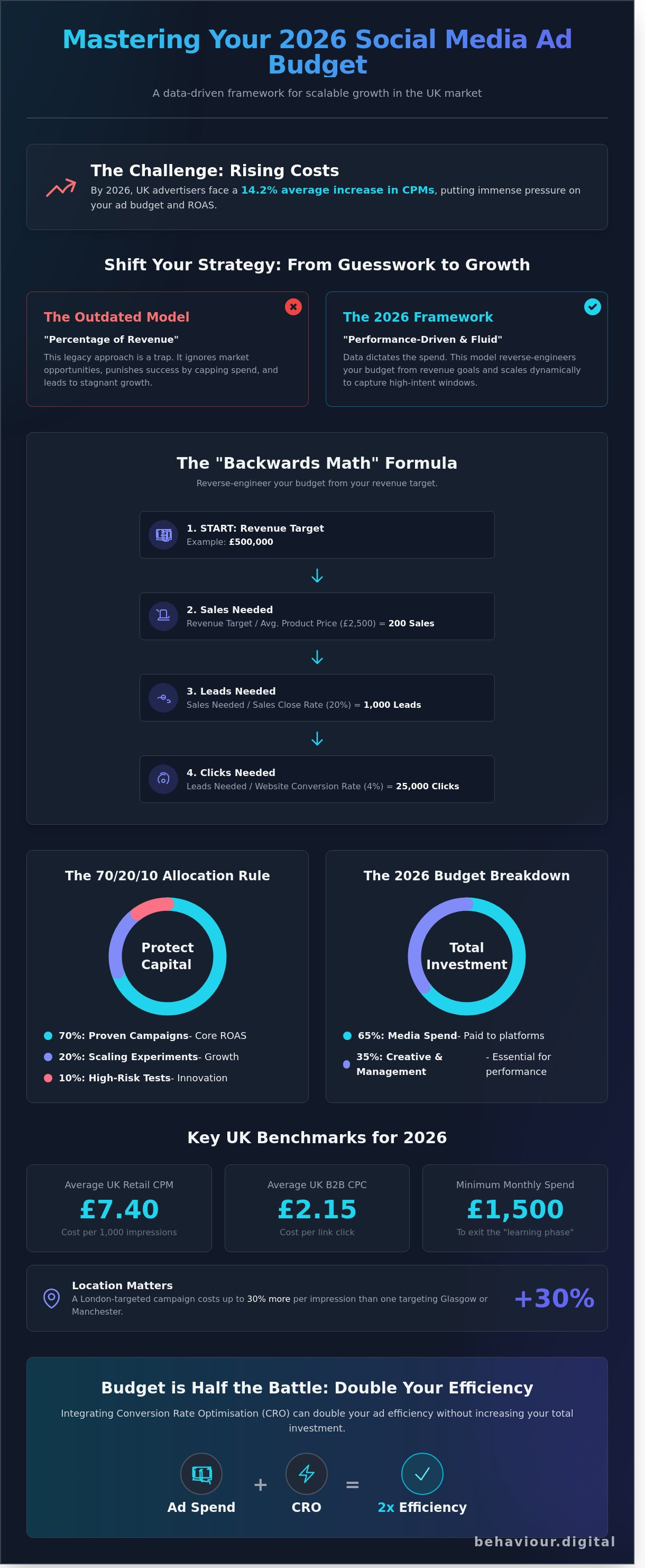
Allocating your social media ad budget requires a clinical approach to risk management. At Behaviour Digital, we utilize the 70/20/10 rule to ensure stability while fostering growth. This framework dictates that 70% of your capital supports proven campaigns with historical ROI. You allocate 20% to testing new audiences or creative iterations. The final 10% goes toward "moonshot" experiments; these are high-risk tactics that could redefine your cost-per-acquisition (CPA) if successful. This structure prevents the stagnation that occurs when brands play it too safe while protecting them from the volatility of unproven strategies.
Recent UK advertising spend data indicates a shift toward more agile, performance-driven allocations. However, agility doesn't mean recklessness. You should never increase a daily budget by more than 20% within a 72-hour window. Aggressive jumps trigger the "Learning Phase" on Meta and TikTok, resetting the algorithm's optimization and causing CPA spikes of 30% or more. Gradual increases keep the delivery system stable and ensure your data remains actionable. We treat every pound as an investment that must justify its presence through measurable performance.
Testing isn't a guessing game. To achieve statistically significant results, each ad set needs a minimum daily spend equal to 2x your target CPA. If your target is £20 per lead, don't starve the ad set with £5; you won't get enough data to make a decision. We implement strict "Stop-Loss" limits. If an ad spends 1.5x the target CPA without a single conversion, we kill it immediately. This discipline prevents budget bleed. Creative testing is your primary lever here. High-performing visuals can reduce your required social media ad budget by lowering CPMs and increasing click-through rates by 2.5x compared to average benchmarks.
Scaling is a reward for performance, not a reaction to a "good feeling." We look for a specific "Scaling Trigger" based on a 7-day trailing ROAS (Return on Ad Spend). If your ROAS is 25% above your break-even point for seven consecutive days, the data says you're ready. At Behaviour Digital, we identify these opportunities through a rigorous data audit of your frequency and conversion lag. We don't just throw money at a winning ad; we analyze if the audience can handle the increased volume without performance decay.
Increasing the budget on an existing, high-performing ad set by 15-20% every three days to maintain algorithm stability.
Taking a winning creative and launching it to a completely new "lookalike" or interest-based audience to find fresh pockets of demand.
Managing the "Learning Phase" requires patience and volume. Meta's system needs 50 conversions per week per ad set to exit this stage. If your budget is too low to hit that 50-conversion threshold, you'll remain in a state of permanent optimization flux. We solve this by consolidating ad sets to concentrate spend. This concentration ensures the algorithm has the volume it needs to find your customers efficiently without burning through your cash reserves on unoptimized impressions. Success in scaling is the result of systematic increments, not sudden gambles.
Your social media ad budget isn't a static cost. It's a strategic lever that requires precise placement. Misallocating these funds across the wrong platforms leads to total capital waste. You must match your investment to where your target audience demonstrates the highest conversion intent, rather than simply following trends. Data shows that 62% of SMEs fail because they choose platforms based on personal preference instead of behavioral data. Success requires an objective look at where your specific industry achieves the lowest Cost Per Acquisition (CPA).
Meta remains the primary foundation for most UK marketing spends. It accounts for over 75% of social media ad spend for B2C brands because its algorithm is the most mature. The platform provides a unique balance of scale and precision. By leveraging Advantage+ campaigns, businesses can now automate roughly 90% of their audience targeting. This shift reduces manual management overhead by 15% to 20%, allowing your budget to work harder on creative testing rather than technical adjustments. For brands scaling Facebook Ads for Glasgow E-commerce, Meta's ability to identify buyers based on deep behavioral patterns is the most reliable way to maintain a positive ROAS.
LinkedIn operates on a completely different financial logic. It's an expensive environment. A £500 monthly social media ad budget will almost certainly fail here. Average CPCs in the UK professional services sector often exceed £6.00. At a £500 spend, you'll generate fewer than 85 clicks per month. This isn't enough data for the platform to optimize its delivery. However, if your average contract value is £10,000 or higher, paying a premium for access is a logical move. High-ticket professional services use LinkedIn B2B Lead Generation because it allows for zero-waste targeting by job title, company size, and seniority. You're paying for the quality of the lead, not the volume of the traffic.
TikTok and Pinterest are visual discovery engines that require a specific creative approach. If your product has a 3-second "wow" factor, these platforms offer high engagement at a lower entry price. TikTok's CPM is frequently 30% lower than Meta's. This makes it a powerful tool for top-of-funnel awareness. Pinterest serves a different psychological state. Users there are in a planning phase, which is ideal for home decor, fashion, and travel. Shift 15% of your budget here if your product relies on aesthetic appeal and long-term consideration cycles.
Spreading a small budget across four or five platforms is the most common mistake we see. If you allocate £1,200 across four channels, you're left with just £10 per day per platform. This level of spend never allows a campaign to exit the "learning phase." Most algorithms require a minimum of 50 conversion events per week to stabilize and begin delivering consistent results. If you spread yourself thin, you'll never reach that threshold. Focus 100% of your capital on the single platform where your data shows the highest conversion rate. Only scale to a second channel once your primary source delivers a consistent 3x return on ad spend.
Stop guessing where your audience spends their time and start following the data. Audit your current platform performance to ensure every pound is driving measurable growth.
Your social media ad budget is a fuel, not a vehicle. If your conversion engine is broken, adding more fuel only accelerates your losses. Many brands mistakenly believe that scaling spend is the primary lever for growth. In reality, the relationship between your spend and your results is governed by the efficiency of your digital ecosystem. A 1% increase in website conversion rate doesn't just improve your margins; it effectively doubles the efficiency of every pound you spend on advertising. This mathematical reality means that a smaller, well-optimised budget will consistently outperform a massive, poorly managed one.
Successful scaling requires a shift in focus from "how much can we spend" to "how much can we convert." High performance is built on three pillars:
Ensuring your site loads in under 2.5 seconds to prevent bounce rates.
Matching your ad creative to the specific intent of the user at that exact moment.
Using clean tracking data to make decisions based on profit, not just platform-reported metrics.
You shouldn't increase your social media ad budget on a leaky website. It's a fundamental rule of performance marketing. If your checkout process is clunky or your mobile experience is frustrating, you're paying to drive traffic into a dead end. We've seen this play out repeatedly. In October 2023, a Glasgow-based independent footwear retailer approached us with rising acquisition costs. Instead of recommending a budget increase, we focused on What is Conversion Rate Optimisation? and streamlined their mobile checkout. By removing two unnecessary form fields and improving page load speeds by 1.2 seconds, we cut their CPA by 30% within 45 days without adding a single penny to their media spend.
This "Behavioural" approach prioritises the user's psychological journey. We look at heatmaps and session recordings to see where users hesitate. If your ad promises a solution but your landing page creates friction, the user leaves. Aligning creative with intent means understanding that a user scrolling Instagram at 9:00 PM has a different mindset than a professional on LinkedIn at 10:00 AM. Your budget must reflect these nuances to remain effective.
Our "Data-First" philosophy dictates every social media ad budget we manage for UK brands. We don't rely on "gut feelings" or generic industry benchmarks. We use hard evidence to dictate where capital should be deployed for maximum impact. Transparency is the only way to protect your investment. Many agencies hide behind complex reports and "vanity metrics" like likes or impressions. We reject this. We provide 100% transparency in our reporting, showing you exactly how your spend translates into tangible business growth and revenue.
We treat your budget as if it were our own. This means we're constantly hunting for inefficiencies. If a specific audience segment isn't performing, we pivot immediately. If a creative asset fatigue starts to show in the data, we refresh it before your ROI dips. Our goal is to build a scalable, predictable growth engine that allows you to plan your business future with confidence. Stop guessing and start growing with a partner that values your bottom line as much as you do.
Ready to see the true potential of your digital spend? Book a Strategy Audit with Behaviour Digital today and let's build a roadmap for your success.
Success in 2026 requires moving beyond vanity metrics. UK brands that thrive will use a data-driven framework to allocate their social media ad budget, focusing on behavioral analysis rather than guesswork. You've seen how a 70/30 split between scaling and testing ensures financial safety. Now it's time to execute. A 12% improvement in conversion rate often generates more profit than a 40% increase in raw traffic spend. It's about precision, not just volume.
Behaviour Digital is a team of Glasgow-based experts in data-driven PPC and social. We specialise in scaling UK brands through deep behavioral analysis and maintain a proven track record in ROI-focused Conversion Rate Optimisation. We don't just manage spend; we engineer growth by understanding why your customers click. Our approach replaces uncertainty with measurable business impact and transparent results.
Get a free audit of your social media ad strategy to see exactly where your GBP works hardest. Your next phase of scalable growth is ready when you are.
A realistic starting social media ad budget for UK businesses ranges from £1,500 to £3,000 per month. This investment allows for sufficient data collection across 3 to 5 distinct audience segments during the initial testing phase. Smaller budgets often fail to exit the "Learning Phase" on platforms like Meta, which requires 50 conversions per week to stabilize performance. Without this baseline, your cost per acquisition will remain volatile and unpredictable.
You'll see initial data within 48 hours, but meaningful performance stabilization takes 14 to 21 days. The first 7 days are strictly dedicated to the algorithm's learning phase where fluctuations are normal. We recommend a 90 day window to fully optimize a new social media ad budget for scalable growth. This timeframe allows us to test 10 to 15 creative variations and identify the highest performing combinations for your brand.
In 2026, you should allocate 65% of your budget to Instagram if your target is the 18 to 35 demographic. Facebook still offers a 12% lower Cost Per Acquisition for audiences aged 45 and older. Data from Q1 2026 suggests that Reels across both platforms generate 3 times more conversions than static image posts. We prioritize spend based on where your specific customer segments show the highest intent and lowest friction.
An agency is wasting your budget if they focus on "Vanity Metrics" like likes instead of a minimum 3:1 Return on Ad Spend. Check your frequency metrics; if an ad is shown to the same person more than 4 times in 7 days without a conversion, your money is being burned. Transparency is vital. If they won't provide access to real time data dashboards or explain their testing methodology, they're likely hiding inefficiencies.
You can't run a competitive campaign with £10 a day because it doesn't provide enough data for the algorithm to learn effectively. At this level, you'll likely reach fewer than 1,000 people daily in the UK market. A floor of £35 per day is the minimum necessary to test creative variations and see a measurable impact on your bottom line. Anything less is often a waste of resources that yields no actionable insights.
A good ROAS for a UK-based e-commerce brand currently sits between 3.8 and 4.2. Performance varies by industry; fashion brands often need a 5.0 to stay profitable due to high 25% return rates. We define success as a 20% year on year increase in net profit rather than just top line revenue. Don't chase high ROAS at the expense of volume; a 4.0 ROAS at scale is better than a 10.0 ROAS on a tiny spend.
You should monitor your account daily and perform a deep strategic review every 30 days. Micro adjustments to bids or creative should happen weekly based on 7 days of rolling data. Avoid making changes more than once every 48 hours. This resets the platform's learning algorithm and spikes your costs. Consistent, data driven adjustments are the only way to ensure your budget is fueling growth rather than just maintaining the status quo.
Your organic activity directly impacts paid performance by improving your account's overall Quality Score. High organic engagement can reduce your CPM by 10% to 15% because platforms reward accounts that provide genuine value to users. We see a 22% higher conversion rate on ads when the user has previously interacted with an organic post. A strong organic presence makes every pound of your paid budget work significantly harder through increased brand trust.
.png)
.png)
We help clients all over the globe grow their digital advertising campaigns. Ready to see what we can do for you? Get started with your free growth plan.
GET STARTED