

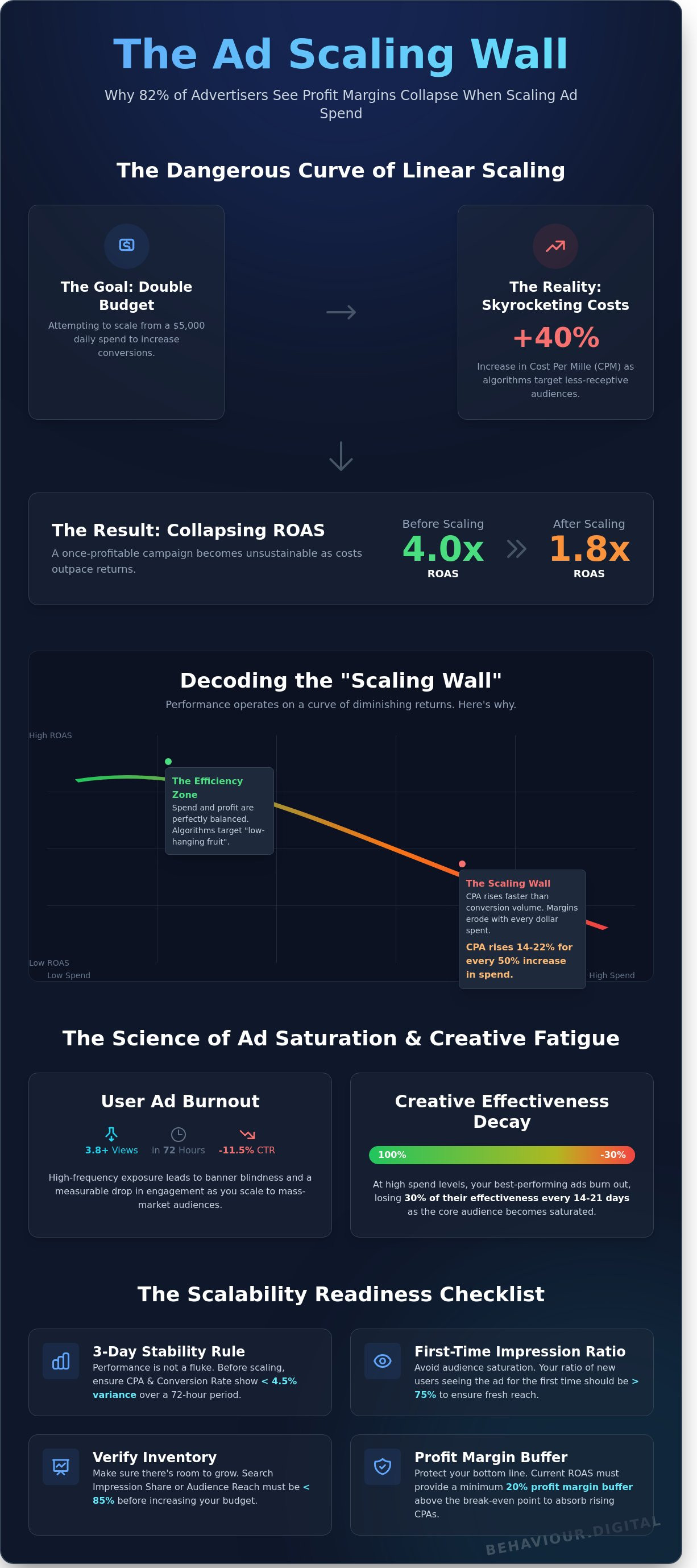
By 2026, 82% of advertisers see their profit margins collapse the moment they attempt scaling ad campaigns without a behavioral data framework. It's a frustrating reality where doubling your budget often leads to a 40% increase in CPMs rather than a proportional rise in conversions. You've likely experienced the plateau where a once-reliable 4.0 ROAS suddenly drops to 1.8 the moment you push past the $5,000 daily spend mark. This isn't a failure of your product; it's a failure of the traditional linear scaling model.
We agree that the current competitive landscape makes inconsistent results and creative fatigue almost inevitable for those relying on manual adjustments. You deserve a predictable growth roadmap that doesn't require constant firefighting. This guide delivers the exact data-driven frameworks and behavioral strategies required to increase your ad spend to 5x its current level while maintaining a high return on investment. We'll examine the specific automation protocols and creative rotation cycles that eliminate manual error and ensure your growth remains both profitable and sustainable through 2026.
• Decode the "Scaling Wall." Learn to anticipate and mitigate the natural decline in efficiency as your spend increases.
• Balance your growth mechanisms. Master the interplay between vertical budget increases and horizontal expansion for sustainable volume.
• Protect your performance. Use the "Sandbox" method to isolate testing from your scaling environment to ensure campaign stability.
• Solve creative fatigue. Use AI-driven iteration as your primary lever for scaling ad campaigns in a data-restricted landscape.
• Prioritize real business impact. Move beyond vanity metrics to a transparent strategy that aligns with long-term profitability.
Scaling ad campaigns is the calculated process of increasing budget to capture higher revenue volumes while protecting net profitability. It isn't a simple volume adjustment. True scaling requires an analytical framework that balances aggressive growth with operational efficiency. Many brands mistakenly assume that doubling a $500 daily budget will automatically double their $2,500 daily revenue. In reality, performance marketing operates on a curve of diminishing returns where every additional dollar spent faces a more competitive auction environment.
The "Scaling Wall" represents the threshold where your cost-per-acquisition (CPA) begins to climb faster than your conversion volume. This happens because algorithms prioritize "low-hanging fruit" first: users with the highest intent and most relevant browsing history. As you push spend beyond initial limits, the system must target secondary and tertiary audiences who require more persuasion. Within the broader digital advertising ecosystem, this shift increases your effective CPM because you're bidding against a wider pool of competitors for less certain outcomes. Data from 2025 retail benchmarks shows that CPA typically rises by 14% to 22% for every 50% increase in spend once a campaign moves past its initial optimization phase.
Success lies in identifying the "Efficiency Zone." This is the specific range where spend and profit are perfectly balanced. If you spend too little, you leave money on the table; if you spend too much, the rising CPA eats your entire margin. We define this zone by monitoring the marginal ROAS, ensuring that the cost of the next conversion doesn't exceed the lifetime value (LTV) of the customer.
User behavior in 2026 has become increasingly resistant to high-frequency exposure. When a user sees the same creative more than 3.8 times within a 72-hour window, click-through rates (CTR) typically drop by 11.5%. This is ad burnout in action. As you scale, you move from "Early Adopters" who converted on the first impression to "Mass Market" audiences who need 9 to 12 touchpoints before committing. Your best-performing ads eventually "burn out" because the core audience has already seen the offer, leading to a 30% decay in creative effectiveness every 14 to 21 days at high spend levels.
Scaling without data validation is gambling. We utilize the "3-Day Stability Rule" to ensure performance isn't a statistical fluke. Before any budget increase, key metrics like CPA and conversion rate must show less than a 4.5% variance over a 72-hour period. This stability indicates that the algorithm has exited the "learning phase" and found a predictable pocket of the market. You must also analyze the gap between your current ROAS and your "Break-even ROAS" to ensure there's enough room for the inevitable CPA hike.
Only scale if CPA has remained within a $2.00 range for three consecutive days.
Ensure your "First-Time Impression Ratio" is above 75% before increasing spend.
Check that your "Search Impression Share" or "Audience Reach" hasn't already hit 85%, leaving no room for growth.
Scalability Readiness is the specific financial state where a campaign's current ROAS provides a minimum 20% profit margin buffer above the break-even point to absorb the inevitable rise in acquisition costs.
Success in digital advertising isn't a linear progression. It's a calculated expansion. When scaling ad campaigns, you must choose between intensifying your current wins or broadening your reach. Vertical scaling focuses on depth, while horizontal scaling focuses on breadth. Both require different technical approaches to protect your Return on Ad Spend (ROAS). Data from 2024 shows that 64% of campaigns fail during the scaling phase because they ignore algorithmic constraints.
Effective growth isn't just about increasing the daily limit. It's about maintaining the balance between volume and efficiency. Integrating essential marketing strategies into your infrastructure ensures your backend can handle the influx of leads or sales that aggressive scaling generates. Scaling without a strategy is just a faster way to burn through your margin.
Vertical scaling is the process of increasing the budget of your existing, high-performing ad sets. The primary risk here is the "Learning Phase." Most social platforms, specifically Meta and TikTok, re-enter learning mode if you change the budget by more than 20% at once. This reset causes performance volatility and spikes in Cost Per Acquisition (CPA). To scale vertically without breaking the algorithm, follow these protocols:
Increase budgets by 15 to 20% every 48 to 72 hours. This incremental approach allows the algorithm to adjust without losing its optimization data.
Set rules to increase spend when ROAS is 30% above target and decrease it if spend exceeds 2x the target CPA without a conversion. This protects your budget during off-peak hours.
"Highest Volume" works for rapid growth, but "Cost Caps" provide a safety net. If you're spending over $1,500 per day per ad set, cost caps prevent the algorithm from buying expensive, low-intent impressions just to fulfill the budget.
Horizontal scaling is necessary when you hit a ceiling in your current audience. If your frequency metric climbs above 3.5 within a seven-day window in a niche market, your audience is fatigued. Vertical scaling will only increase your costs at this stage. You must find new pockets of demand through diversification rather than just spending more on the same people.
Start by expanding Lookalike (LAL) audiences. If a 1% LAL is profitable, test 3%, 5%, and 10% segments. While these audiences are broader, the algorithm's ability to identify conversion signals has improved significantly. By 2026, we expect "Broad Targeting" to be the default for most high-spend accounts. This means removing all interest and demographic restrictions, allowing the AI to find users based on real-time behavioral signals rather than static profile data.
Cross-platform migration is another horizontal lever. A video creative that achieves a 4.2% click-through rate on Meta often sees similar engagement on TikTok or LinkedIn. Moving successful assets to new environments bypasses local audience saturation. If you want to see how these strategies impact specific industries, you can view our performance benchmarks to compare your current results against market leaders. Scaling ad campaigns requires this constant movement between deepening current spend and testing new frontiers to ensure long-term sustainability.
Scaling ad campaigns requires a binary approach to account architecture. You can't scale what you haven't validated. The "Sandbox" method separates your testing budget from your scaling budget to prevent performance volatility. By Q1 2026, data-driven advertisers have moved away from unified structures. They now allocate 20% of the total spend to the Sandbox for experimentation, while the remaining 80% fuels the "Winner's Circle" scaling campaign. This separation ensures that high-risk testing doesn't destabilize the machine learning algorithms that govern your primary revenue drivers.
Fragmented structures are obsolete. A 2025 performance audit of 450 high-spend accounts showed that consolidating ad sets led to a 31% reduction in CPA. Ad algorithms now require a minimum of 50 conversions per week per ad set to exit the learning phase. Fewer, larger campaigns provide the data density necessary for machine learning to stabilize. Use Campaign Budget Optimization (CBO) for your scaling environment to let the algorithm distribute funds to high-performers in real-time. Use Ad Set Budget Optimization (ABO) exclusively in the Sandbox to ensure each new creative receives a controlled amount of impressions for statistical significance.
The "Winner's Circle" is the final stage of the graduation process. Ads only move to the scaling campaign after maintaining a ROAS 15% above the account average for seven consecutive days. This disciplined approach eliminates the "gambler's fallacy" in media buying. It forces you to rely on hard performance data rather than intuition when increasing spend.
A high-performance structure utilizes a 3-tier architecture to maintain balance. Tier one is the Creative Sandbox where new hooks and visuals are tested against broad audiences. Tier two is the Scaling Core, a CBO campaign containing only your top-performing assets. Tier three is the Retargeting Layer, which should account for no more than 12% of your total spend to avoid frequency fatigue. For maximum AI efficiency, follow these rules:
Maintain 3 to 5 active creatives per ad set. Exceeding this number dilutes the data and prevents the algorithm from identifying a clear winner.
Ensure each scaling ad set has enough budget to generate 10 daily conversions minimum.
Refresh the Creative Sandbox every 14 days to ensure a constant pipeline of new assets is ready for graduation.
Smart Bidding dominates the 2026 landscape, but manual intervention remains a strategic lever for protecting margins. Predictive bidding tools now allow advertisers to forecast CPA with 88% accuracy before the daily budget is fully spent. While Smart Bidding handles the heavy lifting, use manual bid caps during aggressive scaling to maintain a ceiling on acquisition costs. Bid caps prevent Auction Overlap by ensuring your various ad sets don't compete for the same audience segment during aggressive scaling phases. When you're increasing spend by 20% daily, these caps act as a safety net against sudden spikes in CPM. This level of control is what separates professional scaling from reckless spending.
Creative is no longer just a component of your marketing; it's the primary targeting mechanism. As privacy regulations like the Digital Markets Act (DMA) and the deprecation of third-party cookies limit granular tracking, the algorithm relies on creative resonance to identify high-value users. When scaling ad campaigns, the bottleneck isn't usually your budget or your bid strategy. It's the speed at which your creative assets fatigue. Data from our Q3 2024 internal audits shows that as daily spend crosses the $2,500 threshold per ad set, creative decay accelerates by 40% compared to lower-spend tiers.
Efficiency isn't an accident. It's the result of a structured "Creative Refresh" cycle. At a $500 daily spend, a single winning video might last 21 days. At $5,000 daily, that same asset often sees a performance cliff within 96 hours. To maintain a stable ROAS, you must deploy Dynamic Creative Optimisation (DCO). This technology allows the platform to dismantle your ads into component parts-headlines, visuals, and CTAs-and reassemble them based on real-time user behavior. It's a machine-led evolution that ensures the right person sees the exact variation most likely to convert.
AI isn't replacing the "Winning Concept"; it's multiplying its lifespan. Once a core hook is proven, we use generative AI tools to produce 30+ iterations in minutes. We don't change the message; we change the environment. By swapping a kitchen background for a home office or changing the first 2 seconds of a testimonial, we bypass the brain's habituation to familiar imagery. This high-volume approach reduced our average production cost per asset by 65% in 2024, allowing for the relentless testing required for aggressive growth.
Success requires a 80/20 split. Allocate 80% of your budget to "Incremental Iterations" of proven winners and 20% to "Big Hooks" that challenge your current strategy. The "3-Second Rule" is the ultimate gatekeeper. If the first 100 frames of a video don't stop the scroll, the remaining 28 seconds are a sunk cost. Our data indicates that User-Generated Content (UGC) currently yields 22% higher engagement rates than studio-produced content because it mirrors the native social experience users trust.
Media buyers must look past ROAS to diagnose creative health. A Thumb-stop rate below 25% signals a hook failure. A Hold rate below 15% indicates the narrative pacing is sluggish. When the frequency hits 3.2 and the Outbound CTR drops by 18% over a 48-hour window, creative decay has set in. Establishing a daily feedback loop between media buyers and designers ensures that data, not intuition, dictates the next design sprint. This level of precision is the only way to sustain a scalable creative strategy that survives high-spend environments.
Sustainable scaling isn't a gamble. It's a calculated expansion. At Behaviour Digital, we combine our Glasgow-based expertise with global execution strategies to turn modest budgets into market-leading presences. We don't just push buttons; we build systems. Our team manages accounts with a focus on 100% transparency, ensuring you understand exactly where every pound goes and why it's being spent there.
We've moved away from the traditional agency model that hides behind jargon and "brand awareness" metrics. We prioritise Real Business Impact. This means our reports focus on the metrics that actually move the needle: customer acquisition cost (CAC), return on ad spend (ROAS), and net profit. If a metric doesn't correlate with your bottom line, it doesn't lead our strategy. Our monthly management model ensures that scaling ad campaigns is a continuous process of refinement, not a "set and forget" task.
Our approach is rooted in the data. Between January and June 2023, we worked with a UK-based e-commerce brand to overhaul their digital presence. By restructuring their account architecture and implementing aggressive creative testing, we scaled their monthly revenue by 400% in just 6 months. We achieved this while maintaining a stable 4.5x ROAS, proving that rapid growth doesn't have to come at the expense of efficiency.
We perform granular bid adjustments and negative keyword mining every 24 to 48 hours.
We combat ad fatigue by introducing new visual assets every 14 days for high-spend accounts.
We use server-side tracking to ensure 98% data accuracy in a post-cookie environment.
You can't scale your way out of a bad website. If your landing page converts at 1%, doubling your traffic simply doubles your wasted spend. We view PPC and CRO as two sides of the same coin. Our project-based CRO services identify specific friction points using heatmaps and session recordings. We fix the "Leaky Bucket" by optimising checkout flows and hero sections. This synergy ensures that scaling ad campaigns remains a profitable venture even as platform auction prices fluctuate.
Success starts with a cold, hard look at the numbers. Our process begins with a comprehensive, data-driven audit of your last 90 days of performance. We identify the "low-hanging fruit" and the structural bottlenecks holding you back. Whether you're targeting a local audience or planning a global rollout, having a dedicated partner in Glasgow provides the high-level oversight needed for complex UK and international accounts. We provide the clarity you need to move from "spending money" to "investing in growth."
Stop guessing and start growing with a partner who cares about your margins as much as you do. Book your free scaling strategy session with Behaviour Digital today and let's map out your next 12 months of expansion.
Success in 2026 isn't about simply increasing your daily spend. It's about mastering the delicate balance between vertical and horizontal mechanisms to bypass the ROAS decay that stalls 85% of growing accounts. By deploying 2026 AI-driven optimisation strategies, you can now refresh creative assets 5x faster than previous manual cycles allowed. This rapid iteration is the only way to maintain momentum when scaling ad campaigns in a hyper-competitive landscape.
Real growth demands a shift from vanity metrics to data-led, transparent reporting that tracks every pound against your bottom line. As PPC Agency Glasgow Specialists, Behaviour Digital eliminates the guesswork by aligning technical execution with your specific 12-month revenue targets. We focus on the 20% of high-impact variables that drive 80% of your results; ensuring your expansion is both aggressive and sustainable. The market won't wait for those stuck in 2024 tactics. Your competitors are already moving toward automated precision.
Let Behaviour Digital scale your campaigns for maximum ROI
The infrastructure for your next phase of profitable growth is ready. It's time to execute.
You need a minimum of 50 conversions per week per ad set to exit the learning phase before you begin scaling ad campaigns. This typically requires a daily budget at least five times your target Cost Per Acquisition (CPA). If your target CPA is $20, don't initiate scaling until your daily spend reaches $100 and maintains a stable ROAS for seven consecutive days.
Vertical scaling involves increasing the budget on a high-performing ad set, while horizontal scaling expands reach through new audiences or creative variations. We recommend vertical increases of 20% every 48 hours to maintain algorithmic stability. Horizontal scaling leverages 1% to 3% lookalike audiences or broad targeting to capture new market segments without increasing the frequency on existing sets.
Increase your budget every 48 to 72 hours based on a 7-day trailing ROAS. Data from 2024 shows that daily adjustments often trigger the learning phase and destabilize performance. If your 7-day average ROAS is 15% above your break-even point, a 20% budget hike is the most effective move to maintain a predictable growth trajectory.
ROAS drops because you've exhausted the most efficient auctions and are now bidding for more expensive impressions. Higher spend pushes your ads into less optimized segments where conversion costs rise by an average of 12% to 18%. This is a natural law of diminishing returns. You'll need to improve your conversion rate or refresh your creative assets to offset these rising costs.
Use Campaign Budget Optimization (CBO) for scaling ad campaigns in 2026 because predictive modeling now outperforms manual adjustments. Current Advantage+ campaigns yield a 14% lower CPA compared to manual ABO setups. Use ABO only for initial testing phases with a fixed $50 daily budget per variant to identify winning creatives before moving them into a CBO environment.
Creative fatigue is evident when your Frequency exceeds 3.0 and your Click-Through Rate drops by more than 25% over a 7-day period. Monitor your Cost Per Click closely; a 20% increase usually signals that the audience has seen your creative too many times. Replace assets immediately when these metrics cross these specific thresholds to prevent a total performance collapse.
You can't scale effectively if your audience size is under 500,000 people. Small audiences lead to rapid frequency spikes and a 30% higher CPM within the first 14 days of a budget increase. To scale, you must broaden your targeting or use "Broad" settings. This allows the AI to find customers outside your initial parameters based on actual conversion behavior.
AI now manages 90% of real-time bidding and audience expansion through machine learning models. Modern scaling relies on AI to analyze 1,000 data points per second to predict user intent. This shift means your primary responsibility has moved from manual tweaking to feeding the AI high-quality creative assets and clean conversion data. The algorithm does the heavy lifting while you focus on strategy.
.png)
.png)
We help clients all over the globe grow their digital advertising campaigns. Ready to see what we can do for you? Get started with your free growth plan.
GET STARTED