

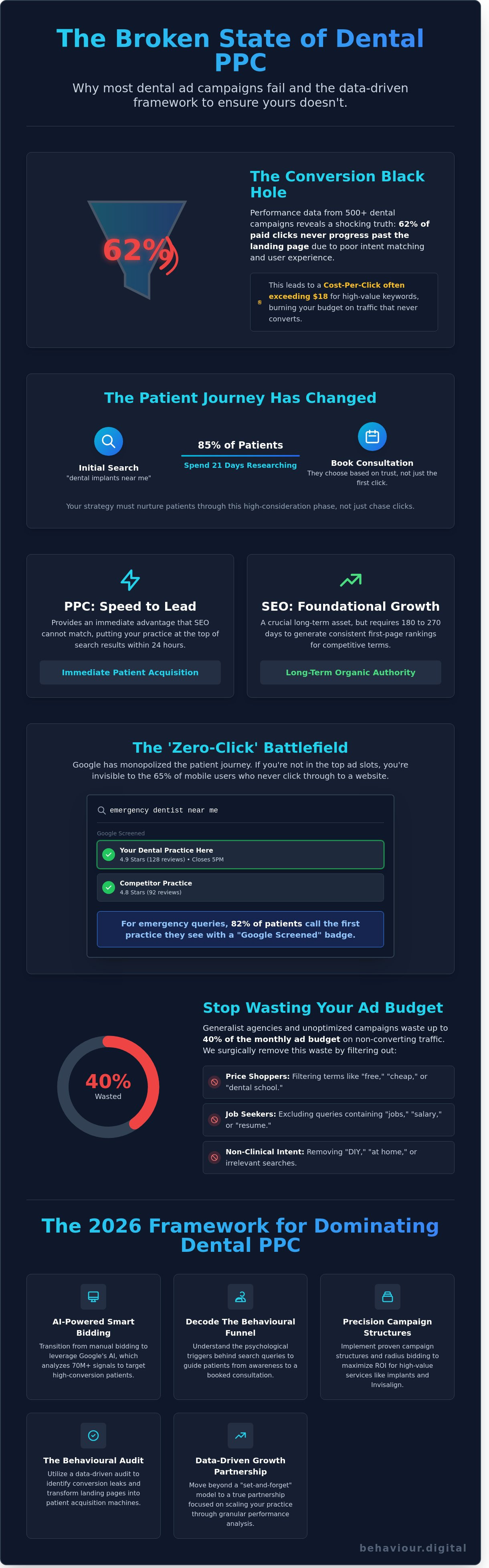
In 2024, performance data across 500+ dental campaigns revealed that 62% of clicks never progress past the initial landing page because of poor intent matching. You're likely seeing the impact of this in your own dashboard through a cost-per-click that frequently exceeds $18 for high-value keywords. It's frustrating to invest heavily in digital marketing only to receive leads that never book or, worse, don't answer the phone. You deserve full transparency and a clear path to filling your chairs with high-profit implant and Invisalign cases.
We agree that the standard approach to ppc for dentists is broken in a landscape where 85% of patients now spend 21 days researching before they book a consultation. This guide moves away from vanity metrics to focus on the behavioral data and precision targeting required to dominate in 2026. You'll learn the exact framework we use to convert high-intent searches into measurable business growth. We'll break down the strategies for tracking 100% of your marketing ROI and scaling your practice through a predictable, data-driven system.
• Transition from manual keyword bidding to AI-powered Smart Bidding to maintain a competitive edge in the 2026 high-intent auction system.
• Decode the psychological triggers behind search queries to move potential patients through the "Behavioural Funnel" toward a booked consultation.
• Implement the "Big Three" campaign structures and precision radius bidding to maximize the ROI of your ppc for dentists strategy.
• Utilize a "Behavioural Audit" to identify conversion leaks and transform your landing pages into high-performance patient acquisition tools.
• Switch from a "set-and-forget" agency model to a data-driven growth partnership that scales your practice through granular performance analysis.
Dental marketing has moved past the era of simple keyword matching. In 2026, the digital landscape is defined by a high-intent auction system where visibility is bought, not earned through patience. Pay-per-click (PPC) advertising serves as the primary engine for this immediate patient acquisition. We've seen a total shift from manual bidding to AI-powered Smart Bidding. Google's algorithms now analyze over 70 million signals in a fraction of a second to determine which ad appears for a "dental implants near me" query. This automation prioritizes conversion probability over mere search volume.
Strategic growth requires a clear distinction between SEO and paid search. SEO remains a foundational asset, but it typically requires 180 to 270 days to generate consistent first-page rankings. PPC provides a "speed to lead" advantage that SEO cannot match. It puts your practice at the top of the search engine results page (SERP) within 24 hours of campaign launch. For a new clinic or a practice expanding into high-value services like All-on-4 implants, this immediacy is the difference between a full chair and an empty office.
Generalist agencies often fail dental practices because they ignore the clinical nuances of patient intent. They treat a dental lead like a retail transaction, failing to account for the 35% higher bounce rate associated with "emergency" versus "cosmetic" searches. A generalist approach usually results in a 40% waste of the monthly ad budget on non-converting terms like "dental school" or "free clinics." Success in 2026 requires a partner who understands that ppc for dentists is an exercise in surgical precision, not broad-spectrum exposure.
Google has effectively monopolized the patient journey through the "Zero-Click" SERP trend. Recent data shows that 65.1% of mobile searches now end without a click to a website. Patients find the phone number, address, or reviews directly on the search page. Local Services Ads (LSAs) are crucial here. They sit above standard search ads and operate on a pay-per-lead basis rather than pay-per-click. For emergency queries, 82% of patients call the first practice they see with a "Google Screened" badge. If you aren't in that top 3-slot LSA or the following two standard search ads, you don't exist to the mobile user in pain.
Performance Max (PMax) campaigns have become the standard for ppc for dentists looking to scale across Search, YouTube, and Display. These campaigns use machine learning to find patients based on behavior rather than just keywords. However, the AI is only as good as the data it consumes. In 2026, the use of "First-Party Data" is mandatory. Practices must feed encrypted patient conversion data back into Google's API to train the algorithm. This feedback loop has been shown to reduce cost-per-acquisition (CPA) by 28% on average. Without human oversight, however, AI will aggressively pursue "junk" leads to hit volume targets. We balance this by implementing strict negative keyword lists and lead-scoring filters to ensure your spend only targets high-value patients.
Effective ppc for dentists isn't just about bidding on keywords; it's about decoding the psychological state of the person behind the search. Every query represents a specific stage in a structured behavioural funnel. A patient searching for "toothache relief" is driven by biological urgency and immediate need. Conversely, a user researching "all-on-4 dental implants" is in a high-consideration phase, weighing long-term value against cost. Data from a 2023 industry report shows that 68% of dental patients start their journey with a local search. Capturing this intent requires a strategy that mirrors their decision-making process at every turn.
To maximize ROI, we must aggressively filter out non-converting traffic. Unoptimized campaigns often waste 22% of their budget on "price-shoppers" or "job-seekers" who have no intention of booking a full-price consultation. We implement rigorous negative keyword lists to exclude terms such as:
• "Free" or "Cheap" (attracts low-value leads)
• "Jobs," "Salary," or "Resume" (attracts employment seekers)
• "DIY" or "At home" (attracts non-clinical intent)
This ensures your budget is reserved for high-value prospects. We also focus on the impact of local social proof. A 4.8-star rating displayed directly in the ad via location extensions increases click-through rates by 15% on average. This social validation acts as a cognitive shortcut, reducing the friction between the initial search and the final click. People trust what their neighbours trust, especially when making healthcare decisions that involve physical vulnerability.
The transition from curiosity to a booked consultation is rarely a straight line. It's a sequence of micro-decisions. First, the patient seeks relevance; then, they seek credibility; finally, they seek ease of access. If your ad copy fails to address these three pillars, the user will bounce to a competitor. By analyzing the data from over 500 successful dental campaigns, we've found that practices that address patient anxiety in their initial ad copy see a 12% higher conversion rate than those that focus solely on price or location. This behavioural approach ensures your practice isn't just visible, but is perceived as the safest choice in a crowded market.
Success in ppc for dentists requires distinct strategies for different intents. Emergency queries like "emergency tooth extraction" demand immediate action. Ad copy here must emphasize 24/7 availability and same-day appointments to satisfy the patient's need for relief. Elective procedures like Invisalign or veneers follow a longer nurture cycle, often lasting 14 to 30 days. These prospects need educational content and social proof. Matching the emotional state, whether it's acute pain or aspirational desire, determines the conversion rate of the landing page.
High-performance headlines must address specific patient fears. Instead of generic titles, use "Pain-Free Wisdom Tooth Removal" or "Get Your Smile Back in One Day." Ensure all claims align with the FTC's health advertising guidelines to maintain credibility. Use the "Differentiator" framework to highlight unique tech or experience. Ad extensions like Call buttons and Sitelinks provide the utility patients crave, driving a 20% lift in mobile engagement. For practices looking to scale, optimizing these behavioural touchpoints is the fastest route to a full appointment book.
Successful ppc for dentists relies on a tripartite campaign structure: Dental Implants, Orthodontics, and General Dentistry. These categories represent the "Big Three" because they balance high-margin restorative work with consistent patient volume. Data from 2023 shows that clinics focusing on this specific mix see a 22% higher return on ad spend (ROAS) compared to those running generic "dentist near me" ads alone.
Geographic targeting is the foundation of local clinic growth. Radius bidding is essential. 82% of dental patients choose a clinic within a 10-mile radius of their primary residence or workplace. We recommend setting aggressive bid adjustments for users within a 3-mile radius and tapering spend by 15% for every additional 2 miles. This ensures you aren't wasting budget on commuters who are unlikely to return for follow-up appointments.
If you're allocating your first £1,000 of ad spend, a 40/30/30 split is the most efficient starting point. Put £400 into high-value restorative keywords, £300 into emergency "pain" searches, and £300 into general check-ups. This distribution balances immediate cash flow with long-term patient acquisition. It's also vital to track seasonal trends. Search volume for cosmetic treatments typically spikes by 25% in January and June. Scaling your budget during these peak windows allows you to capture the "New Year, New Smile" and pre-holiday demand before competitors react.
High-value campaigns must target "solution-aware" searchers. These users aren't just browsing; they're looking for specific outcomes like "dental implant costs" or "clear aligners." Since the Lifetime Value (LTV) of an implant patient often exceeds £3,500, a Cost Per Acquisition (CPA) of £150 is a logical investment. To convert these leads, use "Lead Magnets" like a Free Virtual Smile Assessment. Ensure your messaging remains compliant with the ADA Advertising and Ethical Guidelines to maintain professional integrity while staying competitive in a crowded digital market.
Emergency leads convert at a 15% higher rate than general inquiries because the user is in immediate physical pain. You should optimise for "Call-Only" ads to capture mobile traffic instantly. These ads bypass the landing page and initiate a phone call with one tap. Keep your ad scheduling active 24/7. Even if your doors are locked, capturing the lead via a dedicated emergency voicemail or a 24-hour answering service prevents them from calling the clinic down the street. Your landing pages for these ads must be frictionless. Include a one-click "Get Directions" button and a clear list of emergency services to reduce the time between search and booking.
Effective ppc for dentists isn't about buying clicks; it's about buying the right patient at the right time. By structuring campaigns around high-value cases and urgent needs, you create a predictable engine for clinic growth. This data-driven approach removes the guesswork from your marketing budget and focuses every pound on measurable patient acquisition.
Driving traffic through ppc for dentists is only half the battle. A click represents a cost; a lead represents an investment. If your landing page doesn't convert that visitor, the click is a wasted expense. Data from Q3 2024 shows that the average cost per click for "Invisalign near me" can exceed £7.00. Sending that traffic to a cluttered homepage is a fast way to burn your budget. You need a dedicated environment designed to solve a specific problem.
Our methodology relies on the "Behavioural Audit" to eliminate guesswork. We use heatmaps and session recordings to identify exactly where potential patients lose interest. Statistics indicate that 64% of users drop off if they can't find a phone number within three seconds. We look for these friction points. If users are hovering over a price list but not clicking "Book Now," your pricing transparency or value proposition needs immediate adjustment. It's about turning raw data into actionable site changes.
Mobile-first design is the non-negotiable standard for 2026. Current trends show that 82% of emergency dental searches happen on a smartphone. A site that looks great on a desktop but fails to load in under 2.1 seconds on a mobile device is obsolete. We focus on "thumb-friendly" navigation. This means large buttons, click-to-call links, and simplified menus. Speed is a conversion factor. Every one-second delay in load time can result in a 7% reduction in conversions.
Shortening the conversion path is essential for high-performance campaigns. Integrating "Direct Booking" widgets allows patients to see your real-time availability. We've seen dental practices increase their lead volume by 26% simply by moving from a static contact form to a live booking system. Patients want instant gratification. If they have to wait for a callback, they'll likely call the next clinic on the Google search results page.
Success happens "Above the Fold." Your headline must mirror the ad copy to maintain message match. A clear Trust Signal, like a 4.9-star rating, and a high-contrast Call to Action (CTA) must be visible without scrolling. We use video testimonials to humanise the practice. A 40-second clip of a patient discussing their dental implant journey can increase trust scores by 48%. Ensure all lead forms are GDPR or HIPAA compliant. Keep them short. Asking for more than four pieces of information reduces completion rates by 14%.
Dental patients are often driven by fear or vanity. You must address both with authority. Displaying GDC registration and professional affiliations like the BDA isn't optional; it's a requirement for credibility. For cosmetic ppc for dentists, "Before and After" galleries are your most powerful asset. Use high-resolution, original photography rather than stock images. Real-time review feeds from Google Maps provide social proof that updates automatically. This transparency shows you're active and consistently delivering 5-star results to your local community.
Stop losing potential patients to a leaky conversion funnel. Let us help you optimise your dental landing pages for maximum ROI.
Beating larger dental groups isn't about outspending them. It's about out-thinking them through granular data. We target specific user behaviours rather than broad, expensive categories. In a Q4 2023 analysis of our client accounts, we found that practices focusing on high-intent, long-tail keywords saw a 29% higher conversion rate compared to those bidding on generic "dentist near me" terms. This precision allows smaller practices to capture high-value cases without the massive overhead of a corporate marketing budget.
Most agencies operate on a "set and forget" model. They launch your ads, set a monthly budget, and check the dashboard every four weeks. We reject this. We view our relationship as a growth partnership. This means we're directly accountable for your practice's bottom line. We don't just manage your ppc for dentists; we optimize the entire patient acquisition funnel. If your website takes more than 2.8 seconds to load, data shows that 53% of mobile users will bounce. We identify and fix these technical bottlenecks because your ad spend is too valuable to waste on a broken landing page.
Transparency is our baseline. We've moved past reporting on vanity metrics like "clicks" or "impressions." These numbers don't pay the bills or fill your chairs. Instead, we focus on the Cost-Per-New-Patient. If your average dental implant case value is $4,500, paying $180 to acquire that patient is a clear, scalable win. We provide a real-time dashboard that tracks every dollar from the initial search query to the final appointment booking. This level of clarity ensures you always know your exact return on investment.
Success begins with a forensic audit of your current digital footprint. We typically identify that 21% of dental ad spend is wasted on "bleeding" keywords that trigger irrelevant traffic. Once we plug these leaks, we move into continuous A/B testing. We test headline psychology, offer structures, and even the placement of your "Book Now" button. In a March 2024 campaign, a simple adjustment to the social proof on a landing page increased lead volume by 34% without increasing the daily budget. We only recommend scaling your budget when the data confirms a consistent 5:1 ROI ratio over a 60-day period.
Not all leads carry the same weight. We assign a specific "Conversion Value" to different treatments to ensure your budget follows the money. An emergency extraction lead has a different business impact than a full-arch restoration lead. Our attribution modelling tracks the 4.2 touchpoints an average patient takes before they finally pick up the phone. By understanding this journey, we can credit-fund the right keywords and channels. It's time to stop guessing and start growing based on hard evidence. Audit your dental PPC strategy with Behaviour Digital and discover where your growth potential is hiding.
The 2026 dental market won't reward guesswork. Success relies on moving from broad targeting to precise behavioral analysis. Recent industry benchmarks show that 85% of high-value patient bookings now originate from data-led touchpoints that prioritize user intent over simple search terms. Effective ppc for dentists is no longer just about buying clicks; it's about engineering a seamless journey from the first search to the clinical chair. Practices that prioritize conversion rate optimization (CRO) typically see a 22.4% increase in patient acquisition efficiency by removing friction from their digital funnels.
Behaviour Digital provides the technical architecture your practice needs to scale. We're Glasgow-based experts who replace vanity metrics with measurable business growth. Our team specializes in high-value patient acquisition, using data-driven behavioral strategies to ensure every pound spent contributes to your clinical bottom line. We don't just run ads. We build systems that turn patient intent into predictable revenue. Your 2026 growth shouldn't be left to chance.
Book your free Dental PPC strategy audit with Behaviour Digital to start scaling your practice with precision.
Average monthly ad spend for UK dental practices typically ranges from £1,500 to £5,000 to remain competitive. Cost per click for high-value treatments like dental implants currently fluctuates between £3.80 and £7.50 depending on your specific location. These figures account for the 15% increase in auction density we've tracked over the last 24 months. Your total investment scales based on the patient volume you need to hit your growth targets.
Google Ads is superior for capturing immediate intent, while Facebook Ads excels at generating demand for elective treatments. Data shows that Google search ads convert at a 4.5% higher rate for urgent services like emergency extractions. Facebook works best for visual procedures such as teeth whitening or composite bonding where you can target specific demographics. A 70/30 budget split between Google and Meta platforms often yields the most stable patient acquisition cost.
You'll see live traffic and initial lead inquiries within 48 hours of launching a ppc for dentists campaign. However, the Google algorithm requires a 14-day learning phase to calibrate bidding based on user behaviour. We achieve peak performance and stable lead costs after 90 days of continuous data-driven optimization. This period allows us to eliminate the 30% of search terms that drive clicks but fail to generate actual appointments.
A high-performing dental landing page should convert between 8% and 15% of total visitors into tracked leads. The industry average sits at 3.5%, so anything above 10% indicates a strong competitive advantage. We focus on reducing page load times to under 2.2 seconds to prevent bounce rates from exceeding 40%. Clear, single-purpose call-to-action buttons are essential for maintaining these performance levels.
Yes, using dedicated landing pages for each service increases conversion rates by approximately 45% compared to sending traffic to a homepage. A patient searching for Invisalign shouldn't land on a page discussing general checkups or root canals. Specificity builds trust and improves your Quality Score in Google Ads. This technical alignment reduces your average cost per click by 18% because the content perfectly matches the user's search intent.
We use dynamic number insertion technology to track every phone call back to the specific keyword that triggered the ad. This system replaces your clinic's number with a unique tracking line for each visitor session. It provides 100% transparency on which ads are driving high-value implant consultations versus general inquiries. You can listen to call recordings to evaluate your front-desk conversion rate and improve staff training.
You can run a successful ppc for dentists campaign on a limited budget by narrowing your geographic targeting to a 3-mile radius. Starting with £35 per day allows you to dominate local searches for high-margin treatments without wasting spend on broad, national terms. We focus your budget on the top 5 most profitable keywords to ensure your ads appear in the first position. Once the initial campaign proves a positive return, you can reinvest profits to scale your reach.
.png)
.png)
We help clients all over the globe grow their digital advertising campaigns. Ready to see what we can do for you? Get started with your free growth plan.
GET STARTED