

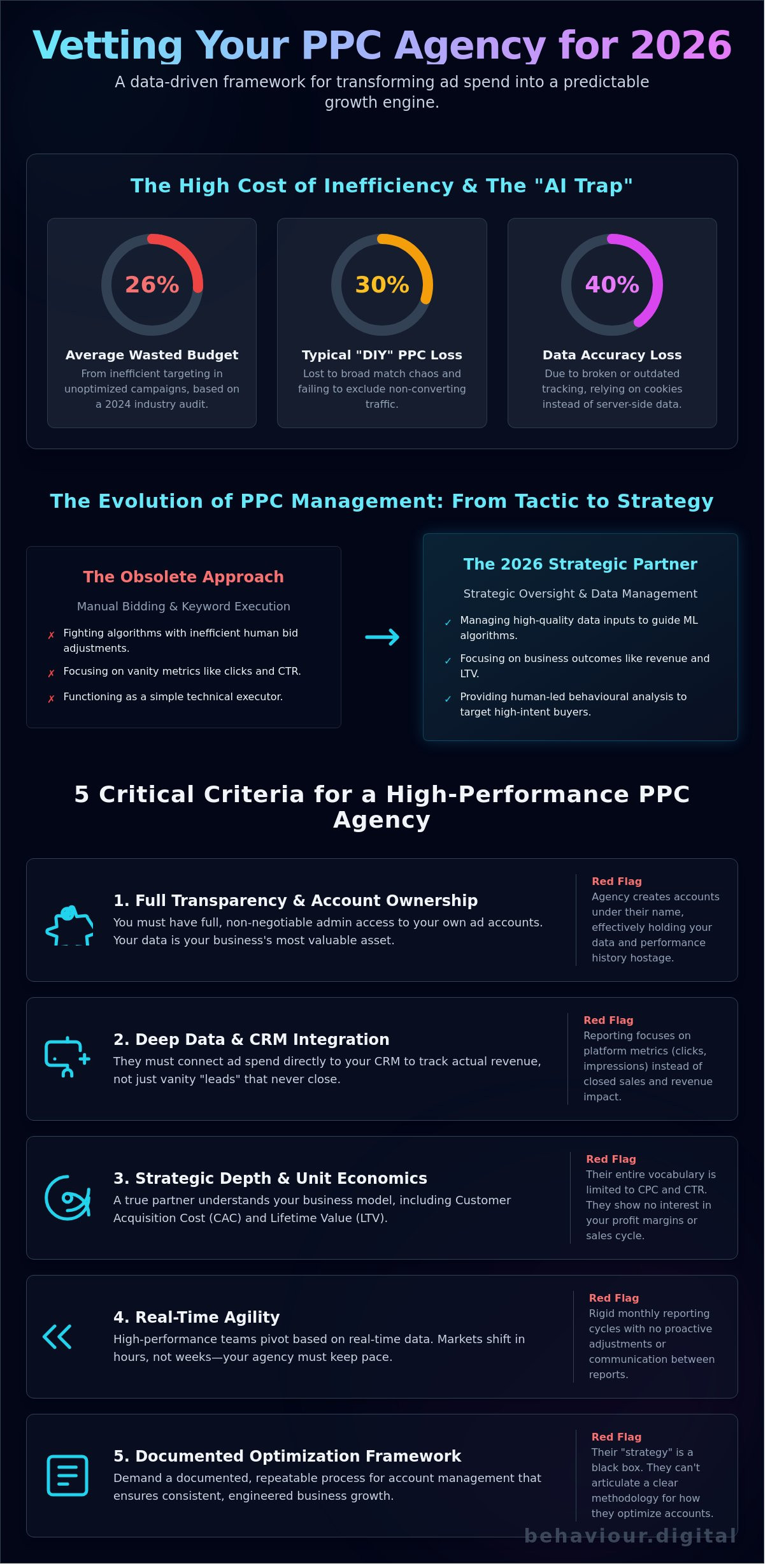
A 2024 industry audit of 2,000 active ad accounts revealed that the average business wastes 26% of its budget on inefficient targeting and unoptimized campaigns. Most brands feel the weight of this inefficiency through stagnant growth and a lack of transparency. You've likely experienced the frustration of seeing high click volumes that never convert into revenue. It's a common trap. Vanity metrics often replace meaningful business outcomes in monthly reports. Selecting the right ppc advertising agency isn't about finding someone who knows the platform. It's about finding a strategic partner that understands your unit economics.
We'll teach you how to cut through the noise to identify and hire a team focused on scalable growth. You'll learn the exact framework for vetting technical expertise and demanding the transparent reporting your business deserves. This guide provides a clear roadmap to secure a partnership that transforms your ad spend into a predictable lead engine for 2026. We're moving past keywords to focus on the data-driven decisions that drive your bottom line.
• Identify the shift from technical execution to strategic growth and why manual bidding is obsolete in the 2026 landscape.
• Evaluate a potential ppc advertising agency based on data transparency, account ownership, and their ability to link spend directly to CRM revenue.
• Bridge the gap between clicks and conversions by integrating behavioral science and CRO into your paid media strategy.
• Navigate agency pricing models to distinguish between scalable performance partners and low-cost "churn and burn" providers.
• Discover how a data-driven approach transforms account management into a precise engine for engineered business growth.
By 2026, the barrier to entry for digital advertising has vanished, but the barrier to profitability has never been higher. A modern ppc advertising agency no longer functions as a mere technical executor of keyword bids. That era ended when Google and Meta shifted their core architecture toward black-box automation and predictive modeling. Today, an agency acts as a strategic growth partner. They manage the high-quality data inputs that feed machine learning algorithms rather than fighting against them. Success in this environment requires a shift from manual adjustments to strategic oversight.
The evolution of paid search has rendered manual bidding obsolete. Algorithms now process millions of signals in milliseconds, making human bid adjustments inefficient. However, this automation creates a new challenge: the "AI Trap." Automated campaigns often prioritize volume over value, leading to inflated numbers that don't reflect actual business growth. Profitability in 2026 depends on human-led behavioural analysis. An expert team must interpret why a user converts, ensuring the AI targets high-intent buyers rather than just chasing cheap clicks. Pay-per-click (PPC) remains the fastest way to generate revenue, but only if the strategy accounts for these complex human variables.
PPC provides the immediate market presence necessary for survival. While a comprehensive Digital Strategy builds long-term authority over a 6 to 12-month horizon, paid media bridges the gap. It captures existing demand instantly. This dual-speed approach ensures your brand remains visible while your organic foundation matures.
In 2026, user intent is fragmented across multiple platforms. A B2B lead might discover your brand through a LinkedIn thought-leadership ad, research your solution via Google Search, and finally convert after seeing a Meta retargeting video. A ppc advertising agency must synchronize these touchpoints to create a cohesive funnel. This multi-channel approach is mandatory because 74% of buyers now engage with more than five pieces of content before making a purchase decision. To scale, you must meet the user where they are, using data to bridge the gaps between platforms.
Self-managed accounts are often a liability rather than an asset. Without professional oversight, businesses frequently lose up to 30% of their ad spend to "broad match" chaos and irrelevant search terms. Common mistakes include:
Failing to exclude non-converting traffic that drains the daily budget by noon.
Optimizing for "button clicks" instead of actual qualified leads or closed sales.
Relying on outdated cookies rather than server-side tracking, leading to a 40% loss in data accuracy.
The Expert Gap in 2026 is the distance between an algorithm's ability to spend your budget and a human's ability to ensure that spend generates a positive contribution margin.
Selecting a ppc advertising agency in 2026 requires looking beyond basic keyword management. You need a partner that treats your capital as their own. Success depends on five specific pillars that separate high-growth partners from mere service providers. First, transparency is non-negotiable. If you don't have full admin access to your Google Ads or Meta accounts, you don't own your data. This lack of control is a significant risk to your business continuity.
Second, data integration must be seamless. A sophisticated agency connects ad spend directly to your CRM. They track actual revenue, not just "leads" that may never close. This alignment ensures that every dollar spent contributes to your bottom line. Third, demand strategic depth. Your agency must understand your unit economics, including Customer Acquisition Cost (CAC) and Lifetime Value (LTV). If they only talk about CTR and CPC, they don't understand your business model.
Fourth, agility determines your competitive edge. Markets shift in hours, not weeks. High-performance teams pivot based on real-time performance data to capitalize on emerging trends. Finally, evaluate their PPC management framework. A documented, repeatable optimization process is the only way to ensure consistent results as you scale.
Refusal to grant admin access is the ultimate red flag. Some agencies claim their "proprietary technology" or "unique account structures" prevent them from sharing access. This is almost always a tactic to make switching providers difficult. You should demand real-time dashboards that pull live data from the API. Static monthly PDF reports are obsolete. They often hide underperforming segments or wasted spend. Adhering to FTC guidelines on digital advertising requires honesty in how ads are presented and tracked. Your agency must mirror this honesty in their reporting. If the data isn't clear, the strategy isn't working.
The best ppc advertising agency operates like a laboratory. They don't guess; they test. A standard 14-day experiment cycle should be the minimum benchmark for ad copy, creative assets, and landing pages. In 2024, data showed that accounts with weekly testing cadences saw a 22% higher ROAS compared to static accounts. Ask for a specific 90-day testing roadmap during the interview process. This plan should detail exactly which variables they will isolate and how they will validate results. If you're ready to move past basic management toward scaling your performance, look for an agency that prioritizes rapid, data-backed iteration. Continuous testing is the only way to maintain a competitive advantage in an AI-driven bidding environment.
High click-through rates often mask a fundamental failure in digital strategy. Most providers celebrate a 5% CTR while ignoring the reality that 98% of that traffic fails to convert. This is the click-to-conversion disconnect. It happens when an agency focuses on the auction rather than the human behind the screen. In 2026, winning requires more than just bidding on the right keywords; it demands a deep integration of conversion rate optimization into every layer of the paid media funnel.
Scaling a brand isn't about buying more traffic. It's about increasing the value of the traffic you already have. We've seen specific behavioural tweaks, such as aligning ad copy psychology with the user's immediate pain point, double ROAS without increasing the monthly ad spend by a single dollar. If your ppc advertising agency doesn't understand the psychological triggers that move a user from a "search" to a "buy" mindset, they're simply managing a budget, not growing a business.
Sending paid traffic to a generic homepage is a strategic error that drains capital. Every ad group needs a dedicated environment designed for one specific action. Google Ads Quality Score relies heavily on landing page relevance; a poor experience can inflate your costs by 400% or more. High-performing campaigns use precision-engineered pages that mirror the ad's promise. There's a direct correlation where aggressive conversion optimisation leads to higher Quality Scores and significantly lower CPCs, allowing you to outbid competitors with larger budgets.
The total deprecation of third-party cookies has forced a shift toward first-party data dominance. Your ppc advertising agency must leverage your internal customer lists to build robust remarketing loops and high-intent lookalike audiences. We no longer rely on vague interest categories. Instead, we use real-world behavioural cues, such as time-on-site or specific page interactions, to segment audiences.
This data-driven approach allows for surgical precision in ad delivery. A user who has engaged with three technical case studies requires a different creative approach than a first-time visitor. By mapping ad creative to these specific stages of the journey, you ensure that every dollar spent is targeting a user with a high probability of conversion. Success in the current market depends on this level of technical and psychological granularity.
Choosing a ppc advertising agency isn't just about finding the lowest management fee. It's about aligning incentives to drive growth. Most agencies operate on three primary models: percentage of spend, flat fees, or performance-based structures. Percentage-based models, typically ranging from 10% to 20% of the media budget, are industry standard but can inadvertently encourage higher spending without proportional returns. Flat fees provide budget stability, while performance-based models tie agency revenue directly to your bottom line.
Avoid the "churn and burn" trap. Low-cost providers often charge minimal fees because they rely on automated templates and high client turnover. If an agency charges less than 10% of your spend for management, they likely aren't dedicating the necessary time to manual bid adjustments or creative testing. This lack of attention leads to wasted ad spend that far exceeds any initial savings on management fees. High-performing accounts require consistent, human-led optimization.
Success in the first 90 days looks different than it does at the one-year mark. During the initial three months, focus on establishing a baseline and improving account hygiene. You should see a steady decrease in Cost Per Acquisition (CPA) and a measurable increase in lead quality. Reporting must move beyond vanity metrics like clicks or impressions. A sophisticated ppc advertising agency prioritizes Lifetime Value (LTV) and actual revenue data over surface-level traffic stats. Data transparency is non-negotiable.
Performance-based pricing sounds attractive because it shifts the financial risk to the agency. However, it requires strict definitions to succeed. You must ensure the agency prioritizes lead quality over sheer volume. A contract should include a lead scoring mechanism to prevent the agency from chasing cheap, low-intent conversions. Structure these agreements to reward growth milestones, ensuring both parties profit from scaled efficiency without creating conflicting interests.
Regional nuances impact search behavior significantly. For businesses targeting the UK or Scottish markets, local market knowledge provides a distinct competitive edge. Working with a team capable of face-to-face strategy sessions at the Red Tree Business Suites allows for deeper integration into your business culture. Local experts understand regional search trends and can navigate the specific competitor landscapes in cities like Glasgow and Edinburgh more effectively than a remote, global firm. This proximity fosters better communication and faster strategic pivots.
Ready to move beyond basic metrics and drive real business impact? Partner with a strategic PPC team today.
Choosing a ppc advertising agency in 2026 requires more than a look at past case studies. You need a partner that treats your capital as their own. At Behaviour Digital, we don't just manage accounts; we engineer business growth through technical precision. Our philosophy is rooted in the belief that every pound spent must have a direct, traceable path to revenue. We operate from Glasgow, but our data-driven strategies scale globally. Success is not a product of luck. It is the deliberate result of conscious strategy and relentless optimisation.
The Behavioural Edge sets us apart from traditional competitors. While a standard ppc advertising agency might focus on basic keyword matching, we integrate Conversion Rate Optimisation (CRO) and data science into every campaign. We analyze user intent at a granular level. This approach allows us to outperform generic strategies by identifying high-value patterns that others miss. Transparency is our baseline. You own your accounts, your data, and your tracking setup. We provide real-time dashboards so you're never left wondering about your performance metrics.
We follow a rigorous methodology designed to eliminate waste and maximize scalability. We don't guess; we test and validate every variable.
We start by identifying the "leaks" in your current setup. Our initial audits typically uncover that 15-20% of ad spend is wasted on irrelevant search terms or broken tracking loops. We fix the foundation before scaling.
We launch data-backed campaigns across Google, Meta, and LinkedIn. We align your messaging with the specific stage of the buyer's journey, ensuring high relevance and lower acquisition costs.
We utilize a 70/30 rhythm for scaling. We allocate 70% of your budget to proven, high-performing "winners" and 30% to aggressive testing of new creative and targeting hypotheses. This ensures stability while capturing new growth.
We offer a 30-minute initial consultation that focuses entirely on your data. There is no sales pitch. We dive into your current account structure to identify exactly where your budget is underperforming. During this session, we identify at least three immediate ROI wins that you can implement right away to improve your margins. We look at your attribution models, your landing page friction points, and your competitive positioning to give you a clear roadmap for 2026.
Stop settling for "average" results and start engineering your growth with a partner that values precision. Book your strategy session with Behaviour Digital today and see the data for yourself.
Winning in 2026 requires more than high click-through rates. It demands a strategy that bridges the gap between user intent and bottom-line profit. You've seen why technical audits and transparent pricing models are non-negotiable for long-term success. Choosing the right ppc advertising agency is the definitive factor between stagnant budgets and exponential, data-backed scaling. At Behaviour Digital, we don't rely on luck or vague industry trends. Based at the Red Tree Business Suites in Glasgow, our experts leverage a rigorous behavioural approach to turn raw data into measurable ROAS.
We focus on the metrics that actually move the needle for your business. It's time to stop settling for vanity metrics and start demanding predictable, scalable growth. Our team is ready to map out your path to market leadership using proven frameworks that eliminate waste. Don't let your competitors claim the top spot while you're still analyzing outdated spreadsheets. Take the first step toward a more profitable future by identifying exactly where your current strategy is leaking revenue.
Request Your Free PPC Performance Audit
Let's build something remarkable together.
A PPC advertising agency manages your paid search and display campaigns to maximize measurable ROI. They handle keyword research, bid management, and ad creative optimization. Their core responsibility involves translating your budget into business growth through continuous data analysis. They don't just set up ads; they refine the entire sales funnel to lower your acquisition costs and scale your performance.
UK agencies typically charge between £500 and £5,000 per month as a flat management fee or 10% to 20% of the total ad spend. Industry data shows the average monthly retainer for small to medium businesses sits at approximately £1,500. Performance-based models are also common. In these setups, fees are tied directly to the volume of leads or sales generated for the client.
You'll see initial data trends within 14 days, but full optimization usually requires 90 days. The first month focuses on technical setup and gathering baseline data. By the second month, the agency begins aggressive A/B testing. According to Google, most campaigns need at least three months of historical data to reach peak efficiency and maintain a stable ROAS.
Choose based on your target market's cultural nuances and your need for face-to-face strategic alignment. A local Glasgow PPC agency offers deep insights into the UK regional market and allows for quarterly in-person strategy sessions. Global firms provide broader scale, but they often lack the specific behavioral data required to dominate local search intents in specific UK territories.
Most modern agencies provide integrated services across Google, Meta, and LinkedIn to ensure a unified customer journey. Performance-driven firms treat social media as an extension of the search funnel. They use remarketing lists from search ads to target users on Instagram or TikTok. This cross-channel approach typically increases conversion rates by 15% compared to running siloed campaigns.
A healthy ROAS in 2026 typically ranges from 4:1 to 6:1 depending on your specific industry and profit margins. E-commerce brands often aim for a 500% return, while high-ticket B2B services might find a 3:1 ratio highly profitable due to high lifetime value. Your agency should prioritize profit on ad spend rather than just top-line revenue to ensure sustainable scaling.
Professional agencies provide Conversion Rate Optimization (CRO) as a core part of their performance strategy. Driving traffic is useless if your landing page doesn't convert visitors into customers. They use heatmaps and session recordings to identify friction points. Improving your conversion rate by just 1% can often double your ROI without you having to increase your monthly ad spend.
.png)
.png)
We help clients all over the globe grow their digital advertising campaigns. Ready to see what we can do for you? Get started with your free growth plan.
GET STARTED