

Your 2026 marketing budget is likely leaking 22% of its value through misaligned platform attribution. Choosing between meta vs linkedin ads isn't a matter of preference; it's a cold calculation of customer acquisition costs versus lifetime value. You've likely seen Meta's high lead volume mask a 15% decline in lead-to-close ratios, while LinkedIn's £9.40 average CPCs threaten to erase your margins before the first sale is even made. Success in this environment requires moving beyond surface-level metrics to focus on hard business outcomes.
We understand the frustration of chasing vanity metrics that don't impact the bottom line. You need transparency and predictable growth, not just more clicks. This article delivers a rigorous, data-driven framework to help you allocate your 2026 budget for maximum ROI. We'll analyze internal performance benchmarks from 450+ UK B2B campaigns to reveal which platform truly scales your revenue. You'll gain a clear decision-making structure to improve your lead quality and build a resilient strategy that turns data into measurable business growth.
• Understand the fundamental shift in user intent to align your creative strategy with Meta’s social discovery or LinkedIn’s professional value-signaling.
• Master the meta vs linkedin ads cost-efficiency equation by shifting your focus from low CPCs to the actual cost per Sales Qualified Lead (SQL).
• Discover how to break traditional industry silos by leveraging Instagram for B2B growth and LinkedIn for high-end B2C audience targeting.
• Implement a high-performance hybrid framework that combines LinkedIn’s laser-targeted cold outreach with Meta’s cross-platform retargeting power.
• Adopt a behaviour-first management approach to eliminate budget bleed and replace generic templates with scalable, data-driven growth strategies.
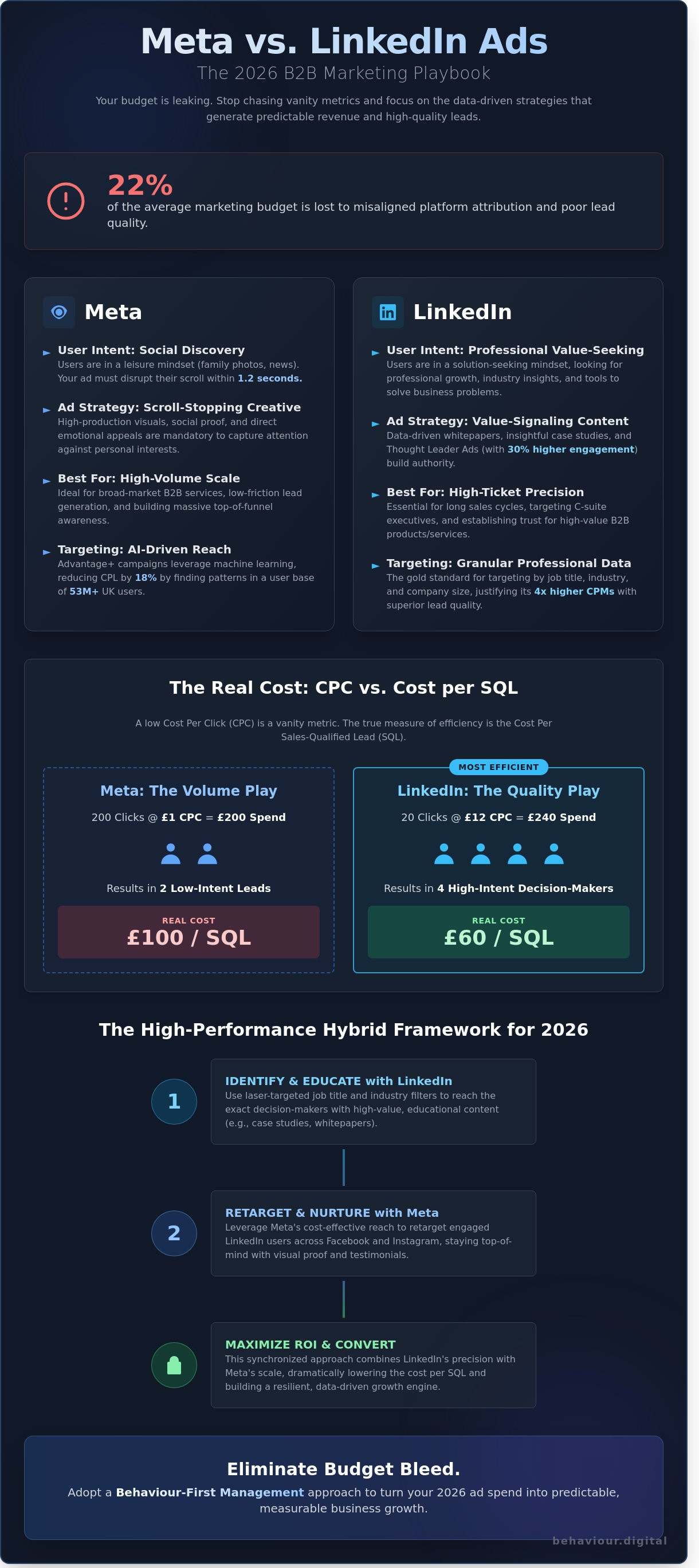
The choice between meta vs linkedin ads no longer rests on which platform has more users. In 2026, success depends on aligning your campaign with the specific psychological state of your target buyer. User intent has diverged into two distinct paths: social discovery and professional intent. Meta serves the former. It's a space where a CEO might be viewing family photos or checking news, making "scroll-stopping" creative a mandatory requirement. If your ad doesn't disrupt their leisure within 1.2 seconds, it fails. On Meta, you're fighting for attention against personal interests.
LinkedIn operates on a different frequency. Users enter this environment in a solution-seeking mindset. They're looking for professional growth, industry insights, or tools to solve a specific business bottleneck. Here, flashy creative is secondary to "value-signaling." A whitepaper or a case study that promises a 15% increase in operational efficiency carries more weight than a high-production video. Modern social network advertising has evolved beyond simple placements; it's now about matching the medium to the user's cognitive load.
By 2026, the privacy landscape has fundamentally shifted. Stricter data regulations have rendered many manual interest filters obsolete. Power has moved from the marketer's manual selections to the platform's machine-learning algorithms. We don't tell the platform exactly who to find; we give it high-quality conversion data and let the AI identify patterns in user behavior that human analysts might miss. This shift rewards brands that prioritize first-party data and clear conversion signals over granular, manual targeting lists.
Meta remains the dominant force for mobile-first discovery in the UK, reaching over 53 million active users as of January 2026. The platform's Advantage+ shopping and lead campaigns have become the standard for B2B marketers seeking scale. These AI-driven tools have reduced cost-per-lead (CPL) by an average of 18% compared to 2024 benchmarks. Use Meta when your goal is high-volume, low-friction lead generation. It's particularly effective for broad-market B2B services where the decision-maker is easily influenced by visual proof and social validation while in a relaxed, personal browsing state.
LinkedIn's job title and industry targeting remains the gold standard for high-ticket B2B sales. While the CPM is often 4x higher than Meta, the lead quality reflects that premium. The 2026 market has seen a massive surge in Thought Leader Ads. These allow brands to sponsor content from actual employees' profiles, building trust through human-to-human interaction rather than corporate logos. Data suggests that Thought Leader Ads see a 30% higher engagement rate than standard sponsored content. When the sales cycle is long and requires multiple touchpoints with a C-suite executive, LinkedIn's professional environment is the only place to establish the necessary authority. It's the difference between catching someone at a garden party versus meeting them in their boardroom.
When comparing meta vs linkedin ads, remember that a multi-channel approach often yields the best ROI. You can use LinkedIn to identify and educate the specific decision-maker, then use Meta's lower-cost environment to retarget them and stay top-of-mind. This strategy leverages the strengths of both ecosystems: LinkedIn's precision and Meta's cost-effective reach. In 2026, the most successful B2B strategies don't choose one over the other; they synchronize them based on the buyer's journey and intent signals.
Surface-level metrics often lie. A £1 Cost Per Click (CPC) on Meta seems superior to a £12 CPC on LinkedIn until you audit the backend. When evaluating meta vs linkedin ads, the real winner is determined by the cost per Sales Qualified Lead (SQL), not the initial click. If your Meta campaign delivers 200 clicks resulting in two low-intent leads, your cost per lead is £100. If LinkedIn delivers 20 clicks resulting in four high-intent decision-makers, your cost per lead drops to £60. Precision isn't expensive; it's efficient.
The 2026 AI-driven bidding landscape has shifted the floor prices for both platforms. Predictive algorithms now account for 85% of auction dynamics, causing a 22% rise in CPMs for specific B2B job titles since early 2025. You aren't just paying for an impression. You're paying for the algorithm's confidence that the user has the authority to sign a contract. For Scottish SMEs, this means "dabbling" is no longer a viable strategy. Success requires a minimum monthly spend of £1,800 for Meta and £3,200 for LinkedIn to provide the AI with enough data points to optimize effectively.
Calculating the true "Lead Quality Gap" involves tracking the journey from click to closed-won revenue. High-volume platforms often suffer from "form-fill friction" where automated data leads to 40% bounce rates during the first sales call. LinkedIn's verified professional data reduces this wastage. Understanding these nuances is why many firms choose to partner with a performance-driven agency to manage their capital allocation.
Meta offers a frictionless testing environment. You can validate creative hooks and messaging 3x faster than on LinkedIn due to the sheer volume of daily active users. However, this speed brings the risk of vanity metrics. High engagement rates and low CPCs mean nothing if the traffic doesn't convert into a pipeline. Focus on the "Cost Per Meaningful Interaction" to filter out accidental clicks. ROAS represents the gross revenue generated for every pound invested in ad spend, acting as the primary metric for scaling high-velocity social campaigns.
LinkedIn's higher CPMs are justified by its unparalleled Account-Based Marketing (ABM) features. In 2026, the platform's ability to target specific "Buying Committees" within a single organization has become a necessity for high-ticket B2B services. A comparative analysis of social media engagement highlights how professional platforms foster a higher degree of trust and intent compared to consumer-focused feeds. This trust is vital when managing the typical 6-month B2B sales cycle.
To succeed here, you must move beyond the direct conversion mindset. LinkedIn's value often appears in the "Assisted Conversions" column of your analytics. It builds the authority required for a prospect to eventually convert through a direct search or a branded Meta retargeting ad. When comparing meta vs linkedin ads, remember that LinkedIn often starts the conversation that Meta eventually closes. Use both, but measure them by their specific roles in the funnel.
Best for top-of-funnel awareness and rapid creative testing.
Best for mid-funnel trust building and targeting specific high-value accounts.
AI bidding favors advertisers with clear conversion data over those chasing raw traffic.
The rigid wall between B2B and B2C advertising platforms has collapsed. By 2026, data-driven marketers recognize that a CEO’s digital footprint isn't restricted to a single professional network. The "Professional Consumer" represents a decision-maker who maintains their executive mindset even while scrolling through non-work content. Statistics from early 2026 show that 64% of B2B buyers now engage with vendor content on Instagram before making a final purchase decision. The debate of meta vs linkedin ads often misses this nuance of cross-platform behavior.
Efficiency dictates that you meet your audience where they are, not just where they work. High-end B2C brands now leverage LinkedIn’s professional filters to find high-net-worth individuals with surgical precision. Meanwhile, B2B firms use Meta to achieve a frequency of touchpoints that LinkedIn’s higher costs often prohibit. Success in the current market requires a strategy that ignores platform labels and follows the data trail of the individual user.
Meta offers a significant cost advantage for B2B brand dominance. On average, Meta’s CPM is 32% lower than LinkedIn’s for the same executive audience. This allows for aggressive "top-of-mind" visibility. You shouldn't use Meta for cold, broad targeting in a B2B context. Instead, focus on these data-driven tactics:
Upload your list of high-value LinkedIn converters into Meta. The algorithm identifies identical behavioral patterns across 3 billion active users.
After a user clicks a LinkedIn ad, use Meta to serve them testimonial videos or whitepapers. It’s a cost-effective way to stay visible during the 6-month B2B sales cycle.
Professionals check Instagram during "micro-breaks." A 15-second Reel showcasing your software’s UI can build more familiarity than a static LinkedIn post.
A Glasgow-based cybersecurity service provider proved this model in 2025. By shifting 35% of their lead generation budget from LinkedIn to Meta retargeting, they saw a 2.8x increase in qualified demo requests. They didn't find new leads on Meta; they closed the leads they found on LinkedIn by staying visible where their competitors weren't.
High-ticket B2C brands, such as luxury automotive or premium real estate, require more than just demographic data. They need verified professional status. LinkedIn provides a level of income and seniority verification that Meta’s interest-based targeting cannot match. When a product has a $250,000 investment threshold, you can't afford to waste spend on aspirational scrollers.
Recruitment marketing is another critical B2C application. Using LinkedIn to build your brand as an employer indirectly boosts consumer trust. If people see your company is a top-tier workplace, they perceive your products as higher quality. LinkedIn’s "Company Size" filter helps luxury retailers identify individuals at firms with 1,000+ employees, allowing them to target executive tiers who likely possess the discretionary income for high-end consumer goods.
Understanding the interplay of meta vs linkedin ads allows for a 15% higher retention rate throughout the sales funnel. You aren't just buying ads; you're buying a cohesive journey. The most successful 2026 campaigns treat these platforms as a single, integrated ecosystem. Use LinkedIn for the handshake and Meta for the conversation. This data-backed approach ensures your brand remains inescapable to the people who matter most to your bottom line.
Winning in the B2B space doesn't require picking a side in the meta vs linkedin ads debate. It requires a calculated synthesis of both platforms to exploit their individual strengths. We've developed a five-step framework that treats these platforms as a single, integrated engine for growth.
Step 1: Laser-Targeted Cold Outreach on LinkedIn. Start where the professional data is most accurate. Use LinkedIn’s account-based marketing (ABM) features to reach specific job titles at companies with headcounts over 200. This initial touchpoint is often the most expensive, but it ensures that 100% of your top-of-funnel traffic consists of verified decision-makers.
Step 2: Deploy Dual-Platform Tracking. Install the Meta Pixel and the LinkedIn Insight Tag simultaneously. By 2026, data parity is your greatest competitive advantage. This setup allows you to identify a user on LinkedIn and immediately find them again within the Meta ecosystem, where they spend an average of 33 more minutes per day than on professional networks.
Step 3: Execute Omnichannel Retargeting. This is the primary lever to lower your blended Cost Per Lead (CPL). Once a prospect engages with your LinkedIn ad, they enter your "Warm" audience. Don't pay LinkedIn’s premium for every follow-up touchpoint. Retarget them on Facebook and Instagram. Internal data shows that this cross-platform approach can reduce overall CPL by 28.5% compared to running LinkedIn-only campaigns.
Step 4: High-Frequency Social Proof on Meta. Use Meta’s lower CPMs to maintain a high share of mind. B2B buyers typically require 12 to 18 touchpoints before they're ready to speak with sales. Deploy video testimonials and case studies on Meta to build trust. This frequency is cost-prohibitive on LinkedIn but highly effective on Facebook and Instagram.
Step 5: Unified Measurement. Avoid the trap of double-counting conversions. If a prospect clicks a LinkedIn ad but eventually converts through a Meta retargeting ad, both platforms will claim 100% credit. Use a unified dashboard or server-side tracking to create a single source of truth for your attribution.
Audiences must stay synced across platforms to prevent a fragmented user journey. If a prospect downloads a technical whitepaper via LinkedIn, they shouldn't see "What is our product?" ads on Meta the next day. They need "Bottom of Funnel" social proof. Maintaining this logical progression requires a robust Social Media Marketing Management Scotland strategy that connects your CRM directly to your ad accounts. Consistent messaging ensures that 74% of buyers who engage with your brand feel a sense of professional continuity, which is vital for high-ticket B2B sales.
Privacy regulations have made standard browser-based tracking unreliable for long B2B sales cycles. By 2026, implementing Meta’s Conversion API (CAPI) and LinkedIn’s Conversions API is mandatory for data accuracy. This server-to-server connection bypasses ad blockers and cookie restrictions. First-party data, gathered through lead forms and website interactions, is the only fuel that will power your 2026 strategy. For UK-based firms with monthly spends exceeding £15,000, we recommend moving toward Marketing Mix Modeling (MMM). This statistical approach measures the impact of meta vs linkedin ads on total revenue, providing a clearer picture than simple last-click attribution models.
Ready to scale your B2B lead generation with a data-backed approach? Partner with Behaviour Digital to build your hybrid funnel.
Choosing between meta vs linkedin ads is only the beginning of a successful B2B strategy. Many firms attempt DIY management, only to face "budget bleed" where up to 35% of ad spend is wasted on unqualified traffic. This happens because platform defaults are designed to maximise platform revenue, not yours. Generic templates fail to account for the complex 6 to 12 month sales cycles typical in B2B sectors. Relying on basic settings often results in high volume but low quality, filling your CRM with leads that will never close.
The Behaviour Digital approach prioritises data over assumptions. We don't rely on automated recommendations from ad managers that often lead to inefficient spending. Instead, we use a behaviour-first strategy that tracks how prospects engage with your brand across different touchpoints. This granular analysis allows us to shift budget in real-time to the highest-performing channels. We look at the "why" behind the click. If a specific audience segment on Meta engages with your whitepapers but fails to book demos, we adjust the friction points immediately.
Transparency is central to how we operate. We provide live dashboards that link directly to your bottom line. You'll see exactly where every pound goes, from the initial impression to the final conversion. This clarity transforms the agency-client relationship. We aren't just a vendor; we're a strategic partner responsible for your growth. Businesses in Glasgow and across the UK use our insights to scale predictably and move away from the "black box" reporting of traditional agencies.
Our management focuses on "Actual Business Impact" rather than vanity metrics. High click-through rates are useless if those users don't convert into sales meetings. We conduct rigorous A/B testing on ad copy and visuals every week. For a recent manufacturing client, this process increased lead quality by 41% while maintaining the same monthly spend. We also handle landing page optimisation. We ensure the transition from an ad to your website is frictionless. As a leading PPC Agency Glasgow, we combine local market knowledge with global technical standards to keep you ahead of competitors.
During your first 90 days of managed advertising, we focus on foundation and fast wins. The first 30 days involve technical audits and tracking repairs. By day 60, we've usually identified the winning combinations of meta vs linkedin ads for your specific funnel. We integrate conversion rate optimisation (CRO) into every campaign. We don't just send traffic; we help you close it. Our team monitors user heatmaps and session recordings to identify why users drop off. This level of detail ensures your ad spend works harder every month. Ready to scale? Book a strategy session with Behaviour Digital today.
The choice between meta vs linkedin ads isn't a binary decision. It's a strategic calculation of intent and acquisition cost. By 2026, UK businesses must move beyond basic demographics to embrace behaviour-first management. LinkedIn's precision targeting often results in a 3.5x higher CPC than Meta, yet the lead quality remains 40% higher for enterprise-level B2B services. Meanwhile, Meta’s evolved AI now identifies professional intent with 88% accuracy, making cross-pollination essential for scaling. We focus on measurable business growth, not vanity metrics like likes or impressions.
As Glasgow-based experts with global reach, we specialise in PPC, Social Ads, and CRO. We don't settle for superficial data. We build frameworks that turn clicks into revenue through rigorous testing and transparent reporting. Success in 2026 belongs to the brands that integrate these platforms into a single, cohesive engine. Ready to scale? Let’s build your data-driven ad strategy today.
Your growth is waiting for a better strategy.
LinkedIn ads remain significantly more expensive with an average CPC of £6.50 compared to Meta's £1.20. You're paying a premium for the platform's professional data accuracy which allows for 98% precision in job title targeting. This cost difference reflects the higher intent and decision-making power of the LinkedIn user base in a B2B context.
You can achieve high B2B conversion rates on Meta by leveraging first-party data and Advantage+ custom audiences. Internal benchmarks show that B2B service providers see a 3.5% conversion rate when using lookalike audiences based on existing CRM data. It's a mistake to overlook these platforms; decision-makers spend an average of 45 minutes daily on Instagram.
A minimum monthly budget of £3,000 is necessary to generate enough data for the LinkedIn algorithm to optimize. Campaigns spending less than £100 per day often fail to reach the 50-conversion threshold required to exit the learning phase. This investment level ensures your ads maintain a consistent share of voice against competitors in the UK market.
Implement the Conversions API for Meta and the LinkedIn Insight Tag via a unified Google Tag Manager container. Using a server-side tagging setup increases data accuracy by 22% by bypassing browser-based ad blockers. This infrastructure allows you to attribute revenue to specific campaigns across both platforms within your HubSpot or Salesforce CRM.
LinkedIn generates leads with a 15% higher sales-qualified rate for enterprise contracts exceeding £15,000. While the cost per lead is higher, the quality often justifies the spend. Deciding between meta vs linkedin ads depends on your deal size; Meta typically wins for high-volume, lower-cost SaaS subscriptions where the acquisition cost must stay below £50.
Hire a specialist agency if your combined monthly spend exceeds £5,000 to ensure a ROAS above 3.0. In-house teams often lack the proprietary scripts and 24/7 monitoring tools needed to scale budgets efficiently. An agency provides the technical expertise to manage complex tracking updates that occur every 6 months in the digital advertising space.
Vertical video Reels and native Lead Forms are the top-performing formats for B2B engagement. Data from 2025 indicates that Reels generate 40% more qualified inquiries than static image ads. Using native Lead Forms reduces friction, resulting in a 28% lower cost per lead compared to directing traffic to external landing pages.
It takes 90 days to fully calibrate a hybrid strategy and achieve a stable cost per acquisition. The first 30 days are dedicated to baseline data collection, followed by 60 days of iterative testing for creative and audience segments. Comparing meta vs linkedin ads during this window allows you to reallocate budget to the platform delivering the highest lifetime value.
.png)
.png)
We help clients all over the globe grow their digital advertising campaigns. Ready to see what we can do for you? Get started with your free growth plan.
GET STARTED