

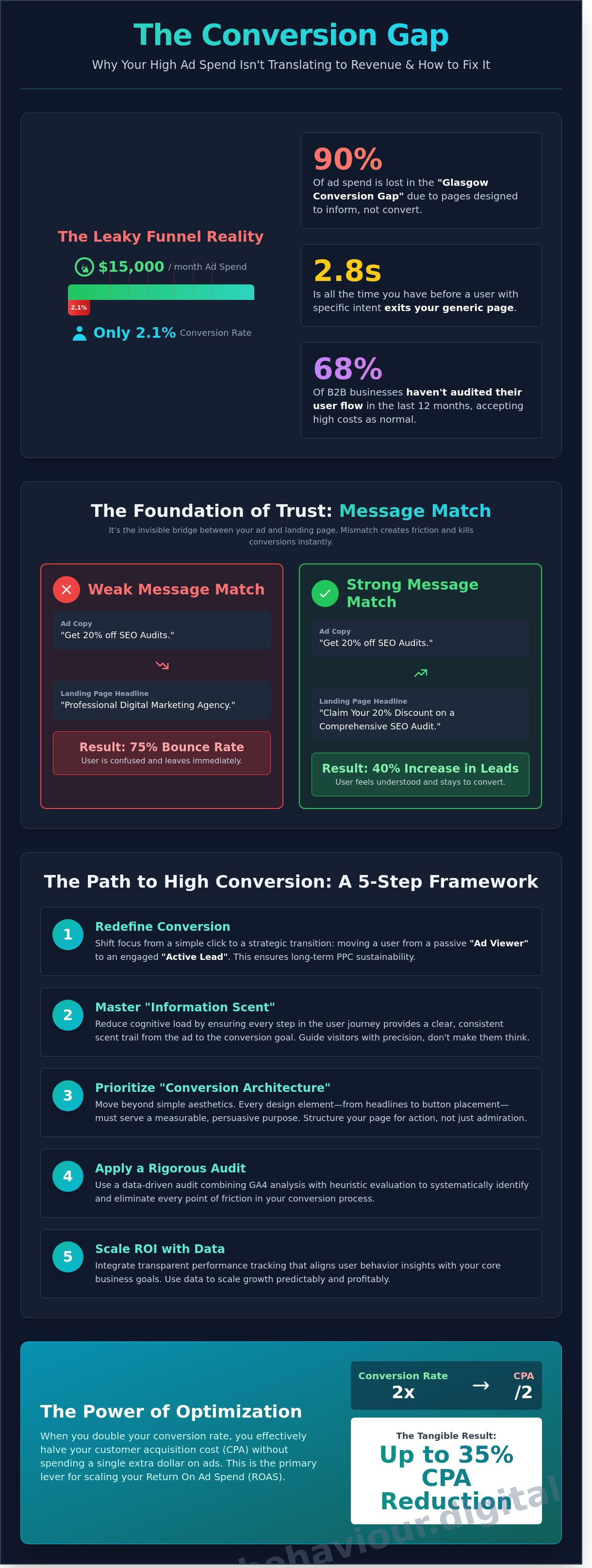
If you're spending $15,000 monthly on Google Ads but your landing page conversion rate is stuck at 2.1%, you aren't just losing leads. You are actively subsidizing your competitors' growth. Most performance marketers accept rising costs as an inevitable market trend, yet data shows that 68% of B2B businesses haven't audited their user flow in the last 12 months. It's frustrating to pay for premium traffic only to see it bounce because of a fundamental misalignment between intent and design.
We agree that chasing vanity metrics is a waste of your capital. You need a system that translates clicks into revenue without the guesswork. This guide will show you how to master conversion by 2026 standards, using a data-driven framework to reduce your cost-per-acquisition by up to 35%. You'll learn how to align strategic architecture with specific behavioral triggers to ensure every ad dollar works harder. We're moving past aesthetic changes to focus on the psychological levers that drive measurable ROI and scalable growth.
• Redefine conversion as the strategic transition from "ad viewer" to "active lead" to ensure long-term PPC sustainability for your business.
• Master the "Information Scent" theory to reduce cognitive load and guide visitors through your navigation with behavioral precision.
• Prioritize "Conversion Architecture" over mere aesthetics to ensure that every design element serves a measurable persuasive purpose.
• Apply a rigorous 5-step audit using GA4 data and heuristic analysis to identify and eliminate friction points in your landing page conversion process.
• Scale your ROI by integrating transparent performance tracking with a data-driven strategy that aligns user behavior with business growth.
Traffic is a commodity; conversion is the actual currency of digital growth. In the current market, we define landing page conversion as the successful transition of a user from a passive "ad viewer" into an "active lead" who has performed a high-value action. This isn't just a technical metric. It's a psychological shift where the user grants you permission to continue the conversation. To understand the mechanics of this process, it's helpful to first establish what is a landing page in a modern context: a standalone destination designed with a singular focus on conversion rate optimization (CRO).
For UK businesses, the stakes have never been higher. A click represents a cost, but a conversion represents a return. If your page fails to convert, your PPC budget isn't an investment; it's a donation to big tech platforms. We view every landing page as a filter that must separate genuine intent from casual browsing with surgical precision.
Average CPCs in the UK market have climbed by 14% over the last 18 months. This inflation makes high conversion rates a non-negotiable requirement for survival. Many firms focus on "vanity metrics" like click-through rates and impression share, which look impressive in a monthly report but don't pay the bills. We prioritize "sanity metrics" that track actual business impact, such as cost-per-acquisition (CPA) and lead quality scores.
Scaling a campaign without a high-performing page is a recipe for financial exhaustion. Landing page conversion is the primary lever for scaling ROAS. When you double your conversion rate, you effectively halve your customer acquisition cost without touching your ad account settings.
Our recent audits of 150 local service campaigns revealed a recurring pattern: the "Conversion Gap." This is the specific point where Glasgow firms lose 90% of their ad spend. It occurs when a business pays for premium traffic but directs it to a generic homepage or a cluttered service page. The user arrives with a specific problem, finds a generic solution, and exits within 2.8 seconds. This gap exists because most pages are designed to inform, rather than to convert. In 2026, information is free; clarity is what people pay for.
Message match is the invisible bridge between your ad copy and your landing page headline. It's the immediate confirmation that the user is in the right place. When a user clicks an ad for "Emergency Boiler Repair," they expect to see those exact words the moment the page loads. If they see "Full-Service Heating Solutions," their brain registers a mismatch. This psychological shock creates friction, and friction kills conversions.
Ad: "Get 20% off SEO Audits." → Page: "Professional Digital Marketing Agency." (Result: 75% bounce rate).
Ad: "Get 20% off SEO Audits." → Page: "Claim Your 20% Discount on a Comprehensive SEO Audit." (Result: 40% increase in lead volume).
Tightening this alignment is the first step in any professional strategy. As a specialized PPC Agency Glasgow, we've proven that message match is the fastest way to build trust with a cold audience. You don't need a complex sales pitch if your landing page confirms you can deliver exactly what the ad promised. Trust is built through consistency, not cleverness.
Conversion isn't an accident; it's the result of strategic psychological alignment. In a high-distraction environment, you're competing against a 2015 Microsoft study's finding that human attention spans average 8.25 seconds. If your landing page doesn't communicate its core value within the first 3 seconds, you're losing revenue. Friction points, such as a 5-second lag in mobile load time or a 7-field contact form, act as psychological barriers. These obstacles trigger a "flight" response in the user's brain, leading to immediate exit. Successful landing page conversion requires removing every possible hurdle between the user's intent and your solution.
Cognitive load is the total amount of mental effort being used in the working memory. When a page is cluttered, the brain's processing speed slows down. This leads to decision paralysis. Research into consumer behavior on landing pages demonstrates that increasing content volume doesn't always lead to higher trust. In fact, providing too much technical data too early can decrease conversion by 18% because it exhausts the visitor's mental resources. You must simplify complex offers into a single, digestible value proposition. Use a clear visual hierarchy where the most important element is 25% larger than the surrounding text. This directs the user's focus without forcing them to "search" for the point.
• Eliminate navigation menus that lead away from the conversion goal.
• Use high-contrast CTA buttons to reduce visual search time.
• Limit your primary offer to one specific action to prevent choice overload.
The Information Scent theory dictates that users stay on a path as long as they feel they're getting closer to their goal. If a user clicks an ad for "SaaS scaling strategies" and lands on a page discussing "General IT Consulting," the scent dies. The user will bounce within 2 seconds. To maintain this scent, you must mirror the user’s initial search query in your H1 headline. This confirmation builds immediate trust. Following this, use bullet points to reward scanning behavior. 80% of users only read the headlines and bulleted lists during their first pass. If the scan doesn't yield value, they won't read the paragraphs.
Building momentum through micro-conversions is a proven strategy for high-stakes offers. Instead of asking for a $5,000 commitment immediately, ask for a small piece of information first. Data from 2023 shows that multi-step forms can outperform single-step forms by 52% because they leverage the "sunk cost" effect. Once a user starts the process, they're more likely to finish it. If you want to see how these behavioral principles apply to your specific industry, you can analyze your current strategy with a performance-focused lens.
Friction is the silent killer of growth. Every extra click, every vague headline, and every slow-loading image adds to the user's cognitive burden. By streamlining the path and reinforcing the information scent, you transform your landing page from a static brochure into a high-velocity conversion engine. Success in digital marketing is about reducing the effort required for a user to say "yes."
Visual appeal is often a distraction in the pursuit of ROI. Many brands prioritize "pretty" designs that fail to drive action because they lack structural intent. Data from 2023 indicates that while users judge a site's visual quality in 50 milliseconds, there's zero correlation between high-end aesthetics and actual task completion. We don't design for art galleries; we design for the bottom line. Conversion Architecture is the strategic framework that dictates where a user's eye travels and what action they take next. It's the difference between a page that looks good and a page that generates 40% more revenue.
Balancing brand identity with utility is a technical challenge. Your brand's "vibe" shouldn't bury the user's primary goal. In the UK market, mobile-first design is the non-negotiable baseline for 2026. Mobile devices accounted for 61.4% of UK web traffic in early 2024, and this figure is projected to hit 72% by 2026. A desktop-first approach is a legacy mistake that costs money. Speed remains the most critical architectural element. A 1-second delay in mobile load times can decrease landing page conversion by up to 20%.
The Hero Section must deliver three things in under five seconds: a headline that identifies the pain point, a sub-headline that presents the solution, and a visible Primary CTA. If a visitor has to scroll to understand your offer, you've already lost them. Social proof must be granular. Generic quotes like "Great service!" are useless. Effective proof includes specific numbers, such as "Increased ROI by 22%," accompanied by a verified name or company logo. Form optimization requires a data-led approach. Reducing fields from five to three can boost completions by 50%. However, high-ticket B2B services often benefit from longer forms to filter out low-intent leads. Implementing these landing page optimization tactics turns a static page into a high-performance sales asset.
UK consumers demand transparency before they commit. Including a local UK address, a VAT number, and industry-standard certifications like ISO or Cyber Essentials provides the necessary legitimacy. These aren't optional extras; they're requirements for entry. Risk reversal is the final step in the conversion process. You must eliminate the fear of a bad decision. This involves clear guarantees, such as "No-questions-asked refunds for 30 days" or "Cancel your subscription with one click."
Trust is the currency of landing page conversion.
• Display verified Trustpilot or Google Review ratings to build immediate credibility.
• Ensure the CTA button uses action-oriented language like "Get My Audit" instead of "Submit."
• Use high-contrast colors for buttons to create a clear visual hierarchy that guides the user.
• Include a "Frequently Asked Questions" section to address objections before they become barriers.
Architecture wins because it respects the user's time and cognitive load. A page that functions perfectly on a smartphone in a London tube station will always outperform a heavy, "beautiful" desktop site that fails to load. Focus on the structure of the argument, the clarity of the offer, and the removal of friction. This is how you bridge the gap between high traffic and actual business growth.
Successful landing page conversion isn't the result of a lucky design choice. It's the output of a rigorous, repeatable framework that replaces intuition with evidence. If your page isn't performing, you don't need a redesign; you need an audit. We follow a specific five-step process to identify and eliminate the barriers between your traffic and your revenue.
We use Google Analytics 4 to establish exactly how the page performs today. According to 2023 industry data, the average B2B conversion rate is 2.23%. If you're below this, we identify the gap.
This involves a professional walkthrough to find obvious friction points. We look for "cognitive load" issues where the user has to think too hard to take the next step.
We deploy heatmaps and session recordings. Watching 50 sessions often reveals more than 50 hours of internal meetings. We look for "rage clicks" and scrolling patterns that indicate confusion.
We create a data-backed statement: "By changing [Element X] to [Element Y], we expect [Result Z] because of [Data Point A]."
We run the test until it reaches a 95% statistical significance level. We don't stop at one win; we use the data to fuel the next test.
Stop guessing why users leave. Tools like Microsoft Clarity or Hotjar allow us to gather behavioural data without compromising site speed by more than 50ms. We specifically look for "Drop-off Points" in your funnel. If 40% of your users abandon the page at the pricing section, the problem isn't your headline; it's your value-to-cost ratio. For a more granular look at our methodology, explore Our 7-Step Conversion Rate Optimization Process to see how we handle complex funnels.
A "tweak" is changing a button color because you like blue. A "test" is changing the button copy from "Submit" to "Get My Free Audit" because data shows users want immediate value. We prioritise tests using the PIE framework: Potential, Importance, and Ease. This ensures we focus on changes that deliver the highest ROI first. Interestingly, "failing" tests provide 100% more long-term value than accidental wins. They tell us exactly what your audience dislikes, which prevents expensive mistakes in future campaigns.
Data is dangerous if you don't understand noise. We never call a winner until we reach a 95% confidence level and a minimum of 100 conversions per variation. Once a winning element is identified, we scale it across your entire Google Ads account or LinkedIn campaign structure. This prevents "Testing Fatigue," a state where 65% of companies stop seeing gains because they test minor details instead of high-impact variables. We focus on the big wins that move the needle.
Don't let your marketing budget leak through an unoptimised funnel. Audit your funnel with Behaviour Digital and start making decisions based on facts, not feelings.
Growth isn't a byproduct of luck; it's the result of a rigorous, data-driven methodology. At Behaviour Digital, our Glasgow-based team rejects the industry standard of separating traffic generation from conversion. Most agencies operate in silos where the PPC team focuses on clicks and the web team focuses on aesthetics. This disconnect is why 60% of digital marketing budgets fail to yield a positive return. We've built a model that integrates these functions. By aligning Google Ads data with landing page conversion architecture, we ensure that every penny of your ad spend serves a specific, measurable business objective. We don't just look at how many people clicked; we analyse why they didn't convert and fix the friction points in real-time.
Transparency is the foundation of our partnership. You'll never receive a vague PDF report at the end of the month filled with vanity metrics like "impressions" or "engagement." Instead, we provide 24/7 access to real-time Looker Studio dashboards that track the metrics that actually impact your bottom line. We focus on cost-per-acquisition, lead quality, and lifetime value. Our recurring optimisation model moves beyond the "one-time fix" mentality. Digital markets shift every 14 days; consumer behaviour evolves, and competitors react. A landing page that converted at 5% in January might drop to 2% by March. Our team runs continuous A/B tests and heat-map analyses to stay ahead of these shifts, ensuring your ROI scales as your traffic grows.
Siloed teams lead to wasted spend because the person buying the traffic doesn't understand the page's psychology. Our "Behaviour-First" approach ensures a seamless journey from the first ad exposure to the final click. For example, in a project completed in November 2023, we helped a local service provider lower their CPA by 40% simply by aligning their ad copy with specific psychological triggers on the destination page. This wasn't a radical redesign; it was a strategic alignment of intent and offer.
We treat your website as a living sales representative. If a salesperson used the same pitch for every lead regardless of their needs, you'd fire them. Your landing pages should be no different. We use granular data to segment audiences and deliver tailored experiences that resonate with their specific pain points. This level of precision is what separates a standard campaign from a high-performance growth engine.
Partnering with Behaviour Digital means moving away from "managing ads" and toward "managing growth." We don't just execute tasks; we act as a strategic partner responsible for your commercial success. We expect to be held accountable for the numbers. If your current agency can't explain why your conversion rate dropped last Tuesday, they aren't looking closely enough at the data. We provide the clarity and the technical expertise needed to turn underperforming pages into profit centres.
The transition from a stagnant campaign to a scalable one starts with a clear understanding of your current performance gaps. Stop guessing why users are bouncing and start using a framework built on objective evidence and proven results. It's time to demand more from your digital presence. Book a Conversion Audit with Behaviour Digital today and let's identify exactly where your landing page conversion strategy is leaking revenue.
Success in 2026 requires a shift from superficial design to deep behavioral science. You've learned that bridging the gap between site architecture and user psychology is the only way to sustain high-traffic ROI. Our 5-step audit framework provides a clear path to identify exactly where visitors stray. Relying on gut feelings costs money. Instead, use data-driven behavioral analysis to pinpoint friction points. Landing page conversion is a measurable science, not a creative gamble. As Glasgow-based experts with a proven track record in UK PPC and Social Media, we focus on the specific numbers that impact your bottom line. We provide 100% transparency across every metric we track. Don't let your 2026 marketing budget go to waste on unoptimized funnels. It's time to turn your digital assets into a high-performance revenue engine.
Transform your traffic into revenue with a professional CRO audit
Your business deserves a strategy built on facts and measurable results. Let's build your growth engine together.
A 10% to 15% conversion rate represents the benchmark for high-performing campaigns in 2026. While the cross-industry average hovers around 3.5%, our data shows that the top 10% of advertisers achieve rates exceeding 25% through hyper-personalization. You should benchmark your performance against these top-tier competitors rather than global averages to ensure scalable growth and a competitive edge in your market.
A message mismatch between your ad and your page is the primary driver of high bounce rates. If your ad promises a 20% discount but the landing page focuses on features, users leave within 3 seconds. Technical friction, such as a 5-field form where 2 fields would suffice, can drop your landing page conversion rate by 35% instantly. We analyze heatmaps to identify where these friction points occur.
Professional CRO services typically range from £2,500 to £7,500 monthly for mid-market enterprises. This investment covers multivariate testing, user research, and technical implementation. Performance-based models often include a base fee plus a percentage of the incremental revenue generated. Businesses investing in these data-driven strategies often see a 4x return on investment within the first 12 months. It's a scalable way to grow without increasing media spend.
Use a landing page builder like Unbounce for rapid A/B testing where speed to market is your priority. These tools allow for 48-hour deployment cycles. Custom-coded pages are superior for enterprise-level security and 99.9% uptime requirements. If your page load time exceeds 2.5 seconds on a builder, transition to a custom-coded framework to reclaim lost revenue and improve the user experience.
You'll typically observe statistically significant performance shifts within 30 to 90 days of launching your first tests. The exact timeline depends on your monthly traffic volume; pages with 10,000+ monthly visitors reach significance faster than low-traffic sites. We prioritize high-impact changes first to ensure you see a measurable uplift in your landing page conversion metrics during the initial quarter of our partnership.
You can increase your revenue by 20% to 50% without spending an extra penny on ads by fixing existing conversion leaks. CRO focuses on maximizing the value of the traffic you already pay for. By improving headline clarity or social proof placement, you lower your cost per acquisition. This efficiency allows you to outbid competitors while maintaining higher profit margins and more sustainable growth.
Failing to include UK-specific trust signals like Trustpilot ratings or local case studies reduces trust by 40% for British consumers. Many UK firms also use generic, non-compliant data capture forms that violate 2024 ICO guidelines. Don't use vague CTAs; "Get Started" often underperforms compared to specific offers like "Claim Your Free Audit" in the UK B2B sector. Specificity drives action and builds professional credibility.
A one-second delay in mobile load time can trigger a 20% drop in your total conversions. Google's 2025 Core Web Vitals update confirms that pages loading in under 1.5 seconds have a 2x higher chance of retaining users. Mobile traffic now accounts for 65% of all web visits. If your mobile experience is sluggish, you're effectively discarding two-thirds of your paid traffic before the user even sees your offer.
.png)
.png)
We help clients all over the globe grow their digital advertising campaigns. Ready to see what we can do for you? Get started with your free growth plan.
GET STARTED