

Is your Google Ads budget delivering diminishing returns? You're not alone. As costs rise and competition intensifies, the default choice is no longer the only strategic one. The critical debate for 2026 is no longer *if* you should consider alternatives, but *how* you should integrate them. This data-driven showdown of Google Ads vs Microsoft Ads moves beyond simple reach metrics to focus on what truly matters: cost-efficiency, audience quality, and scalable business growth.
Forget the guesswork and industry platitudes. This analysis provides a clear, actionable framework to evaluate both platforms based on real-world performance data. By the end, you will have the strategic clarity to decide whether Google, Microsoft, or a hybrid approach will generate the highest possible ROI for your business. You will learn where to invest your next marketing dollar with confidence, backed by data, not assumptions.
In the world of pay-per-click (PPC) advertising, two platforms dominate the conversation: Google Ads and Microsoft Ads. The decision between them is not a simple matter of choosing the biggest player. It's a strategic choice based on data, audience, and specific business objectives. The debate over google ads vs microsoft ads is less about finding a universal "best" and more about identifying the optimal tool for driving measurable growth for your business.
To make an informed, data-driven decision, you must first understand the fundamental differences in their reach, audience composition, and strategic value. Market share is a powerful metric, but it is not the sole determinant of return on investment (ROI). Success is defined by reaching the right user, at the right moment, with the right cost-per-acquisition-not just by accessing the largest possible audience.
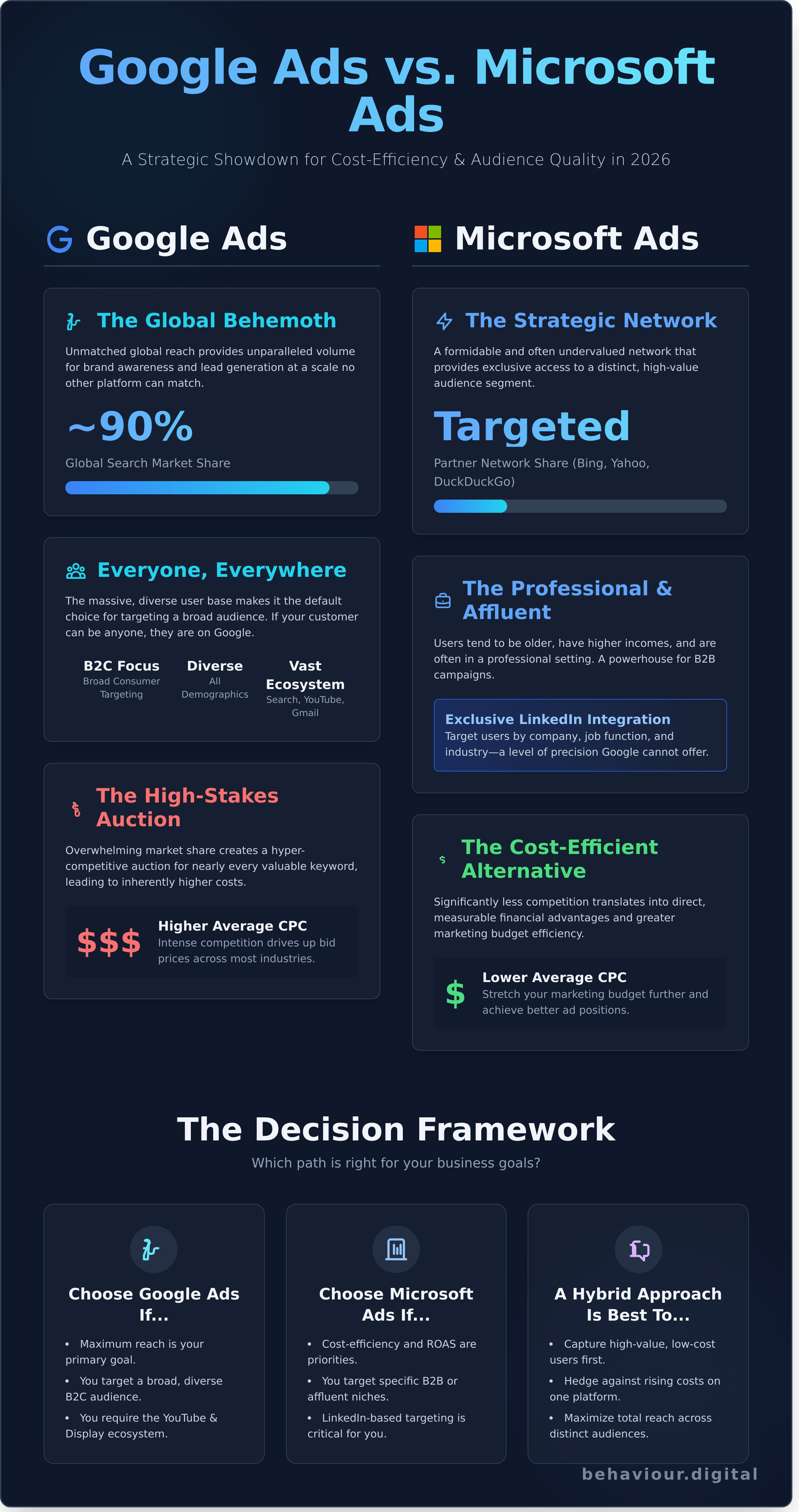
Google Ads is the undisputed market leader, commanding approximately 90% of the global search engine market. This dominance provides access to an unparalleled volume of daily searches, user data, and intent signals. The Google Ads online advertising platform extends far beyond its search engine, encompassing a vast ecosystem that includes YouTube, Gmail, and the Google Display Network, which reaches over 90% of internet users worldwide. This scale offers immense potential for brand awareness and lead generation at a volume no other platform can match.
Microsoft Ads, while smaller, is a formidable challenger with a strategic and often undervalued network. It powers search results not only for Bing but also for partners like Yahoo, AOL, and the privacy-focused DuckDuckGo. This network provides exclusive access to a distinct audience segment that may not be active on Google. Furthermore, Microsoft's strategic partnerships, such as powering the ad-supported tier for Netflix, open up unique inventory. For many advertisers, this translates to reaching an older, more affluent, and B2B-oriented demographic with potentially less competition and lower costs.
While both platforms operate on a similar PPC model, the strategic decision between them hinges on two fundamental business metrics: who you can reach and what it costs to reach them. When evaluating google ads vs microsoft ads, moving beyond surface-level reach statistics to analyze audience composition and cost-efficiency is where true competitive advantage is found. These factors directly impact your Return on Ad Spend (ROAS) and the overall viability of your campaigns.
Google’s audience is the internet. Its massive, diverse user base makes it the default choice for B2C companies targeting a broad demographic. If your customer can be anyone, they are on Google.
Microsoft’s audience, however, is more distinct. Users of the Microsoft Search Network (which includes Bing, Yahoo, and DuckDuckGo) tend to be older, have higher household incomes, and are more likely to be in a professional setting. The platform’s most powerful feature is its exclusive integration with LinkedIn, allowing for unparalleled precision in B2B campaigns. You can target users based on their company, job function, and industry-a level of professional demographic targeting that Google simply cannot offer.
The most compelling financial argument for Microsoft Ads is its lower cost structure. Because Google’s overwhelming share of the digital ad spending market size creates a hyper-competitive auction for nearly every valuable keyword, costs are inherently higher. Microsoft Ads operates with significantly less competition.
This translates into direct, measurable advantages:
Targeting is where the strategic differences become most apparent. Microsoft provides superior control over device targeting, allowing advertisers to isolate or exclude tablet traffic from desktop campaigns-a critical feature for B2B companies where device usage patterns are distinct. While Google’s location targeting is marginally more extensive due to its data scale, Microsoft’s audience targeting holds a powerful, exclusive asset: LinkedIn data. The ability to layer professional demographic information onto search campaigns is a game-changer for businesses targeting specific industries or job roles.
For standard text and shopping ads, the platforms are nearly identical in functionality. Both offer a full suite of ad extensions and robust product feed management. The real divergence appears in specialized formats. While Google's Performance Max and YouTube ads leverage its massive network for automated, multi-channel campaigns, Microsoft Ads offers unique value through its integration with the world's largest professional network. This allows for hyper-specific targeting that Google cannot match. For those wanting to explore every detail, a more in-depth comparison of Google Ads and Microsoft Ads provides further data on feature parity and subtle differences. Ultimately, these unique formats directly influence which platform will deliver more efficient results for your audience.
The debate over google ads vs microsoft ads isn't about picking a winner; it's about making a strategic, data-driven decision based on your specific business objectives. The right choice depends entirely on your budget, target audience, and growth goals. For many, the question isn't which one to choose, but how to leverage each platform’s unique strengths for maximum business impact.
To the common objection, 'Is Microsoft Ads even worth the effort?'-the answer is a definitive yes. While it requires management, it offers access to a valuable, often untapped audience with less competition. The real question is where to allocate your resources first.
The most sophisticated approach to the google ads vs microsoft ads question is to use both. This isn't about doubling the work; it's about creating a synergistic system for growth. Use Google for high-volume traffic and broad-reach campaigns, then leverage Microsoft Ads to capture high-intent, lower-cost conversions from its unique audience. The best part? You can easily import your successful Google Ads campaigns directly into Microsoft to test the waters with minimal effort.
This dual-platform strategy delivers a more resilient and profitable paid media portfolio. Need a strategy tailored to your business? Talk to our PPC experts.
The strategic question of google ads vs microsoft ads is not just about choosing a platform, but about execution. For businesses aiming for maximum market penetration, using both is the optimal path. However, this introduces a significant operational challenge: managing a multi-platform strategy effectively.
Success demands more than simply importing campaigns. It requires dedicated time for optimisation, a deep understanding of each platform's nuances, and a robust system for tracking and reporting. Without a cohesive approach, you risk diluted efforts and a fragmented view of your performance.
These challenges are universal, and for businesses looking to scale, particularly in competitive regions like Asia-Pacific, partnering with a performance marketing agency can be the key to overcoming them. If this resonates with your growth plans, you can find out more about how specialists tackle these issues.
Ultimately, the debate over google ads vs microsoft ads is secondary to the quality of execution. A strategic partner provides the expertise and unified oversight necessary to turn multi-platform complexity into a powerful engine for scalable growth. At Behaviour Digital, we build these engines.
The debate over google ads vs microsoft ads rarely concludes with a single winner. The data is clear: Google offers unparalleled reach, while Microsoft provides access to a distinct, often more cost-effective demographic. The most sophisticated strategy transcends this binary choice. For sustained growth, the critical question isn't which platform to use, but how to leverage both in a cohesive, data-driven ecosystem that maximises your return on every pound spent.
Unlocking that potential requires specialist expertise. As a Glasgow-based agency serving the UK, Behaviour Digital engineers performance-focused strategies across both platforms. We move beyond vanity metrics to deliver what truly matters: measurable business growth. The first step is to understand your unique landscape. Get a free PPC audit to discover your cross-platform opportunity.
Your next stage of growth isn't waiting on a single platform. It's in the intelligent integration of both. Let's build it together.
Yes, data consistently shows that Microsoft Ads offers a lower average Cost-Per-Click (CPC) across most industries. This is a direct result of lower competition on the platform. However, cost is only one metric. The critical factor is Return on Ad Spend (ROAS). A lower CPC provides a significant advantage, but the ultimate value is determined by conversion rates and the quality of the traffic, which must be measured independently for each platform.
Yes, Microsoft Ads provides a direct import tool to seamlessly transfer your existing Google Ads campaigns. This feature is an excellent starting point for accelerating your setup process. However, for optimal performance, these imported campaigns require platform-specific adjustments. Simply mirroring your strategy ignores the unique audience demographics and user behaviours on the Microsoft Search Network. We recommend a full audit and optimization post-import to maximise results.
Projecting precise market share figures for 2026 is speculative. However, current data shows the Microsoft Search Network (which includes Bing, Yahoo, and DuckDuckGo) holds a significant and growing portion of the UK desktop search market. The strategic focus should not be on future predictions but on the tangible, high-value audience that is currently accessible on the platform. This represents a clear opportunity for incremental growth right now.
Microsoft Ads often holds a distinct advantage for B2B advertisers. Its user base typically skews older, more affluent, and has a higher concentration of desktop users-a key demographic in professional environments. Furthermore, its integration with LinkedIn allows for powerful targeting based on company, job function, and industry. While Google’s volume is essential, Microsoft provides a more targeted environment for reaching key business decision-makers efficiently.
Absolutely. Treating Google Ads and Microsoft Ads as separate investment channels with dedicated budgets is critical for performance measurement. This allows for precise tracking of costs, conversions, and ROAS for each platform independently. A combined budget obscures vital data, making it impossible to make informed, data-driven decisions about where to allocate your ad spend for maximum impact. Clear budget separation is fundamental to strategic growth.
Managing both platforms introduces complexity, but the operational overhead is manageable with a structured process. The core principles of PPC management are identical, and tools like the Google Ads import feature reduce initial setup time. The primary challenge lies not in duplicate work, but in platform-specific optimization. An efficient, data-centric workflow ensures that managing a multi-platform strategy translates into higher returns, not just more work.
There is no single answer; the superior platform for ROAS depends entirely on your business, industry, and audience. Microsoft Ads frequently delivers a higher ROAS percentage due to lower CPCs, but Google’s immense volume can generate greater overall profit. The definitive answer for your business is found through rigorous, data-driven testing. A direct performance comparison of Google Ads vs Microsoft Ads is the only way to identify which channel drives the most profitable growth.
.png)
.png)
We help clients all over the globe grow their digital advertising campaigns. Ready to see what we can do for you? Get started with your free growth plan.
GET STARTED