Google Ads Trends for 2026: What Will Actually Drive Performance

Google Ads in 2026: Less Control, More Leverage

If 2024–2025 was the transition period, 2026 is the point of no return for Google Ads.

Automation is no longer optional.
Manual optimisation is no longer a competitive advantage.
And advertisers clinging to “the old way” will quietly bleed performance while wondering why CPAs keep rising.

The good news?
For brands and agencies willing to adapt, 2026 offers more leverage than ever before.

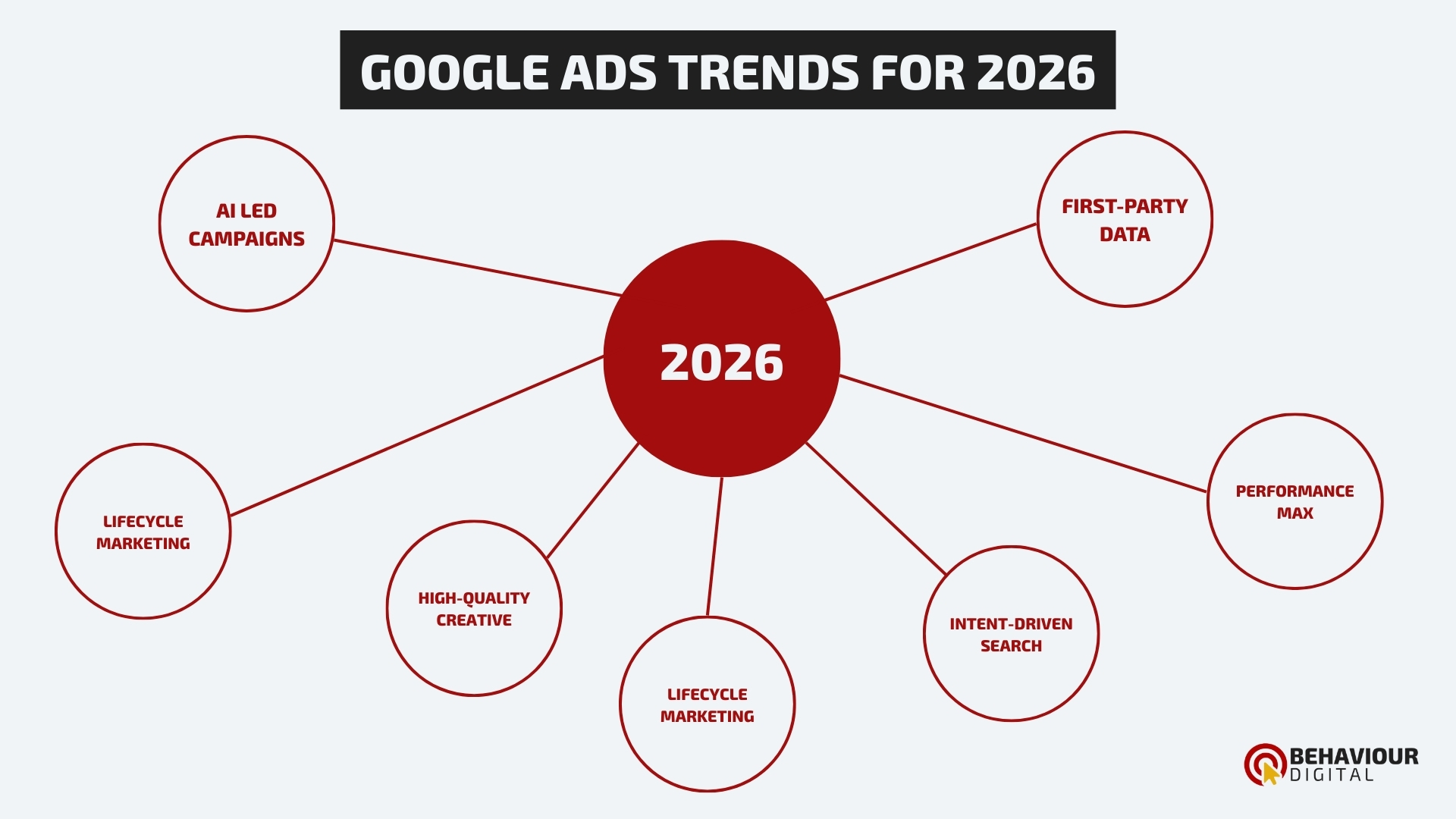
Here are the Google Ads trends that will actually matter in 2026 - and what to do about them.

1. AI-Led Campaigns Become the Default (Not the Experiment)

By 2026, Google Ads is no longer a platform you “manage” - it’s one you train.

AI now controls:

  • Bidding decisions
  • Query matching
  • Creative combinations
  • Budget distribution across channels

Campaign types like Performance Max, Demand Gen, and Broad Match Search are no longer “nice to test”. They’re the backbone of most high-performing accounts.

What this means in practice

  • Manual CPC and hyper-segmented structures lose relevance
  • Signal quality becomes more important than account complexity
  • Strategy shifts from optimisation inside the platform to inputs into the platform

2. First-Party Data Becomes the Most Valuable Asset in Google Ads

With third-party cookies gone and tracking more fragmented, first-party data is now Google Ads fuel.

In 2026, strong accounts consistently use:

Accounts without this data don’t “fail” - they just underperform quietly and consistently.

The real shift

Google Ads optimisation is moving away from:

“What keyword did they click?”

And towards:

“What type of user is this, and how valuable are they long-term?”

3. Performance Max Is No Longer Optional (But Still Not a Silver Bullet)

By 2026, Performance Max is unavoidable - but still misunderstood.

What’s changed:

  • PMax now drives a significant share of incremental revenue
  • Asset-level insights are improving (slowly)
  • Signal quality (conversion actions, values, audience data) matters more than structure

What hasn’t changed:

  • Poor inputs = poor outcomes
  • Weak creative caps performance
  • PMax won’t fix broken funnels

Winning approach in 2026

  • Use PMax for scale
  • Use Search + Demand Gen for control and learning
  • Feed PMax with high-quality conversion signals, not volume-only goals

4. Search Is Becoming Less Keyword-Driven (and More Intent-Driven)

Exact match isn’t exact.
Phrase match isn’t precise.
And broad match - paired with smart bidding - is often the top performer.

In 2026, Google Ads Search is about intent modelling, not keyword matching.

This is driven by:

  • AI-powered query interpretation
  • Generative search results
  • Fewer clicks, but higher-intent ones

What advertisers must adapt to

  • Fewer, broader keyword themes
  • Stronger ad copy aligned to user problems
  • Landing pages that convert without relying on exact query alignment

5. Creative Is the Biggest Performance Lever (Even in Search)

Creative used to mean “display and video”.

In 2026, creative quality impacts everything:

  • Search CTR
  • PMax coverage
  • Demand Gen performance
  • YouTube conversion rates

Responsive Search Ads, video assets, image assets, headlines, descriptions - they all feed the same AI system.

What high-performing accounts do differently

  • Test messaging constantly
  • Rotate angles, not just formats
  • Write ads for humans, not keyword insertion

6. Measurement Shifts from Precision to Modelling

Perfect attribution is gone - and it’s not coming back.

In 2026, Google Ads measurement relies on:

Winning advertisers accept this reality and focus on:

  • Trends over time
  • Blended CPA / ROAS
  • Incrementality, not platform-reported perfection

The mindset shift

If you’re still chasing 100% attribution accuracy, you’re optimising the wrong problem.

7. Lifecycle Marketing Outperforms Pure Acquisition

Google Ads is no longer just a top-of-funnel engine.

In 2026, the strongest accounts:

  • Optimise for customer lifetime value
  • Segment new vs returning users
  • Use value-based bidding aggressively
  • Support retention and upsell, not just acquisition

This is especially critical as acquisition costs continue to rise.

What This Means for Advertisers in 2026

To win with Google Ads in 2026, you need to:

  • Embrace automation (but guide it properly)
  • Invest in first-party data and clean tracking
  • Focus on creative and messaging, not just keywords
  • Measure success holistically, not obsessively
  • Build strategies around lifetime value, not single conversions

The advertisers who struggle in 2026 won’t be the ones with small budgets.
They’ll be the ones still running 2019 strategies on a 2026 platform.
Facebook/Meta Ads Safe Zones for Reels and Stories

Final Thought

Google Ads in 2026 rewards clarity, signal quality, and strategic restraint.

Less micromanagement.
More intelligent inputs.
Better creative.
Smarter measurement.

If you get those right, the platform does the heavy lifting.

Luke McGregor, Behaviour Digital
Best in class support

Ready to Grow?

We help clients all over the globe grow their digital advertising campaigns. Ready to see what we can do for you? Get started with your free growth plan.

GET STARTED