

Your "best practices" are likely the most expensive bottleneck in your sales funnel. While most brands follow generic checklists, data shows that 70% of e-commerce sites fail to address the specific friction points that stop their unique customers from buying. This is why generic ecommerce conversion rate optimization services often fail; they ignore the psychological nuances of your specific audience. You've probably noticed your Customer Acquisition Costs (CAC) rising by more than 42% over the last year, making your current ad profitability feel unsustainable. It's frustrating to watch high-intent traffic vanish at the checkout without a clear explanation for why they left.
Successful scaling requires a systematic, behaviour-first approach rather than internal guesswork. We'll show you how to transform passive browsing into measurable revenue through deep-dive analytical insights and strategic testing. You'll learn how to build a clear roadmap of data-backed improvements that align your paid traffic with a high-performance landing page experience. This guide ensures every visitor has a clear path to purchase, turning your website into a predictable engine for growth.
• Stop wasting marketing budget on a "leaky bucket" and learn why driving traffic to a non-optimised site is a fundamental strategic failure.
• Decode the "Why" behind user actions by combining qualitative insights with quantitative data to create a complete picture of customer behaviour.
• Identify the critical differences between one-time audits and long-term growth programmes when selecting professional ecommerce conversion rate optimization services.
• Discover the essential questions to ask potential partners to ensure they focus on measurable business impact rather than superficial tactical tweaks.
• Master a proven 7-step framework designed to bridge the gap between initial ad clicks and scalable, predictable revenue growth.
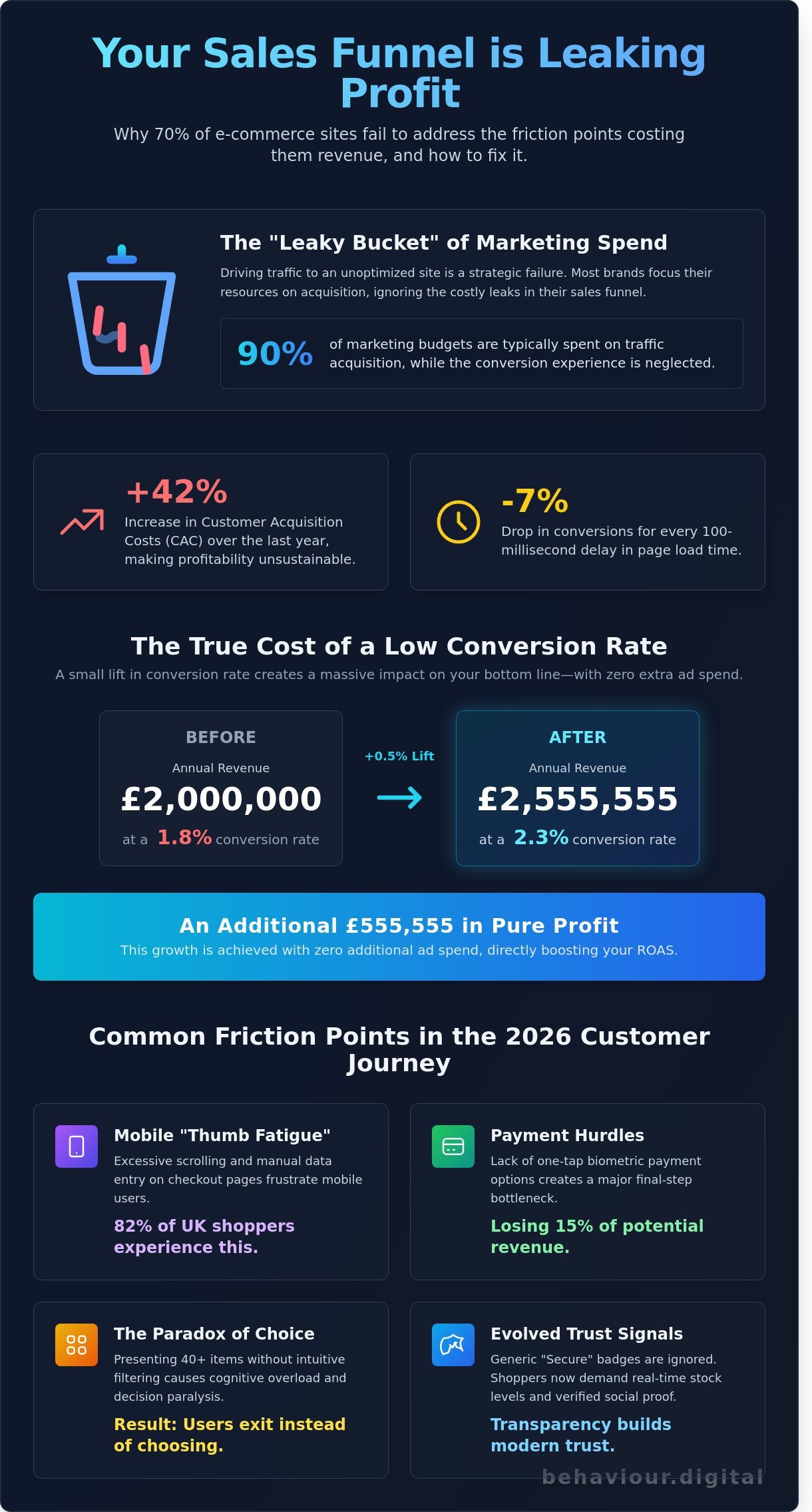
Driving traffic to a website that doesn't convert is like pouring water into a leaky bucket. You can increase the flow, but the waste remains constant. Most brands focus 90% of their budget on acquisition, yet they ignore the structural holes in their sales funnel. This approach is no longer sustainable. In 2026, the digital marketplace is too competitive for guesswork. If your site's architecture doesn't guide users toward a purchase, your marketing spend is essentially a donation to Google and Meta.
Modern ecommerce conversion rate optimization services have moved past simple A/B testing. We've entered an era where strategic growth is driven by behavioral science and deep data integration. Conversion rate optimization is now a fundamental business process that aligns user intent with technical performance. Effective ecommerce conversion rate optimization services prioritize these behavioral insights over vanity metrics. It's about understanding why a customer hesitates at the 14-second mark on a product page and removing that friction immediately.
The UK market in 2026 presents unique challenges. Consumer trust is at an all-time low, and expectations for speed are at an all-time high. A 100-millisecond delay in page load now correlates to a 7% drop in conversions. With Customer Acquisition Costs (CAC) rising by 22% since early 2025, survival depends on your ability to convert the traffic you already have. CRO isn't a luxury anymore; it's the only way to protect your profit margins from being swallowed by rising ad bids.
Small numbers hide massive financial impacts. Consider an e-commerce brand generating £2,000,000 in annual revenue with a 1.8% conversion rate. Lifting that rate by just 0.5% to 2.3% results in an additional £555,555 in yearly revenue. This growth requires zero additional ad spend. It's pure bottom-line profit that scales your business instantly. This compound effect also transforms your paid media performance. When your site converts better, your Return on Ad Spend (ROAS) increases, allowing you to outbid competitors for the highest-quality traffic. Don't rely on industry averages. A 2% conversion rate might be "average," but if your margins are thin or your product is high-ticket, that average is a slow death for your brand.
Mobile-first design is often discussed but rarely executed correctly. Data from Q1 2026 shows that 82% of UK shoppers experience "thumb fatigue" on checkout pages that require excessive scrolling or manual data entry. If your checkout doesn't support one-tap biometric payments, you're losing 15% of your potential revenue at the final hurdle. The Paradox of Choice is another silent killer. When product listing pages present 40 or more items without intuitive filtering, the human brain experiences cognitive overload. This leads to decision paralysis where the user exits the site rather than choosing. Finally, trust signals have evolved. A generic "Secure Checkout" badge is ignored. Today's shoppers demand transparency regarding delivery dates, real-time stock levels, and verified third-party social proof integrated directly into the buy-box area.
Data provides the skeleton of your sales funnel, but human intent provides the muscle. At Behaviour Digital, we don't just track metrics; we decode the motivations behind every click. Most brands focus on the "what"-the 69.9% average cart abandonment rate reported by the Baymard Institute in 2024. We focus on the "why". Understanding why a user hesitates at the shipping selection or exits on the payment page is the only way to build a sustainable growth engine. This shift from reactive tracking to proactive analysis is why experts consider high-level underused e-commerce strategy frameworks as the primary lever for scaling revenue without increasing ad spend.
Our methodology relies on the synergy between quantitative and qualitative data. Quantitative data tells us where the leak is; qualitative data tells us how to plug it. We utilize heatmaps to see where attention lingers and session recordings to witness the exact moment a user becomes frustrated. Eye-tracking studies show that users often ignore sidebar promotions, focusing instead on trust signals and price clarity. When we deploy ecommerce conversion rate optimization services, we use these insights to trigger psychological responses ethically. Urgency and scarcity, such as "only 4 items left in stock," only work when they're authentic. Social proof, like real-time purchase notifications, must feel like a recommendation, not a sales tactic.
We analyze click patterns to find "dead-ends" where users expect a link but find static text. In a recent 2024 audit, we found that 22% of mobile users tried to click unlinked product images, leading to immediate exit. We also track scroll-depth. If your primary value proposition is buried 70% down the page, 55% of your audience will never see it. Identifying "rage clicks"-where a user clicks the same element three or more times in rapid succession-allows us to fix technical bugs that kill conversions instantly. Our team at Behaviour Digital treats every rage click as a direct request for a better user experience.
Reducing cognitive load is the priority for the UK market. Research indicates that UK shoppers prefer a checkout process with no more than 3 to 5 clear steps. Every additional form field increases the "interaction tax," leading to fatigue. Delivery transparency is equally critical. A 2023 study showed that 48% of shoppers abandon carts because extra costs like shipping and taxes were too high or calculated too late in the process. We advocate for showing total costs as early as the product page to maintain trust. Behavioural CRO is the intersection of data science and consumer psychology.
Google Analytics 4 (GA4) event tracking and conversion funnels.
Post-purchase surveys and 1-on-1 user testing sessions.
Core Web Vitals audit to ensure speed doesn't disrupt the psychological flow.
Cognitive load reduction through simplified UI and clear information hierarchy.
Success in e-commerce isn't about luck; it's the result of a conscious strategy and continuous optimization. By aligning your site's architecture with natural human behavior, you create a frictionless path to purchase that feels intuitive to the buyer and profitable for the business.
The average e-commerce site loses 70.19% of its potential revenue to cart abandonment. This isn't a minor leak. It's a systemic failure. Deciding how to address this requires a choice between a diagnostic intervention and a continuous growth engine. Your selection of ecommerce conversion rate optimization services must align with your current technical debt and your aggressive growth targets for the next 12 months. Success isn't found in a single change. It's found in the precision of the strategy you deploy.
An audit is a forensic investigation into your store's performance. It isn't a surface-level scan. We conduct a technical review to find bugs in the checkout flow, a heuristic analysis to spot psychological friction, and a data deep-dive using GA4 and heatmaps. This process uncovers why users leave after adding items to their cart. Implementing a structured audit allows you to optimize your website for higher conversions by identifying high-friction points before they cost you another quarter of stagnant sales.
The deliverable is a prioritized roadmap. We categorize findings into two groups:
Immediate fixes like resolving a broken "Apply Coupon" button or clarifying shipping costs.
Larger experiments, such as redesigning the entire product page layout or implementing a one-click checkout.
This approach is ideal for brands needing a fresh perspective or a pre-peak season health check. If you haven't performed a deep-dive in the last 18 months, your site is likely operating on outdated assumptions.
Static sites die. Consumer behavior changes weekly, and your site must evolve or become obsolete. Ongoing ecommerce conversion rate optimization services focus on the "Test, Learn, Scale" cycle. We don't guess. Guessing is the most expensive way to run a business. Instead, we use A/B testing to validate every hypothesis. If a change doesn't produce a statistically significant lift, we don't deploy it. This keeps your user experience lean and effective.
Continuous refinement is critical for PPC and Social Media traffic. If you're spending $10,000 a month on ads but your landing pages convert at less than 3%, you're burning capital. A monthly CRO model ensures your pages adapt to changing market trends and seasonal shifts. It transforms your website from a static brochure into a dynamic sales machine that learns from every visitor interaction.
CRO doesn't happen in a vacuum. It requires tight integration with your existing developers and marketing leads. We act as the bridge between data and execution. We provide the data-backed "why" so your developers can focus on the "how" without wasting time on low-impact tasks. This synergy reduces friction and speeds up the implementation of winning tests. When your marketing team and CRO partners work as a single unit, the result is a scalable growth engine that consistently lowers customer acquisition costs.
Choose a project-based audit if you need a roadmap. Choose monthly management if you're ready to dominate your niche through data-driven evolution. Both paths lead to growth, but only one ensures you stay ahead of the competition indefinitely.
Selecting a partner for your business growth shouldn't feel like a gamble. In 2026, the gap between superficial "button-changers" and data-science-led experts has widened significantly. When you evaluate ecommerce conversion rate optimization services, you must look beyond aesthetic adjustments. A professional agency doesn't guess; they build hypotheses based on heatmaps, session recordings, and rigorous quantitative analysis. They focus on the 15% of users who drop off at the final payment stage, rather than just changing a hero image and hoping for the best.
Transparency serves as your primary safeguard against ineffective spending. A credible agency provides total access to their testing dashboards and raw data streams in GA4 or BigQuery. If a provider hides their methodology behind "proprietary algorithms," they're likely masking a lack of statistical rigour. You need to see the logic behind every test. This includes how they handle the 30% of experiments that inevitably fail. Real experts use losing tests to refine their understanding of your customer's psychology, turning a "failed" experiment into a roadmap for the next 12% revenue lift.
Evaluating case studies requires a sharp eye for business impact over vanity metrics. Don't be impressed by a "50% increase in clicks" on a promotional banner. Instead, look for documented growth in Revenue Per Visitor (RPV) and Average Order Value (AOV). For example, a successful project for a UK retailer in June 2025 resulted in a 18.4% increase in checkout completions by optimizing the mobile-first payment interface. This is the level of specificity you should demand. Local market knowledge is equally vital. Glasgow-based e-commerce brands need partners who understand the UK's 82% mobile commerce penetration and the specific delivery expectations of British shoppers.
Be skeptical of any agency promising a specific 25% or 30% increase before they've audited your data. These guarantees are mathematically impossible to make upfront. Professional providers always mention statistical significance; they won't call a test "successful" unless it reaches a 95% confidence level. Avoid those who rely on "best practice" templates. Generic templates ignore the unique friction points of your specific audience, often leading to a plateau in performance after the initial low-hanging fruit is picked.
Your chosen agency must demonstrate technical mastery over your platform, whether it's Shopify Plus, Magento, or a headless setup. Proficiency in tools like VWO, Hotjar, or Optimizely is the baseline for 2026. The real value lies in their ability to integrate CRO data with your CRM and backend analytics. This ensures that a "win" in conversion doesn't lead to a spike in returns or a drop in customer lifetime value. They should also implement server-side tracking to combat the 40% data loss currently caused by modern privacy settings and ad-blockers.
Generating traffic is only half the battle. If your store suffers from high bounce rates or a 70% cart abandonment rate, increasing your ad spend just scales your inefficiency. Our Glasgow-based team bridges the gap between expensive ad clicks and actual revenue. We don't settle for "best practices" because every brand's data tells a different story. We provide ecommerce conversion rate optimization services that transform your existing traffic into a predictable revenue stream.
Our approach is rooted in the psychology of the user. We look past the "what" and focus on the "why" behind every exit. By integrating our CRO efforts with your PPC and Social Media management, we create a closed-loop system where every pound spent on advertising is supported by a high-converting landing environment. This synergy often results in a 25% to 40% increase in ROAS without increasing the initial acquisition budget. We focus on the bottom line, not vanity metrics.
Success in e-commerce isn't a product of luck; it's the result of a rigorous, repeatable system. Our 7-step process ensures that every change we make on your site is backed by evidence. We start by removing the guesswork and replacing it with a roadmap for scalable growth.
We audit your Google Analytics 4 setup and heatmaps to identify where users drop off. We establish KPIs based on your specific margins and average order value (AOV).
We form a hypothesis based on user friction points. We then run rigorous A/B tests using tools like VWO or FigPii. We look for a 95% statistical significance before declaring a winner.
We deploy the winning variations. We provide transparent reports that show the direct impact on your revenue. Then, we start the cycle again to find the next 1% gain.
This iterative loop ensures your site never stagnates. In a market where acquisition costs rose by 222% over the last eight years, your ability to convert traffic more efficiently than your competitors is your only sustainable advantage. Behaviour Digital acts as your strategic partner, taking full responsibility for the performance of your digital storefront.
The path to a more profitable store begins with clarity. We offer a comprehensive site audit that identifies the immediate "leaks" in your conversion funnel. This isn't a generic checklist. It's a deep dive into your specific user data, identifying the exact friction points that cost you sales every day. We've seen brands unlock 15% more revenue just by fixing checkout errors they didn't know existed.
We believe in transparency and accountability. Our project-based fees provide a clear, milestone-driven investment path, so you always know what you're paying for and what results to expect. There are no hidden costs or vague "management fees." We’re here to build a long-term partnership based on measurable financial growth. Contact our Glasgow team today to discuss your e-commerce growth strategy.
Traffic is only the first step. If your store's conversion rate hasn't improved since 2024, you're likely losing revenue to competitors who prioritize behavioral psychology. Our Glasgow-based agency doesn't rely on guesswork. We use 100% data-driven insights to decode exactly why your customers hesitate. Specialized ecommerce conversion rate optimization services from our team bridge the gap between expensive traffic and actual profit. We've proven that integrating CRO with PPC and Social Media creates a 24/7 sales machine that scales predictably. It's not about luck; it's about a systematic approach to user actions. Your 2026 growth strategy depends on how well you understand these digital footprints today. Don't settle for mediocre results when a refined strategy is within reach. We're ready to help you turn those insights into tangible business value. It's time to stop leaving money on the table and start building a resilient brand that converts every click with precision. Success is a choice you make through better data.
Book your bespoke E-commerce CRO audit with Behaviour Digital
A competitive conversion rate for e-commerce leaders in 2026 targets between 3.2% and 5.5% depending on the specific sector. While the global average often hovers around 2.1%, high-growth brands focus on exceeding the 4% threshold to ensure sustainable profitability. Your benchmark should reflect your industry; for example, luxury goods often see 1.2% while health and beauty brands frequently reach 4.8%. We prioritize data-driven strategies to push your metrics beyond these standard market medians.
You'll typically observe initial performance shifts within the first 30 to 45 days of launching your first set of experiments. Significant, statistically valid revenue growth usually materializes after 90 days of continuous testing and iteration. The timeline depends on your current monthly traffic and the speed of your development team. We focus on high-impact wins in the first month to secure early ROI while building a long-term roadmap for scalable growth.
Statistical significance in A/B testing generally requires at least 10,000 monthly sessions to reach a 95% confidence level within a reasonable timeframe. If your store has lower traffic, we pivot our strategy toward qualitative research, heuristic analysis, and user recordings to identify friction. You don't need millions of visitors to fix a broken checkout flow or confusing navigation. Small sites often see a 20% lift just by resolving technical bugs discovered during our initial audit.
UX design focuses on the overall usability and aesthetic satisfaction of the user journey, whereas CRO focuses specifically on driving measurable business outcomes. UX is the foundation that ensures a site is easy to navigate, but CRO uses rigorous data to ensure those interactions lead to a purchase. Our ecommerce conversion rate optimization services bridge this gap by testing how specific design choices influence your final transaction volume. It's the difference between a beautiful website and a high-performance sales engine.
Professional ecommerce conversion rate optimization services in the UK generally range from £2,500 to £10,000 per month based on the project scope. Some agencies operate on a performance-based model, taking a base fee plus 10% of the incremental revenue generated from successful tests. Costs vary depending on your tech stack complexity and the number of experiments run simultaneously. We provide transparent, fixed pricing structures that align our efforts with your actual business growth targets.
CRO directly lowers your Customer Acquisition Cost (CAC) by increasing the value of every click you buy. If your conversion rate increases from 2% to 3%, your cost per acquisition drops by 33% without changing your ad creative or bidding strategy. This efficiency allows you to scale your ad spend more aggressively than competitors who haven't optimized their landing pages. It transforms your paid media from a volatile expense into a predictable, scalable investment.
A losing A/B test is a valuable data point that prevents you from implementing a permanent change that would have decreased your revenue. Roughly 60% of hypotheses don't result in an immediate lift, which is why testing is a mandatory safeguard for your store. We analyze the user behavior within the losing variation to refine our next hypothesis. This process ensures that only proven, revenue-positive updates are ever fully deployed to your live production environment.
Hiring a specialist agency gives you immediate access to a dedicated team of data analysts, UX researchers, and conversion copywriters. Most internal teams don't have the £20,000 annual budget required for premium testing tools or the experience gained from running hundreds of previous experiments. We act as a strategic partner, taking full responsibility for the technical execution and the final results. This allows your team to focus on product development while we handle the complexities of scaling your revenue.
.png)
.png)
We help clients all over the globe grow their digital advertising campaigns. Ready to see what we can do for you? Get started with your free growth plan.
GET STARTED