

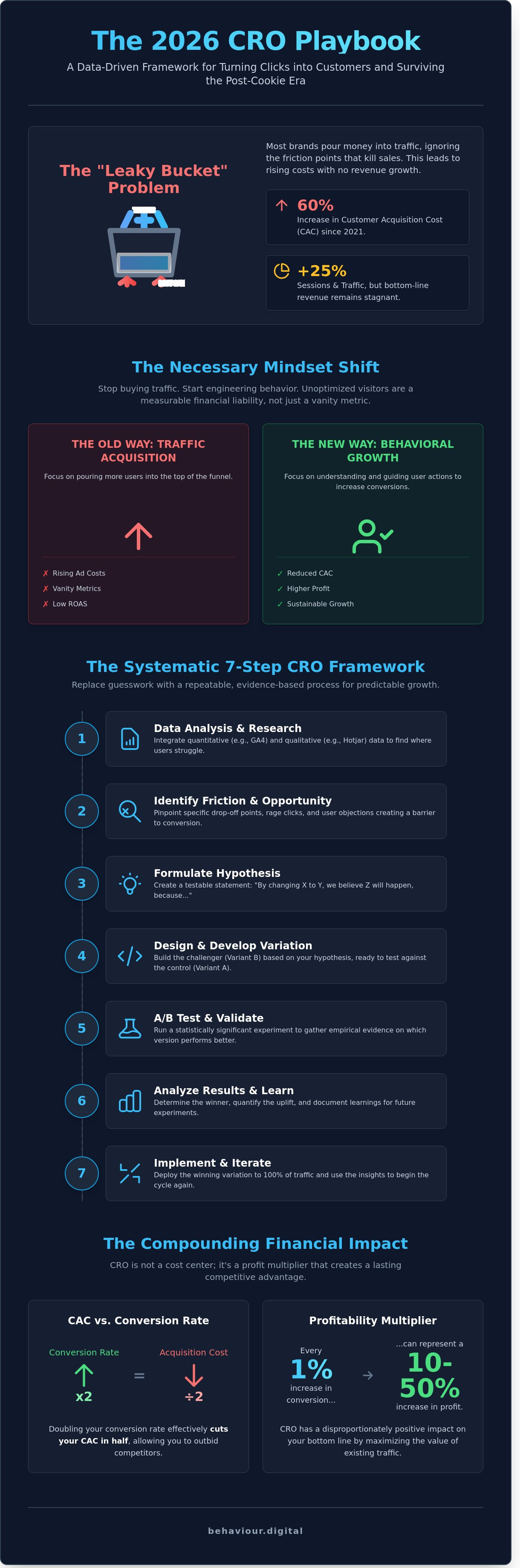
If your customer acquisition cost has climbed 60% since 2021, you aren't alone; you're just paying for a leaky bucket. Most brands focus on pouring more traffic into the top of the funnel while ignoring the friction points that kill sales. It's frustrating to see sessions climb by 25% on your analytics dashboard while your bottom-line revenue remains stagnant. You've likely felt the pressure of rising ad costs and the confusion of managing tools like Hotjar or Optimizely without seeing a clear return. This is where conversion rate optimization moves from a luxury to a survival requirement for 2026.
We agree that vanity metrics don't pay the bills. You need a strategy that translates clicks into cash flow. This guide promises to help you master the art and science of turning passive visitors into loyal customers with our data-driven, behavioral approach to growth. We'll break down a repeatable framework to help you secure a higher ROAS from existing campaigns and build brand authority. Expect a deep dive into the psychological triggers and analytical models that define the next era of digital performance.
• Shift your perspective from simple traffic acquisition to behavioral growth, treating unoptimized visitors as a measurable financial liability.
• Apply the Fogg Behavior Model to identify the exact triggers needed to align user motivation with seamless digital actions.
• Integrate quantitative tracking with qualitative insights to build a high-performance conversion rate optimization strategy rooted in evidence.
• Execute a systematic 7-step framework that replaces guesswork with validated hypotheses and predictable funnel improvements.
• Learn how a strategic growth partner can eliminate internal bias and double the efficiency of your existing PPC and social media spend.
The standard definition of Conversion rate optimization describes it as the systematic process of increasing the percentage of website visitors who take a specific, desired action. In 2026, this definition has shifted from simple A/B testing to a sophisticated behavioral science. It's the bridge between raw traffic and actual revenue. Without a rigorous conversion strategy, your marketing spend is merely a contribution to a "leaky bucket."
High traffic volume used to be the primary metric for success. That era is over. If your site attracts 50,000 visitors monthly but fails to convert them, that traffic becomes a financial liability. You're paying for server load, data processing, and ad clicks that yield zero return. Conversion rate optimization transforms these passive browsers into active participants. It forces your digital assets to work harder, ensuring that every pound spent on acquisition delivers a measurable result.
Modern CRO focuses heavily on the distinction between macro and micro-conversions. While a completed sale is the ultimate macro-goal, micro-conversions provide the roadmap. These include actions like newsletter sign-ups, whitepaper downloads, or even specific scroll depths. By 2026, tracking these engagement signals is mandatory. They allow us to identify exactly where a user loses interest, long before they reach the final checkout stage. This granular data lets us fix friction points that a human analyst might overlook.
The financial impact of CRO is most visible in your Customer Acquisition Cost (CAC). When your conversion rate doubles, your CAC effectively drops by 50%. This creates a massive competitive advantage. You can afford to outbid competitors in ad auctions because your backend is more efficient at turning those clicks into cash. It's a compounding effect that stabilizes your bottom line against market volatility.
Glasgow and the wider UK digital markets have become hyper-competitive. Ad costs across major platforms rose by 14% in 2025 alone, making organic and paid reach more expensive than ever. Small and medium businesses can't simply spend their way to the top. They must optimize. When you partner with a PPC agency Glasgow, CRO acts as a force multiplier for your ad spend. It ensures that the premium traffic you're buying doesn't go to waste on a confusing landing page. Every 1% increase in conversion can represent a 10-50% increase in profit.
The technical landscape of conversion rate optimization changed forever with the total phase-out of third-party cookies. We now optimize for the "anonymous user." This requires a shift toward zero-party data, which is information users intentionally share with a brand. Modern strategies use interactive elements and value-exchanges to gather this data legally and transparently.
AI agents now play a dominant role in predicting user friction. These tools analyze millions of session recordings in seconds, identifying patterns of "rage-clicking" or navigation loops that suggest a broken user experience. Instead of waiting weeks for enough data to run a traditional test, AI allows for predictive modeling. We can now simulate how a layout change will affect conversion before a single real user sees it. This speed is essential for maintaining growth in a fast-moving market.
Using AI to forecast user behavior based on real-time interaction.
Building trust to gain direct insights from your audience.
Eliminating the 3-5 small hurdles that stop a checkout.
Effective conversion rate optimization isn't a guessing game. It's a rigorous application of behavioral science. People don't click buttons because they're colorful; they click because the interface aligns with their psychological state. To drive growth, we must decode why users hesitate and what triggers them to act. Every element on a page either adds to the user's motivation or increases their cognitive load. Success depends on how well you manage these mental forces.
The Fogg Behavior Model provides a clear framework for this analysis. It suggests that behavior happens when Motivation, Ability, and a Prompt converge at the same moment. If a user's motivation is low, the task must be incredibly easy. If the task is hard, motivation must be peak. We use this data-driven approach to ensure your site delivers the right prompt at the exact moment a user is ready. This expert guide to CRO highlights how balancing these three factors serves as the foundation of any scalable digital strategy.
Cognitive biases also play a critical role in how people interact with your brand. Humans use mental shortcuts to make decisions quickly. Social proof, like displaying "Joined by 12,450+ professionals," reduces the perceived risk of a new purchase. Scarcity, such as "Only 4 spots remaining for the March intake," triggers the fear of missing out. Anchoring sets a price expectation, making subsequent offers feel like a significant gain. We apply these triggers ethically to guide the user toward the solution they need without creating unnecessary friction.
Intent dictates behavior. A user "browsing" is looking for education, while a user "buying" is looking for validation and a fast checkout. Your value proposition must pivot based on this intent. Generic messaging fails to convert because it lacks relevance. In a 2024 project, we modified a client's headline from "Professional Accounting Software" to "Save 12 Hours of Bookkeeping Every Month." This shift addressed a specific pain point and resulted in a 25% increase in trial sign-ups. Success comes from speaking to the user's current reality, not just listing your product's features.
Friction is the silent killer of your bottom line. It's anything that makes the user think too hard or wait too long. By 2026, mobile devices will handle over 72% of UK e-commerce transactions. "Good enough" mobile design is now a liability that costs revenue. If your site takes longer than 3 seconds to load, data shows that 40% of your audience will bounce. This delay causes immediate psychological frustration, destroying the trust you've worked to build.
Reducing cognitive load means making the path to purchase the path of least resistance. We strip away unnecessary form fields, clarify navigation, and ensure the next step is always obvious. Our team at Behaviour Digital focuses on these micro-interactions because they aggregate into massive macro-results. Speed and simplicity aren't just technical goals; they're the primary drivers of user satisfaction and measurable revenue growth.
Effective growth isn't a guessing game. It's a clinical process of identifying friction and removing it. To master this, you must distinguish between the 'What' and the 'Why.' Quantitative data tells you what is happening. It shows that 4.2% of users drop off at the checkout page or that your mobile bounce rate is 15% higher than desktop. However, numbers don't explain human motivation. This is where What is Conversion Rate Optimization? becomes a question of psychology as much as mathematics. You need qualitative insights to understand why those users are leaving. Without both, you're merely rearranging deck chairs on a sinking ship.
Precision in measurement is the baseline for any scalable strategy. We rely on GA4 and server-side tracking to ensure data integrity, especially in a cookieless environment. For businesses investing in social media marketing management Scotland, proper conversion tracking is vital to attribute ROI correctly across fragmented touchpoints. If your tracking pixels are misfiring by even 5%, your entire optimization roadmap is built on a lie.
Tools like Hotjar or Microsoft Clarity reveal that 80% of users rarely scroll past the first 1,200 pixels. Identifying these 'dead zones' allows you to move critical CTAs into high-engagement areas.
Instead of looking at site-wide averages, we analyze specific groups. For example, users acquired in March 2023 might show a 22% higher lifetime value than those from June, signaling a shift in lead quality.
This bypasses browser-based ad blockers, often recovering up to 15% of "lost" data that client-side scripts miss.
It provides the emotional context that numbers alone cannot capture. While a spreadsheet shows a high exit rate on a sign-up form, qualitative research reveals that users find your "Terms and Conditions" checkbox intimidating or confusing. We use remote user testing to observe real people interacting with your interface. Watching a user struggle to find the 'Search' bar for 45 seconds is more instructive than a thousand rows of bounce rate data.
Running sessions with just 5 participants can uncover 85% of core usability issues. It's a high-impact, low-cost method to find 'hidden' navigation bottlenecks.
These are a goldmine. Asking "What almost stopped you from buying today?" right after a transaction yields raw, unfiltered objections that you can address in your next conversion rate optimization sprint.
We look for "rage clicks" where users click a non-functional element 3 or 4 times in rapid succession, indicating a clear UX failure.
The biggest threat to your growth isn't the competition; it's the HIPPO (Highest Paid Person's Opinion). Opinion-based marketing is expensive and usually wrong. In 74% of cases, initial intuitions about what will "look better" fail to produce a statistically significant lift in an A/B test. We kill the HIPPO by letting the data speak. If the CEO likes the red button but the data shows the green button generates 12% more revenue, the green button stays. This conversion rate optimization approach ensures that every change to your site is an investment, not a gamble. Decisions are made in the lab, not the boardroom.
Conversion rate optimization isn't a collection of "best practices" or random guesses. It's a rigorous, engineering-led process designed to eliminate friction and maximize revenue. Success in this field requires a transition from subjective opinions to data-backed certainty. At Behaviour Digital, we utilize a 7-step framework that ensures every experiment contributes to a measurable business outcome.
- We begin by identifying where your funnel is leaking. If your Google Analytics 4 data shows a 70% drop-off on the shipping selection page, that's where we focus. We combine quantitative data with qualitative insights from heatmaps and session recordings to understand user frustration.
- Every test must start with a logical "If/Then" statement. For example: "If we add a trust badge near the 'Buy Now' button, then conversion rates will increase by 5% because it reduces perceived security risk."
- Not all ideas are equal. We use the PIE framework (Potential, Importance, Ease) to rank experiments. We ask how much improvement can be made, how valuable the traffic is on that page, and how technically difficult the change will be.
- Our team creates the visual and functional variants for the test. This step ensures that the test version is high-fidelity and doesn't break the user experience across different devices or browsers.
- We deploy the experiment using A/B, split, or multivariate testing. Most tests run for at least 14 days to account for weekly traffic fluctuations and to reach statistical significance.
- We don't just look at who won. We dive into the data to see how different segments reacted. Even a "losing" test is a victory if it provides a deep insight into your audience's psychology.
- Winners are deployed to 100% of your traffic immediately. Then, we use those results to fuel the next round of hypotheses, creating a continuous loop of growth.
Most businesses fail because they test low-impact elements like footer links or "About Us" copy. Data shows that 60% of optimization gains come from focusing on high-intent pages. You should prioritize your Checkout, Pricing, and Bottom-of-Funnel landing pages first. We balance 20% "quick wins," such as fixing broken forms, with 80% strategic experiments that can shift your entire growth trajectory. It's about moving the needle where it matters most for your bottom line.
Standard A/B testing requires a specific volume to be valid. If your site has fewer than 1,000 conversions per month, reaching a 95% confidence level could take half a year. In these cases, we pivot to sequential testing or radical redesigns rather than micro-tweaks. For a deeper dive into how we handle these technical challenges, see Our 7-Step Conversion Rate Optimization Process. Using multivariate testing is reserved for high-traffic environments where we need to understand how multiple variables interact simultaneously. For smaller players, bold, singular changes often yield faster, more reliable data.
Stop guessing and start growing. Partner with Behaviour Digital to build your data-driven conversion rate optimization engine.
Internal marketing teams often fall into the "DIY Trap." While these teams possess deep product knowledge, they frequently suffer from expert blindness. They're too close to the interface to see the friction points that frustrate a first-time visitor. Data from a 2023 industry analysis shows that 76% of internal optimization attempts fail to reach statistical significance because of confirmation bias. An external partner provides the objective distance needed to challenge assumptions and identify the "invisible" barriers to entry.
Strategic conversion rate optimization doesn't exist in a vacuum. It acts as a force multiplier for your existing traffic acquisition. When you optimize the landing page experience, your PPC and Social Media spend work twice as hard. If your current Cost Per Acquisition (CPA) is £45, a 22% increase in conversion efficiency drops that CPA to £35.10 immediately. This creates a surplus budget you can reinvest into further scaling, allowing you to outbid competitors who are still struggling with inefficient funnels.
Inaction is an expensive choice that compounds over time. If your site generates £60,000 monthly with a 2.1% conversion rate, a modest 0.4% improvement represents an additional £137,000 in annual revenue. Every day you delay testing, you're essentially handing that market share to competitors who prioritize data over guesswork. We've seen businesses lose upwards of £10,000 a week simply because they refused to fix a broken mobile checkout flow or a confusing navigation menu.
Behaviour Digital integrates behavioral psychology with hard data to stop this revenue leak. We don't just look at where users click; we analyze why they hesitate. By applying principles like cognitive load reduction and the Fogg Behavior Model, we identify the exact moment a user loses trust. We then apply rigorous A/B testing to validate solutions before they ever touch your live production environment. This ensures every change is a step toward measurable growth, not just a cosmetic update.
Treating conversion rate optimization as a one-time project is a fundamental mistake. Consumer behavior shifts rapidly. What worked in January 2023 won't necessarily convert in 2024. A monthly commitment to experimentation builds a culture of growth within your business. This iterative process has been shown to increase Customer Lifetime Value (CLV) by up to 28% over a 12-month period by refining every touchpoint of the buyer journey, from the first click to the final upsell.
Our process begins with a professional CRO audit. We examine heatmaps, session recordings, and funnel analytics from the last 90 days to find the leaks in your revenue. We bridge the gap between Glasgow business values, like integrity and directness, and global digital standards. This ensures your brand remains competitive on a world stage while staying true to its roots. Book your project-based CRO consultation with Behaviour Digital today to stop leaving revenue on the table and start scaling with precision.
Winning in 2026 requires more than just standard A/B testing; it demands a deep understanding of why users click. Success hinges on a 7-step framework that bridges the gap between raw numbers and human psychology. Data from Q1 2025 shows that companies prioritizing behavioral insights see a 32% higher uplift in customer lifetime value compared to those relying on intuition. Your strategy must balance quantitative metrics with qualitative empathy to build a scalable engine for growth. It's about precision over guesswork.
Effective conversion rate optimization isn't a one-off project. It's a continuous cycle of evidence-based refinement that protects your margins. At Behaviour Digital, we function as your strategic partner to turn these complex insights into profit. Our Glasgow-based team combines global expertise with a relentless focus on ROAS. We're specialists in behavioral psychology and UX who ensure every design choice serves your bottom line. We don't just deliver reports; we deliver results that scale.
Drive more revenue with our data-led Conversion Rate Optimisation services
The path to market leadership is paved with data. Let's start building your measurable success today.
A good conversion rate for e-commerce in 2026 sits between 2.5% and 4.2% depending on your specific industry vertical. Data from IRP Commerce shows the global average remains near 1.9%, so hitting a 3.5% benchmark places you in the top 20% of global retailers. High-performing luxury brands often target 1.5%, while fast-moving consumer goods frequently achieve 5% through aggressive data-driven tactics.
You'll typically see measurable revenue impact within 90 days of implementing your first structured test cycle. Technical fixes and "low-hanging fruit" provide immediate gains in the first 30 days, but reaching statistical significance for complex A/B tests requires 4 to 12 weeks of consistent data collection. A 6-month commitment to conversion rate optimization usually results in a 15% to 25% sustained uplift in total conversions.
You don't need millions of visitors, but a baseline of 5,000 monthly unique sessions is necessary for statistically valid A/B testing. If your traffic is below this threshold, we focus on qualitative methods like heuristic evaluations and user testing with 5 to 10 participants. These methods identify 85% of usability issues without needing massive data sets, allowing for high-impact improvements even on low-traffic pages.
SEO focuses on increasing the volume and quality of traffic from search engines, while CRO focuses on what that traffic does once it arrives. SEO solves the problem of visibility by moving your site to the first page of Google results. In contrast, conversion rate optimization uses behavioral data to ensure those visitors complete a purchase or fill out a lead form instead of bouncing.
Professional CRO retainers in the UK range from £2,500 to £7,500 per month for mid-market businesses. One-off comprehensive audits usually start at £5,000 and include a full technical, heuristic, and data-driven roadmap. These prices reflect the cost of a dedicated team including a data analyst, UX designer, and front-end developer, all focused on delivering a 3x to 5x return on your investment.
CRO improves your Google Ads Quality Score by directly enhancing the landing page experience, which accounts for roughly 39% of your total score. When your page is optimized for conversions, bounce rates drop and time-on-site increases. Google's algorithm recognizes this relevance, rewarding your account with lower costs-per-click and better ad positions. This synergy can reduce your customer acquisition costs by 10% to 15% within three months.
VWO and Convert.com are the most effective tools for SMBs after the 2023 sunset of Google Optimize. VWO offers a free starter tier for up to 50,000 monthly visitors, which is perfect for businesses testing the waters. Convert.com is a superior choice for privacy-conscious brands, offering deep integrations with Shopify and GA4 for approximately £600 per month. Both tools provide the technical infrastructure needed to run reliable experiments without slowing down your site.
CRO is vital for any digital platform that has a specific business goal, including B2B lead generation, SaaS, and non-profit sites. B2B companies often see a 30% increase in qualified demo requests by optimizing their contact forms and value propositions. Whether your goal is a £1,000 transaction or a simple newsletter sign-up, the process of removing friction and using data to influence behavior remains the same across all industries.
.png)
.png)
We help clients all over the globe grow their digital advertising campaigns. Ready to see what we can do for you? Get started with your free growth plan.
GET STARTED