

Did you know that the average cost-per-click for UK businesses on Google Search has risen by over 20% in the last 12 months? It's a frustrating reality. You're paying more than ever to attract visitors, only to see them abandon your landing pages, inflating your acquisition costs and delivering zero return.
This guide is built on a different principle. It’s not about chasing more traffic; it’s about systematically converting the traffic you already have. We will show you precisely how a data-driven strategy for conversion rate optimisation Scotland can transform your website from a digital brochure into your most effective, 24/7 salesperson. The goal isn't marketing fluff; it's predictable revenue growth, built on a foundation of behavioural science and local market expertise.
Get ready to discover the proven methodologies that lower customer acquisition costs and turn your existing web presence into a high-performance growth engine for 2026 and beyond.
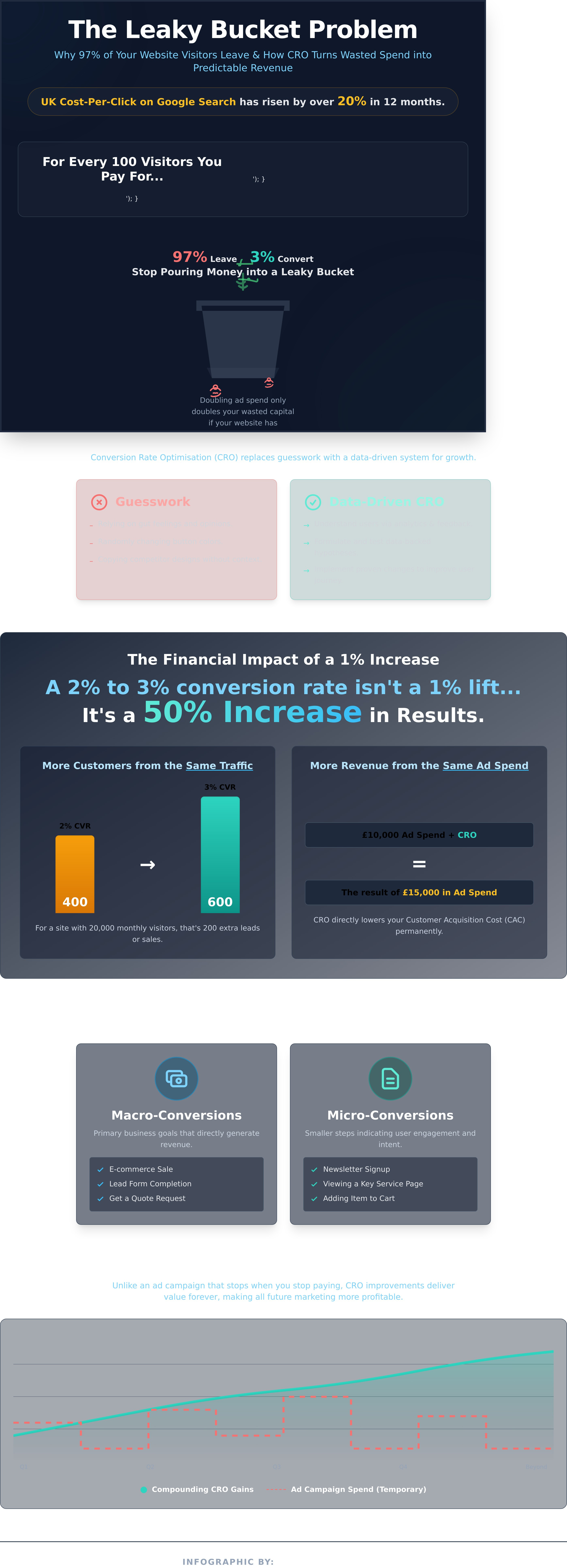
The average website conversion rate hovers between 2% and 3%. This is a hard metric. It means for every 100 visitors you pay to bring to your site, 97 leave without taking the action you need them to. As UK ad costs are projected to climb another 12-15% by 2026, paying for traffic that doesn't convert is an unsustainable model for growth. This is the core financial problem that strategic conversion rate optimisation in Scotland is engineered to solve.
Conversion Rate Optimisation (CRO) is not about guesswork or changing button colours. It’s a disciplined, data-driven process for increasing the percentage of website visitors who complete a desired action. The methodology, detailed in academic resources like Wikipedia's entry on what conversion rate optimisation is, involves understanding how users navigate your site through analytics and user feedback, then formulating and testing hypotheses to improve their journey. It’s about building a more efficient digital asset.
Many businesses fall into the 'Leaky Bucket' trap. They see low sales and assume the solution is more traffic, so they increase their ad spend. This is like pouring more water into a bucket riddled with holes. If your user journey is broken-a confusing checkout, a slow-loading page, an unclear value proposition-doubling your ad budget only doubles your wasted capital. A focused CRO strategy finds and plugs these leaks first, ensuring every pound spent on advertising generates maximum value.
The true power of CRO lies in its compounding effect on your entire marketing ecosystem. Unlike an ad campaign that stops when you stop paying, an improvement to your conversion rate is a permanent asset. A 0.5% lift achieved in Q1 continues to deliver value in Q2, Q3, and beyond. It makes your SEO, PPC, and social media marketing more profitable by default, systematically increasing your total marketing ROI without increasing your spend.
A 'conversion' is any meaningful action a user takes. We separate these into two categories. Macro-conversions are primary business goals like an e-commerce sale for an Aberdeen retailer or a lead form completion for a Glasgow B2B firm. Micro-conversions are smaller steps indicating intent, such as a newsletter signup or viewing a key service page. Tracking this full funnel is vital for Scottish SMEs to understand user behaviour and identify critical optimisation opportunities before the final checkout.
The difference between a 2% and 3% conversion rate isn't 1%; it's a 50% increase in results. For a site with 20,000 monthly visitors, that's the difference between 400 and 600 leads or sales from the exact same traffic. By acquiring more customers from your existing audience, CRO directly and permanently reduces your Customer Acquisition Cost (CAC). For a £10,000 ad spend, increasing your conversion rate from 2% to 3% generates the same bottom-line result as an additional £5,000 in advertising, but without the extra cost.
Your Scottish customer isn't a demographic. They are a set of behaviours, intentions, and trust signals unique to this market. Effective conversion rate optimisation in Scotland moves beyond generic profiles like 'female, 25-34, Edinburgh' and decodes the underlying psychographics that drive decisions. Success isn't found in broad assumptions; it's engineered by analysing granular, localised user data.
We focus on the 'why' behind the click. Why did a user from Aberdeen abandon their cart while a user from Dundee completed the purchase? The answer is rarely a simple technical glitch. It's often a complex interplay of perceived trust, mobile usability, and regional friction points that generic CRO strategies completely miss. Understanding this digital body language is the first step toward measurable growth.
Distinguishing between a user who is 'just browsing' and one who is 'ready to buy' is critical. High-intent behaviour isn't random; it leaves a clear data trail. A user quickly navigating from a service page to your pricing, then to your case studies, is signalling a different intent than someone landing on a single blog post from social media and leaving. We map this Scottish buyer's journey from initial awareness to final action, identifying the exact touchpoints where momentum is lost. For instance, heatmap analysis for a Glasgow-based client revealed 68% of users dropped off on the checkout page, specifically at the address input field, revealing a critical usability flaw for mobile users.
Trust is the ultimate conversion currency, and its value is amplified in the Scottish market. Economic sentiment directly influences purchasing decisions. The latest Scottish Consumer Sentiment Indicator shows that household confidence is a key variable, meaning users are more discerning than ever. In this environment, local social proof is non-negotiable. A video testimonial from a client in Fife will outperform ten anonymous 5-star reviews. It demonstrates tangible, local success. Highlighting a physical Scottish address or a local phone number isn't just a contact detail; it's a powerful signal of accountability and presence that builds immediate credibility in a landscape increasingly filled with generic, AI-generated content
Decoding these complex behavioural signals is the core of a successful strategy for conversion rate optimisation in Scotland. It requires a specialist approach that combines data analytics with a deep understanding of the local user mindset. If you're ready to move beyond guesswork, we can help you map your customer's journey and pinpoint precise opportunities for growth.

Generic 'best practices' are a liability. What works for a B2B SaaS company in London will fail for an e-commerce brand in Glasgow. Relying on generalised advice ignores the unique purchasing behaviours, logistical challenges, and cultural nuances of the Scottish market. Growth doesn't come from copying trends; it comes from a rigorous, data-driven process designed to uncover what your specific customers actually want.
Our entire approach is built on a five-step, repeatable framework that eliminates guesswork and drives measurable revenue growth: Audit, Hypothesise, Test, Analyse, and Scale. This is the engine that powers high-performance digital experiences.
We start by digging deep into your data to build a complete picture of user behaviour. This involves a dual approach: quantitative analysis of your Google Analytics 4 and server-side tracking data to see what is happening, and qualitative analysis using session recordings and targeted user surveys to understand why. For example, across multiple Scottish e-commerce sites, the number one conversion killer we consistently find is unexpected delivery surcharges for non-central belt postcodes. With recent UK e-commerce statistics showing online retail sales making up over 26% of all retail, eliminating this checkout friction is a critical revenue opportunity.
An idea is not a strategy. We translate insights from the audit into structured, testable hypotheses. A valid hypothesis isn't a vague guess; it's a scientific statement: "We believe that by displaying a clear delivery cost calculator on the product page, we will increase add-to-cart rates by 10% because it removes price uncertainty early in the user journey." Every test we run is designed to achieve at least 95% statistical significance. Stopping a test early because one variation is ahead after 48 hours is a recipe for false positives and wasted resources. This rigorous, data-first methodology is a core component of Our 7-Step CRO Process.
Not all tests are created equal. We prioritise our roadmap using the PIE framework, scoring each hypothesis on its Potential revenue impact, its Importance to the user journey, and the Ease of implementation. This ensures we focus engineering resources on changes that deliver the highest return, fast.
Looking towards 2026, the role of A/B and multivariate testing is evolving. It’s moving beyond simple button colour changes to testing entire AI-personalised user flows and dynamic pricing models. This is the future of conversion rate optimisation scotland-based businesses must embrace to stay competitive. Our framework isn't just about fixing today's problems; it's about building a durable competitive advantage for tomorrow.
Paid media is an accelerant. It buys you traffic, visibility, and data at a scale organic channels can't immediately deliver. But traffic alone doesn't pay the bills. Without a systematic approach to converting that expensive traffic, you're not investing in growth; you're just funding clicks. This is where Conversion Rate Optimisation (CRO) transforms your ad spend from a cost centre into a predictable revenue engine.
The relationship between CRO and Pay-Per-Click (PPC) management is symbiotic. Your landing page experience is a primary component of Google's Quality Score algorithm. A highly relevant, fast-loading, and frictionless landing page directly lowers your Cost Per Click (CPC). Google's own data indicates that improving your Quality Score from 5/10 to 10/10 can reduce your CPC by as much as 50%. You pay less for a better ad position, simply because you provide a superior user experience post-click. It's a direct financial incentive to invest in CRO.
Sending paid traffic to your homepage is a cardinal sin of digital advertising. A user searching for "emergency commercial boiler repair" doesn't want to navigate your generic "Services" menu. They need an immediate, specific solution. This disconnect is why dedicated, message-matched landing pages are non-negotiable. This level of synergy between paid search and user experience is the focus for any results-driven PPC Agency Glasgow understands is essential for market leadership.
Personalisation tools like Dynamic Keyword Insertion (DKI) create hyper-relevant ad copy, but that promise must be fulfilled the second the user lands on your page. If the ad says "Bespoke Oak Kitchens in Aberdeen," your landing page headline must echo that exact phrase, reinforcing to the user they are in the right place. This seamless journey from search query to solution is a cornerstone of effective conversion rate optimisation scotland businesses rely on to maximise return on ad spend (ROAS).
On platforms like Meta and TikTok, you're competing for fractured attention. Users are 'fast-fingered' and will abandon a slow or confusing experience in less than three seconds. This is especially critical in the Scottish market, where rural 4G and 5G connectivity can be inconsistent. A page that takes five seconds to load in a weak signal area of the Cairngorms is a lead you've paid for and lost. Ensuring your mobile pages load in under two seconds isn't a luxury; it's a necessity.
A rigorous CRO programme doesn't guess which is better. It tests both, analysing the data to find the precise balance between lead volume and value for your specific business goals. Stop wasting your budget on clicks that go nowhere. Let's analyse your paid media funnels and build a system for scalable growth.
Choosing a partner for conversion rate optimisation in Scotland is more than a line item in your marketing budget. It’s an investment in scalable growth. The right agency doesn't just deliver reports filled with vanity metrics like clicks or traffic; they deliver a tangible impact on your bottom line. Success isn’t a higher conversion rate. It's higher profit.
At Behaviour Digital, we operate as a strategic extension of your team. We don’t hide behind complex jargon or opaque processes. Our methodology is built on a foundation of data-driven analysis and a relentless focus on commercial outcomes. We integrate CRO into a wider digital ecosystem, ensuring that insights from user behaviour analysis inform your SEO, paid media, and content strategies for a powerful compounding effect.
Proximity breeds accountability. Our Dalmarnock Road, Glasgow office isn't just a pin on a map; it's a hub for face-to-face strategy sessions where we align our tactics with your business objectives. We possess a deep, nuanced understanding of the Scottish and wider UK market, from consumer behaviour in key sectors to the specific regulatory landscape. This local expertise is a critical advantage when debating a dedicated CRO Agency vs DIY solutions, which often lack this vital context.
Our approach to conversion rate optimisation Scotland-based businesses trust is built on this integrated framework. We don't see CRO as an isolated discipline. It’s the connective tissue that makes your entire digital marketing spend more efficient. Here’s how it connects:
Your first 30 days with us are structured for immediate impact. We begin with a comprehensive data audit, identifying the most significant revenue leaks. By week two, we present a prioritised roadmap of data-backed hypotheses. By week four, your first A/B test is live. Our process is transparent and built for momentum. We measure success not by abstract percentages but by the metrics that matter: increased Average Order Value (AOV), higher Customer Lifetime Value (CLV), and demonstrable ROI. This is the Behaviour Digital commitment.
Stop leaving money on the table. It’s time to convert website visitors into profitable customers with a proven, data-led strategy. Book your CRO audit with our Glasgow team today and discover your business's true potential.
Accepting that 97% of your website traffic leaves without converting isn't a business strategy; it's a liability. As we've detailed, the path to scalable growth lies in a disciplined, data-first approach. It requires understanding the specific behavioural drivers of the Scottish consumer and abandoning guesswork in favour of a structured testing framework. This is how you transform your marketing budget from an expense into a high-return investment.
For ambitious brands, this strategic approach to conversion rate optimisation scotland provides isn't a luxury. It's the essential mechanism for predictable revenue. Since 2022, our team at the Red Tree Business Suites in Glasgow has specialised in integrating PPC and CRO to deliver precisely that: measurable business impact, not vanity metrics. The first step is replacing assumptions with analysis.
Stop wasting ad spend. Get your professional CRO audit from our Glasgow team.
Your future growth is waiting in the data. Let's unlock it together.
A "good" conversion rate is entirely dependent on your industry, not your location. For example, WordStream data from 2023 shows e-commerce averages around 2.8%, while the finance sector can reach 5% or higher. The goal isn't a generic number. It's about establishing your current baseline and implementing a data-driven strategy to achieve continuous, measurable improvement on that specific figure year after year.
A comprehensive CRO retainer in Scotland typically costs between £2,500 and £8,000 per month. One-off projects, such as a foundational conversion audit, generally start at £5,000. The final investment depends on your website's traffic volume, technical complexity, and the required testing velocity. We focus on performance, ensuring our services generate a return that far exceeds the cost.
You can expect to see statistically significant results from initial A/B tests within 60 to 90 days. This period is necessary to gather sufficient data for confident, accurate decisions. While some quick wins may emerge earlier, the true financial impact of CRO compounds over 6-12 months as each test provides new insights, creating a powerful engine for sustained growth.
No, but you need enough data for valid conclusions. For A/B testing, we recommend a minimum of 1,000 conversions per month to achieve statistical significance efficiently. If your site has less traffic, we shift focus to qualitative analysis. We use tools like heatmaps and user session recordings to identify and fix major friction points, improving performance without high-volume testing.
User Experience (UX) design focuses on making a website easy and pleasant to use, while Conversion Rate Optimisation (CRO) is the scientific process of increasing the percentage of users who complete a specific goal. UX ensures the path is clear. CRO uses data and testing to persuade more people to walk down that path and convert. A great UX is the foundation for effective CRO.
Yes, CRO directly lowers your Cost Per Acquisition (CPA) from paid campaigns. By doubling your landing page's conversion rate from 2% to 4%, you effectively halve your CPA for the same ad spend. An improved user experience also boosts your Quality Score in Google Ads, which can lower your cost-per-click (CPC) by up to 50%, making your entire ad budget more efficient.
Our process is powered by a stack of best-in-class technology. For A/B and multivariate testing, we utilise VWO and Google Optimize. We analyse user behaviour with the heatmaps and session recordings from Hotjar and Microsoft Clarity. All our hypotheses are validated against the hard data we collect and segment within Google Analytics 4, ensuring every decision is backed by evidence.
Effective CRO is always an ongoing service. A one-time audit can fix obvious issues, but user behaviour, technology, and market competition are constantly changing. An iterative, ongoing program of testing and learning is the only way to build a sustainable competitive advantage. Our conversion rate optimisation Scotland services are designed as long-term growth partnerships for this exact reason.
.png)
.png)
We help clients all over the globe grow their digital advertising campaigns. Ready to see what we can do for you? Get started with your free growth plan.
GET STARTED