

Your website traffic is climbing, but your revenue is flat. You're investing in paid ads, yet the return feels negligible. This isn't a traffic problem; it's a conversion problem. The gap between user attention and tangible business results is bridged by a single, powerful discipline: data-driven conversion optimisation.
This is not another article about changing button colours. We are moving beyond the definition to deliver a systematic, repeatable framework for scalable growth. We will equip you with the process to translate user behaviour insights directly into measurable revenue, demystifying the technical jargon and focusing purely on business impact. You will learn how to identify your website's most critical friction points and gain the confidence to invest in a strategy that turns your existing traffic into your most valuable asset.
Most businesses are obsessed with traffic. More visitors, more clicks, more sessions. But traffic alone doesn't guarantee growth. Pouring more traffic into a website that doesn't convert is like filling a leaky bucket-a costly and inefficient exercise. This is where conversion optimisation becomes your most valuable asset.
In business terms, conversion optimisation (CRO) is the systematic process of increasing the percentage of website visitors who take a desired action. It’s not about attracting more people; it's about getting more value from the people you already have. This discipline moves beyond guesswork, using a structured methodology to analyse user behaviour and remove friction from the customer journey. The core principles behind what defines conversion rate optimization focus on understanding user intent and aligning your website experience with their goals to drive specific, measurable outcomes.
CRO isn't about guesswork; it's a data-driven process for understanding user behaviour to improve business outcomes.
A strategic focus on CRO directly impacts your bottom line. By improving the efficiency of your website, you lower your Customer Acquisition Cost (CAC) for every new customer. This increased efficiency makes your paid media campaigns on platforms like Google Ads and Meta far more scalable and profitable. The insights gained from CRO testing also provide an invaluable feedback loop, informing your product development, messaging, and overall marketing strategy.
It’s a common mistake to view these disciplines in isolation. SEO and PPC are powerful tools for driving traffic to your digital storefront. CRO is the process that ensures the storefront is optimised to turn that footfall into revenue. They work together in a virtuous cycle: insights from CRO (e.g., higher engagement on a landing page variant) can improve Google Ads Quality Scores and SEO rankings. Ultimately, investing in CRO multiplies the value of every pound spent on traffic acquisition.
Success in digital marketing isn't luck; it's a science. Effective conversion optimisation relies on a disciplined, repeatable process that systematically turns user behaviour insights into measurable revenue growth. This structured approach, detailed in many a conversion rate optimization guide, moves beyond guesswork. Our framework is a continuous cycle built on four core pillars: Research, Hypothesis, Experimentation, and Iteration.
We begin by establishing a clear, data-backed understanding of user behaviour.
Insights are worthless without action. We translate our findings into a testable hypothesis with a clear structure: We believe that [making a specific change] for [a specific audience] will result in [a measurable outcome]. This precision ensures every test has a purpose. We then validate this hypothesis through controlled experimentation, choosing the right method for the job-be it A/B testing (Version A vs. B), multivariate testing (testing multiple combinations), or split URL testing (testing entirely different pages). We run tests until we reach statistical significance, ensuring the results are reliable, not random.
The final step closes the loop. Whether a test wins, loses, or is inconclusive, it generates valuable data. A "failed" test that disproves a hypothesis is often just as insightful as a winner, as it tells us what our users don't want. We meticulously analyse these outcomes, document the learnings, and feed them directly back into the research phase. This iterative cycle is the engine of sustained growth and the foundation of our entire conversion optimisation strategy.
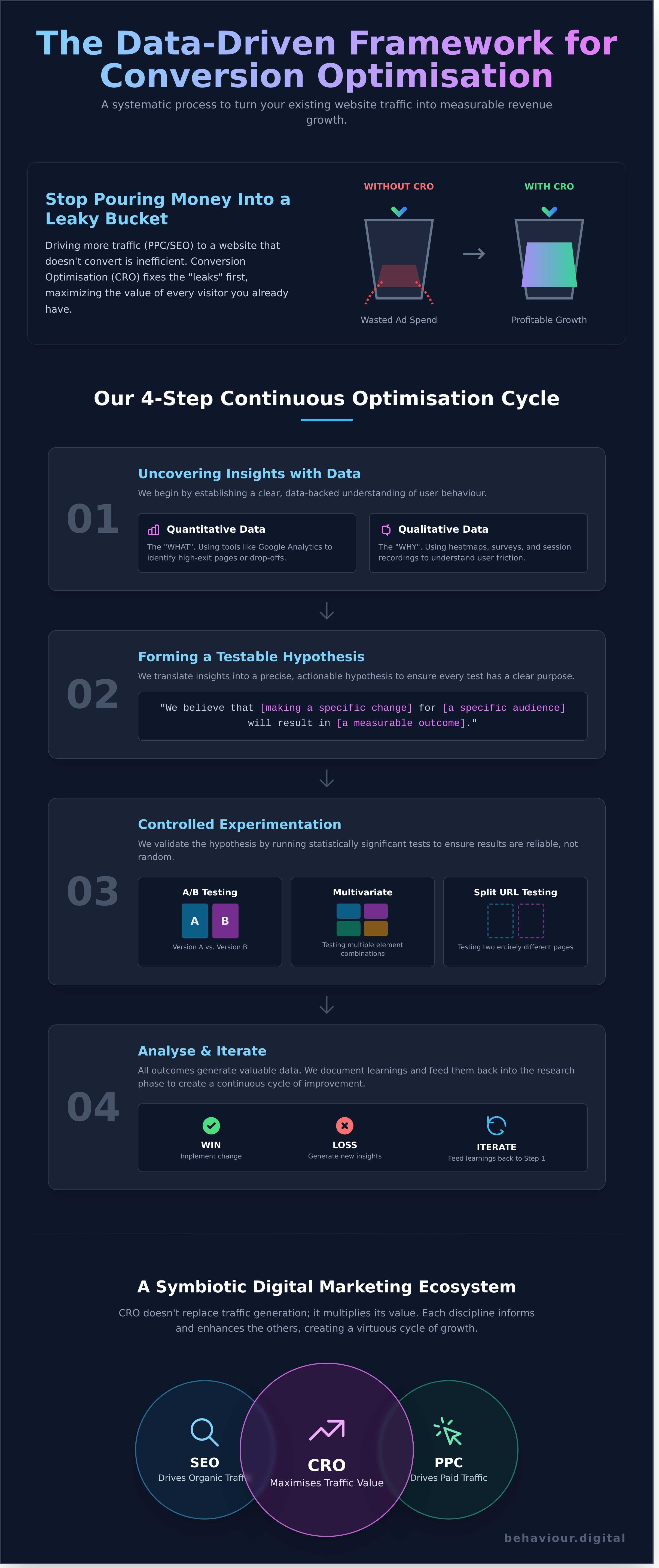
Let's be clear: genuine conversion optimisation is not about guessing button colours. It is a data-driven discipline focused on systematically removing friction from the user journey to drive measurable business growth. Each method we deploy corresponds to a specific stage in our framework, addressing hypotheses grounded in real user behaviour. This structured process transforms CRO from a gamble into a predictable engine for revenue. For a comprehensive look at building such a framework, HubSpot's Ultimate Guide to Conversion Rate Optimization offers a solid strategic foundation.
Your user's first impression is decisive. We focus on creating a frictionless path to conversion. This means intuitive site navigation, radically simplified forms, and calls-to-action (CTAs) that communicate value, not just a command. Persuasive copywriting is crucial; your value proposition must be instantly understood. We analyse every word to ensure it answers the user's primary question: "What's in it for me?" In today's market, this entire process must be flawless on mobile devices first. The foundation for all of this is strategic web design, and working with an expert team like PurpleCow Digital Marketing ensures your website is built from the ground up to convert.
A high-converting funnel is a seamless one. We start with message match: the promise made in your ad must be the first thing a user sees on the landing page. Anything less creates dissonance and bounce. We then meticulously analyse the entire conversion path. For a UK e-commerce client, this might mean mapping the journey from a product page to the final 'thank you' screen, identifying drop-off points. Is the three-step checkout too complex? Are unexpected shipping costs causing cart abandonment? We find and fix these revenue leaks.
The ultimate goal of conversion optimisation is not a percentage uplift on a dashboard; it is tangible, scalable business growth. Many stakeholders question the value of small, incremental wins, but this overlooks the power of compounding. A 2% improvement every month results in over 26% annual growth. True success is measured by the bottom line, and a disciplined process is required to achieve it.
Calculating the ROI of a CRO program is straightforward: it is the incremental revenue generated by winning tests minus the investment in tools and expertise. This focus on financial impact separates professional optimisation from simple A/B testing.
Focusing solely on conversion rate is a critical error. A test can easily increase conversions while simultaneously destroying profitability. Imagine offering a 50% discount; your conversion rate will soar, but your revenue per visitor (RPV) and average order value (AOV) will plummet. This is not a win; it's a loss. For lead generation, the same principle applies to metrics like Lead-to-Customer Rate and Customer Lifetime Value (CLV). Always measure against primary business objectives.
Effective conversion optimisation is not a single skill; it's a multidisciplinary system. It demands a sophisticated blend of data analytics, user experience (UX) design, persuasive copywriting, front-end development, and high-level business strategy. For most in-house teams, mastering all these domains is an unrealistic expectation.
This is where a strategic shift in perspective becomes critical. Hiring a specialist agency isn't a cost centre-it's an investment in a dedicated growth team. While DIY efforts often lead to sporadic testing and inconclusive results, a professional partner implements a rigorous, data-driven framework designed for one purpose: generating a measurable return on investment
The advanced frameworks discussed in this article are not just theory; they are the foundation of our process. We move beyond simple A/B testing to build comprehensive conversion optimisation programs that deliver sustainable business impact. Our approach is built on a partnership model.
We operate with complete transparency, ensuring you understand the data and the strategic reasoning behind every hypothesis we test. We integrate with your team, acting as a strategic extension focused on achieving your most ambitious revenue targets. If you are ready to move from guessing to a systematic process of growth, we can show you the way. Start a conversation about your growth goals today.
The path to sustainable growth in 2026 is paved with data, not just traffic. As we've explored, success isn't about guesswork; it's about a disciplined, iterative process built on a deep understanding of user behaviour. By implementing a structured framework and leveraging the right tools, you move from hoping for results to engineering them. This is the power of effective conversion optimisation: it's the critical lever for turning your existing audience into measurable, predictable revenue and building a decisive competitive advantage.
Ready to translate these insights into a concrete action plan? As a data-driven digital advertising agency based in Glasgow, we partner with ambitious businesses across the UK to deliver transparent, measurable growth. We focus on the metrics that matter to your bottom line. Take the next step towards maximising your digital potential. Book a free strategy call to discuss your conversion goals. Your data holds the key to scalable growth-let's unlock it together.
There is no universal "good" conversion rate. A 2% rate for a high-value B2B service can be exceptional, while 5% for a low-cost e-commerce item might be average. The only metric that matters is your own, improved over time. We focus on establishing a data-backed baseline and then systematically driving measurable growth. The goal is continuous improvement, not chasing an arbitrary industry benchmark that lacks context for your specific business model and revenue goals.
To achieve statistically significant results from A/B testing, a minimum of 1,000-2,000 monthly conversions per goal is a strong starting point. Below this, tests take too long to validate. However, qualitative analysis-like heatmaps, session recordings, and user surveys-can deliver valuable insights at any traffic level. This initial data gathering is a crucial first step in any effective conversion optimisation program, building the foundation for future high-impact testing.
Initial "quick wins" from fixing obvious user friction points can often be identified and implemented within the first 30-60 days. However, true, sustainable growth comes from a continuous, data-driven testing program. A/B tests typically run for 2-4 weeks to achieve statistical validity. The real value is cumulative; each test provides insights that fuel the next, creating an engine for consistent, long-term performance improvement and measurable business impact.
Conversion Rate Optimisation (CRO) is the complete strategic process of understanding user behaviour and systematically improving your website to increase conversions. It involves research, data analysis, hypothesis generation, and prioritisation. A/B testing is simply one tool-a tactic-used within the CRO framework to validate a specific hypothesis by comparing two versions of a page. CRO is the overarching strategy; A/B testing is the experiment that provides the data.
In the UK, professional conversion optimisation services typically range from £3,000 to £10,000+ per month on a retainer basis. The cost reflects the depth of expertise, the complexity of the analytics and testing required, and the overall scope of the program. We view this not as an expense, but as a direct investment in scalable growth. A performance-based approach ensures that our work is directly tied to generating a significant, measurable return on your investment.
Yes, absolutely. CRO and SEO have a powerful symbiotic relationship. By optimising user experience, CRO directly improves engagement metrics that search engines like Google value. A better user journey leads to lower bounce rates, increased time on site, and more pages per session. These positive behavioural signals indicate that your content is valuable and relevant, which can contribute to improved rankings and organic visibility over time. It benefits both users and algorithms.
The first step is ensuring data integrity. Confirm that your analytics platform (e.g., Google Analytics 4) is correctly configured to measure key business goals and micro-conversions. The second step is quantitative and qualitative research: analyse user behaviour with heatmaps and session recordings, and review analytics data to identify drop-off points. From this data, you can formulate an evidence-based hypothesis for your first test. A solid foundation of accurate data is non-negotiable.
.png)
.png)
We help clients all over the globe grow their digital advertising campaigns. Ready to see what we can do for you? Get started with your free growth plan.
GET STARTED