

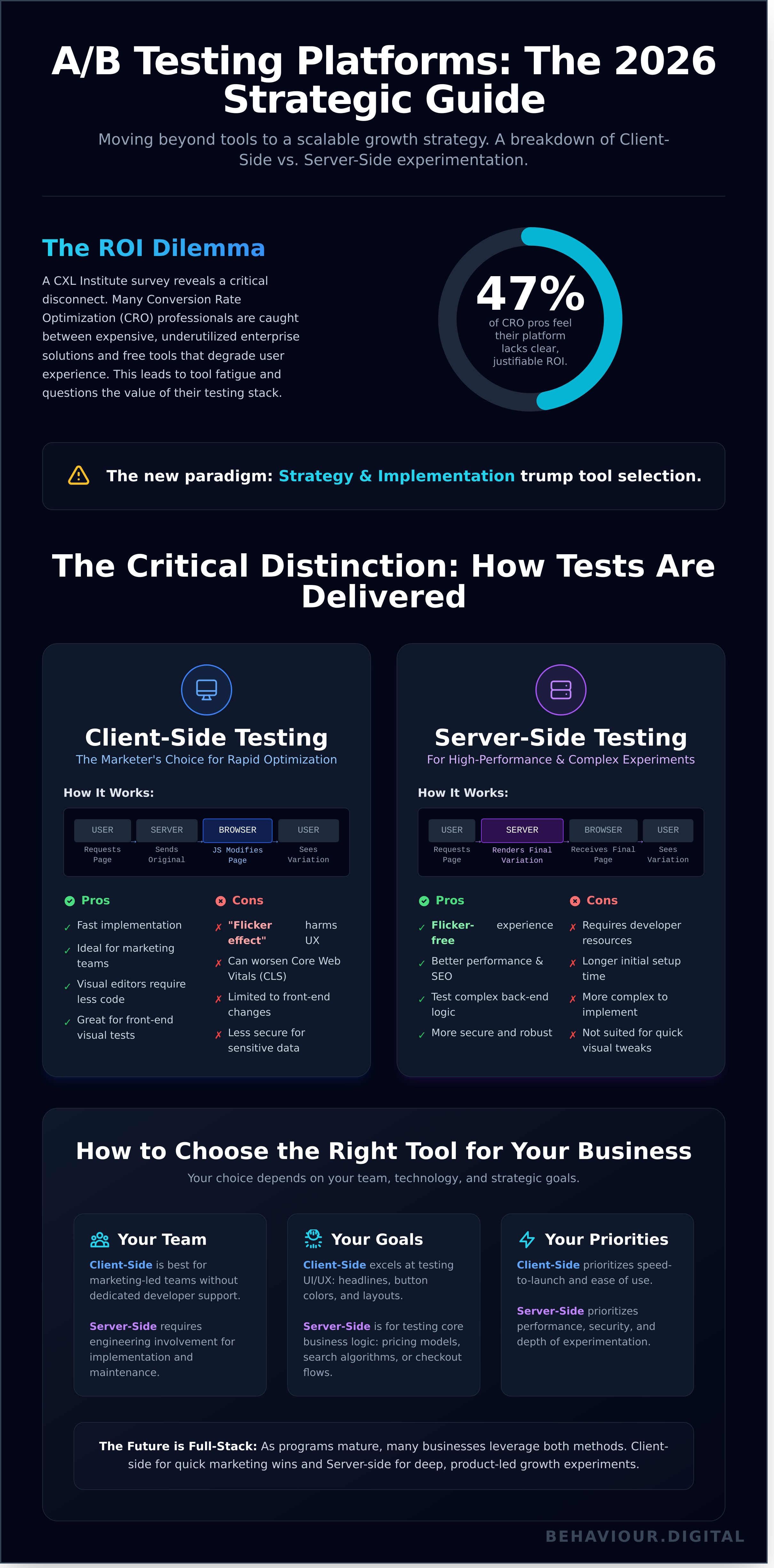
A recent CXL Institute survey revealed that 47% of CRO professionals feel their current testing platform fails to deliver a clear, justifiable ROI. It's a familiar problem. You're caught between expensive enterprise solutions that drain your budget and free tools that cause a jarring 'flicker effect,' damaging the user experience you've worked so hard to build. The market for effective a/b testing tools is saturated, and the resulting tool fatigue is real.
This guide cuts through that noise. We'll provide a strategic framework for selecting a platform that actually drives scalable growth for your business in 2026, translating raw data into measurable profit. We will break down the critical differences between client-side and server-side testing and give you the exact model to calculate the ROI of any tool you're considering, ensuring your next investment is a definitive win.
The digital experimentation landscape has fundamentally matured. Since the sunset of Google Optimize on September 30, 2023, the market has fragmented into specialized, high-impact platforms. The conversation is no longer about finding a free tool; it's about embedding a rigorous testing methodology into the core of your business operations. In 2026, purchasing a tool is the last step, not the first. The real work lies in building a strategy that drives measurable growth.
Success today demands a shift from opinion-based changes to statistically validated improvements. We must move beyond the "HIPPO" (Highest Paid Person's Opinion) and embrace empirical evidence. For those new to the discipline, understanding what is A/B testing at its core is crucial. It's not a marketing gimmick; it's a scientific method applied to business. At its most precise, A/B testing is a systematic process of clinical comparison to eliminate business bias. This process is the engine of any modern Conversion Rate Optimization (CRO) ecosystem, where analytics, user research, and experimentation work in concert to create scalable gains.
The era of third-party cookies is over. Regulations like GDPR and CCPA are now the baseline, and consumer trust is a non-negotiable asset. A 2025 Forrester report projects that 80% of B2C companies failing to adapt their data strategy for privacy will see a measurable decline in customer lifetime value. Modern experimentation platforms are built on a privacy-first architecture, leveraging first-party data and server-side tracking to ensure your testing stack is both effective and compliant, safeguarding user trust.
Testing button colors was a valid starting point in 2016. In 2026, it’s a waste of traffic. High-impact experimentation now focuses on complex variables: pricing models, multi-step checkout flows, and entire user journeys. The rise of AI-driven variant generation allows teams to test dozens of sophisticated personalization hypotheses simultaneously, a velocity unthinkable just five years ago. Your strategy must evolve from cosmetic tweaks to fundamental business model validation.
The right tool is a catalyst, not a solution. It enables a culture of continuous improvement and provides the data integrity required for confident, high-stakes decisions. The best a/b testing tools are not just software; they are platforms that integrate into a broader CRO strategy. The following sections will dissect the market's leading platforms, not just by their features, but by their ability to support the strategic, privacy-conscious, and high-impact experimentation that defines success today.
Selecting the right A/B testing tool isn't a one-size-fits-all decision. The optimal platform is dictated by your technical resources, strategic goals, and the maturity of your experimentation program. A tool that empowers a marketing team to test landing page headlines is fundamentally different from one that enables engineers to optimize a core search algorithm. The market is segmented along clear technical and strategic lines, from low-code visual editors to developer-centric SDKs, and from budget-friendly starters to enterprise-grade powerhouses.
The most critical distinction lies in how a test is delivered to the user: on their browser (client-side) or from your server (server-side). This single choice has cascading implications for speed, security, and the types of experiments you can run. As companies mature, many find the need for both, leading to the rise of 'Full-Stack' experimentation platforms designed to support comprehensive, product-led growth strategies.
Client-side tools operate by injecting a JavaScript snippet into your website. This script then modifies the page directly in the user's browser to display a variation. It's the dominant method for rapid, marketing-led optimization. The primary advantage is speed of implementation. A CRO specialist with minimal coding knowledge can launch a test on a button color or headline in under an hour using a visual editor.
However, this approach isn't without its costs. The most significant is the "flicker effect," where the original page loads for a fraction of a second before the JavaScript executes and renders the variation. This flash of original content can harm user experience and, more critically, negatively impact Core Web Vitals. Studies show that poorly implemented client-side tests can increase Cumulative Layout Shift (CLS) by over 0.1, pushing a page from "good" to "needs improvement" in Google's eyes. These tools are ideal for teams without dedicated developer support who need to test front-end visual elements quickly.
Server-side testing renders the variation before the page is ever sent to the user's browser. The logic is handled on your server, ensuring a seamless, flicker-free experience. This is the gold standard for performance, security, and complex experimentation. You aren't just changing what a user sees; you're testing fundamental business logic.
The trade-off is clear: implementation is a developer-led process. It requires integrating a platform's SDK into your codebase, a task that demands engineering resources and a longer deployment cycle compared to its client-side counterparts. It's a strategic investment in control and performance over convenience.
Ultimately, the choice between these various a/b testing tools reflects an organization's commitment to data-driven growth. The industry's evolution towards full-stack platforms signals a strategic shift where experimentation is no longer a marketing tactic but a core business function. As detailed in the Harvard Business Review's analysis, The Surprising Power of Online Experiments, building a true culture of experimentation drives innovation at every level. Making the right technology choice is the first step. A data-driven technology audit can map your business goals to the right platform, preventing costly missteps and ensuring your investment delivers measurable results.
Selecting the right A/B testing platform is not a technical choice; it's a strategic business decision. The market has matured beyond one-size-fits-all solutions. Today's leading platforms are highly specialised, designed to serve distinct levels of organisational maturity, data infrastructure, and growth ambition. Your choice directly impacts your ability to generate reliable data and drive measurable revenue growth. We've analysed the landscape to identify the five platforms that define the market in 2026, each excelling in a specific strategic domain
For UK agencies and mid-market companies, the choice often narrows to Convert.com and VWO. Convert.com's predictable, flat-rate pricing is highly attractive for agencies managing multiple clients, contrasting with VWO’s traffic-based tiers which can escalate costs. While both platforms offer feature parity on core CRO tools like heatmaps and segmentation, the philosophy differs. VWO provides an integrated suite, whereas Convert focuses on being the fastest, most reliable testing engine. For a growing Glasgow-based business, Convert.com's streamlined interface offers a faster path to value. A simpler tool encourages a focus on solid hypothesis generation, which is central to all A/B testing principles, ensuring the team masters the fundamentals before exploring more complex features.
Stepping into the enterprise arena requires a significant shift in budget and strategy. An investment of over $50,000 annually in platforms like Optimizely or AB Tasty is justified only when monthly traffic exceeds 3-5 million unique visitors and experimentation becomes a core business function. At this scale, the power of multi-armed bandit testing and AI-driven personalisation isn't a luxury; it's a necessity for maximising ROI. These advanced a/b testing tools integrate deeply with sophisticated Customer Data Platforms (CDPs) like Segment and CRMs like Salesforce, allowing test results to enrich customer profiles and drive omnichannel personalisation strategies that are simply unattainable with mid-market solutions.
Selecting an A/B testing platform isn't about finding the longest feature list. It's a strategic decision that directly impacts your revenue, team efficiency, and ability to scale. The sticker price on a tool's website is merely the entry point. True evaluation requires a rigorous analysis of its total cost, statistical integrity, and integration within your existing operational framework.
Beneath the surface, the tool's statistical engine dictates the reliability of your results. Most platforms use one of two models. The traditional Frequentist approach relies on p-values and a 95% confidence threshold to declare a winner. It’s robust but rigid, often requiring large sample sizes and strict adherence to pre-defined test durations. In contrast, a Bayesian engine calculates the "probability to be best" for each variant, providing more intuitive data for business decisions and often reaching conclusions with 15-20% less traffic.
Your monthly traffic is the ultimate constraint on your testing program. To detect a modest 5% uplift on a page with a 2% conversion rate, you'll need approximately 33,000 unique visitors per variation to reach statistical significance. If your site has 50,000 monthly unique visitors (MUVs), running a single A/B test could take over a month. Paying for enterprise-grade a/b testing tools without the traffic to support them is a guaranteed way to burn capital with no return.
The best tool is one your team will actually use. An intuitive visual editor can empower your marketing team to launch 70% of tests-like headline or CTA changes-without developer input. However, for complex experiments involving dynamic content or checkout flows, a flexible code editor is non-negotiable. The ideal platform provides both. This balance is fundamental to a high-velocity optimization culture. Learn more about our CRO process and how we structure teams for maximum impact.
Finally, no tool is an island. Your chosen platform must integrate seamlessly with your core tech stack. A lack of native integration with GA4, Shopify, Segment, or your CRM creates data silos that kill efficiency and obscure insights. Equally critical is support. When a key experiment fails, you need an expert available in your time zone, not a generic ticket system with a 48-hour response time. The quality of documentation and community support separates functional a/b testing tools from true growth partners.
Choosing the right platform is the first step. Executing a high-tempo testing program that drives real business growth is the next. If you need an expert partner to navigate this complexity and build a scalable testing program, talk to our CRO strategists.
Many businesses fall into the same expensive trap. They invest over £20,000 annually in a premium platform like Optimizely or VWO, expecting automatic growth. The reality is different. A 2025 CXL Institute report found that 61% of companies running experiments fail to achieve significant business impact. The reason is simple: the tool is just an engine. Without a strategic roadmap, it's an engine with no driver, no fuel, and no destination.
This is where strategy transforms cost into profit. We view conversion rate optimization (CRO) as a direct amplifier for your paid media spend. Every pound you invest in Google Ads or Meta is an opportunity. By systematically improving your conversion rate, you aren't just getting more sales; you're fundamentally lowering your Customer Acquisition Cost (CAC). For one of our clients in the finance sector, a 0.7% lift in lead form submission rate reduced their paid search CAC by 18% in just 90 days. That’s the synergy of world-class PPC management and rigorous CRO.
The power of this approach is best seen through results. We partnered with a Scottish luxury e-commerce brand struggling with a 1.2% conversion rate and high cart abandonment. Instead of just testing button colours, we used data to identify major friction points in their checkout process. Our strategic tests simplified the user journey and clarified their value proposition. The result? A sustained conversion rate of 2.8% within six months, adding over £450,000 to their annual top-line revenue. The a/b testing tools were facilitators; the strategy was the catalyst.
We don't start with software. We start with your user. Our process begins with deep qualitative and quantitative analysis to understand user behaviour on your site. This insight fuels our 7-step optimization framework, ensuring every test is built on a strong, data-backed hypothesis. We manage the complex technical implementation, from flicker-free rendering to statistical validation, freeing your team to focus on strategic growth initiatives.
Managing a CRO program in-house stretches resources thin. An agency-managed stack provides not just software access but a dedicated team of CRO strategists, analysts, and developers. Our Glasgow-based experts deliver performance, not just reports. We provide complete transparency through weekly dashboards and bi-weekly strategy calls, making us an extension of your team. It's time to unlock your website's true potential.
Book a Strategy Call with Behaviour Digital and let's build your revenue engine.
The 2026 landscape is clear: your success won't be defined by the software you choose, but by the strategic framework you build around it. Even the most advanced a/b testing tools are ineffective without a rigorous process and expert analysis to translate raw data into revenue. The critical takeaway is that implementation, backed by a deep understanding of user behaviour, consistently delivers a higher ROI than the platform itself.
This is where strategy meets execution. At Behaviour Digital, we specialize in high-performance PPC and CRO that deliver quantifiable business impact. Since 2022, we've managed complex testing stacks for UK businesses, turning data into decisive growth. We don't just run tests; we build scalable conversion systems.
Ready to move beyond the platform? Scale your growth with a data-driven CRO strategy. The next stage of your business is waiting.
PostHog is a leading free alternative since Google Optimize was sunset in September 2023. It offers a generous free tier that includes A/B testing and feature flags for up to 1 million monthly events. This makes it a powerful, data-centric option for startups focused on product-led growth. Unlike many limited free plans, PostHog provides a comprehensive suite for understanding user behavior, not just running simple visual tests. It's built for scalable, data-driven decision-making.
An A/B test should run for a minimum of two full business cycles, typically 14 days, to generate reliable data. This duration normalizes fluctuations from weekends, holidays, or specific marketing campaigns. The primary goal is reaching a pre-calculated sample size that ensures at least a 95% statistical significance level. Ending a test prematurely based on early signals is a critical error that leads to implementing false positives and hurting long-term revenue growth.
Yes, A/B testing tools can marginally increase load time, but the impact on SEO is negligible when implemented correctly. Most modern platforms use asynchronous JavaScript, minimizing user-perceived latency to less than 100 milliseconds. Google has confirmed that using testing tools according to best practices, such as using rel="canonical" tags and not running tests for excessive periods, does not negatively affect rankings. The conversion lift from a successful test almost always outweighs any minor performance cost.
A/B testing compares two or more distinct versions of a single page, while multivariate testing (MVT) tests multiple combinations of changes simultaneously. For example, an A/B test might compare a red call-to-action button against a green one. An MVT could test two headlines, two button colors, and two images in every possible combination (2x2x2=8 versions) to identify the highest-performing combination. MVT is more complex and requires significantly more traffic to achieve statistical significance.
Yes, you can perform A/B testing on a low-traffic site, but you must focus on high-impact changes to detect a significant lift. With fewer than 5,000 unique monthly visitors to the test page, you don't have enough data for subtle tests. Instead, test radical redesigns or major value proposition shifts. The goal is to create a large enough performance difference, such as a 20%+ conversion lift, to be statistically detectable with a limited sample size.
In 2026, the cost of A/B testing tools ranges from free plans to over $50,000 annually for enterprise platforms. Entry-level paid plans from providers like VWO or Convert typically start around $200-$400 per month for up to 50,000 tracked users. Mid-tier solutions average $1,000-$2,000 per month. Enterprise platforms like Optimizely have custom pricing based on traffic and feature needs, often exceeding $4,000 per month. The investment must align with your company's optimization maturity.
No, a developer isn't required for basic setup or simple visual tests, but their involvement is critical for complex experiments. Most modern a/b testing tools offer a visual editor that allows marketers to modify text or button colors without code. However, for implementing server-side tests, testing dynamic content, or complex integrations, a developer's expertise is essential. A technical partner ensures tests are implemented cleanly without impacting site performance or creating bugs.
Statistical significance is the mathematical measure of confidence that a test result isn't due to random chance. For your business, reaching a significance level of 95% or higher means you can be 95% certain the winning variation will actually improve performance when rolled out. Acting on results with low significance is a gamble. It risks investing resources into changes that produce no real lift or, worse, negatively impact your revenue. Data-driven decisions demand this validation to ensure real business impact.
.png)
.png)
We help clients all over the globe grow their digital advertising campaigns. Ready to see what we can do for you? Get started with your free growth plan.
GET STARTED